

et al. 1987, 1992; Hoigné and Bader 1976, 1983; Beltrán et al. 1994a, b; Legube and
Karpel Vel Leitner 1999):
2O 3 þ 2H 2 O ! 2HO
•
þ O 2 þ 2HO 2
•
k % 10
8 x10
10 1=ðM sÞ
ð7:7Þ
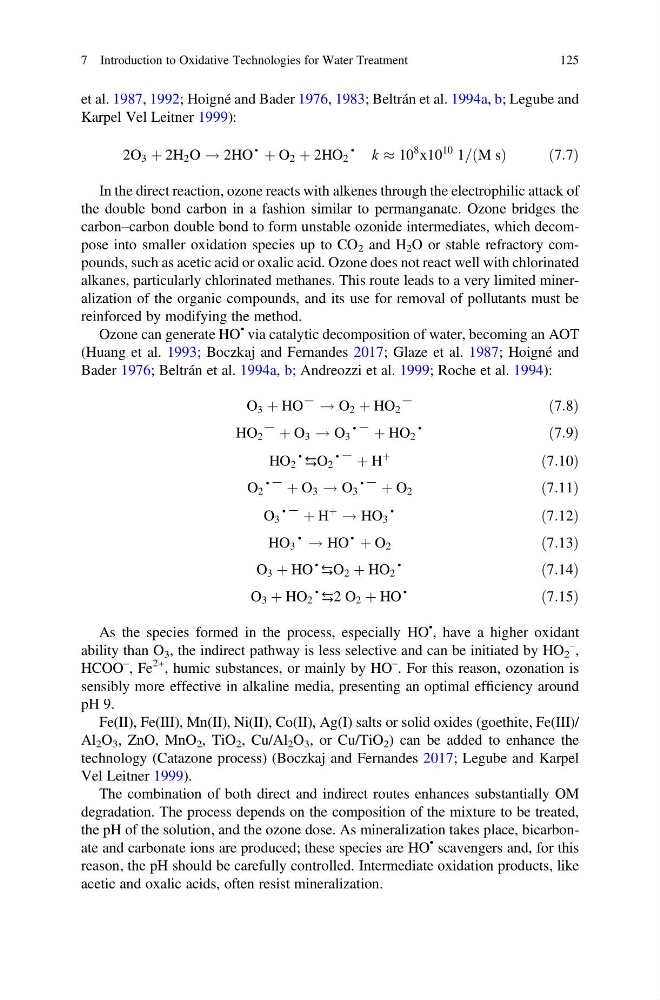
In the direct reaction, ozone reacts with alkenes through the electrophilic attack of
the double bond carbon in a fashion similar to permanganate. Ozone bridges the
carbon–carbon double bond to form unstable ozonide intermediates, which decompose into smaller oxidation species up to CO 2 and H 2 O or stable refractory compounds, such as acetic acid or oxalic acid. Ozone does not react well with chlorinated
alkanes, particularly chlorinated methanes. This route leads to a very limited mineralization of the organic compounds, and its use for removal of pollutants must be
reinforced by modifying the method.
Ozone can generate HO
• via catalytic decomposition of water, becoming an AOT
(Huang et al. 1993; Boczkaj and Fernandes 2017; Glaze et al. 1987; Hoigné and
Bader 1976; Beltrán et al. 1994a, b; Andreozzi et al. 1999; Roche et al. 1994):
O 3 þ HO À ! O 2 þ HO 2
À
ð7:8Þ
HO 2
À þ O 3 ! O 3
• À þ HO 2
•
ð7:9Þ
HO 2
•
⇆O 2
• À þ H
þ
ð7:10Þ
O 2
• À þ O 3 ! O 3
• À þ O 2
ð7:11Þ
O 3
• À þ H
þ
! HO 3
•
ð7:12Þ
HO 3
•
! HO
•
þ O 2
ð7:13Þ
O 3 þ HO
•
⇆O 2 þ HO 2
•
ð7:14Þ
O 3 þ HO 2
•
⇆2 O 2 þ HO
•
ð7:15Þ
As the species formed in the process, especially HO
• , have a higher oxidant
ability than O 3 , the indirect pathway is less selective and can be initiated by HO 2
– ,
HCOO
– , Fe
2+ , humic substances, or mainly by HO
– . For this reason, ozonation is
sensibly more effective in alkaline media, presenting an optimal efficiency around
pH 9.
Fe(II), Fe(III), Mn(II), Ni(II), Co(II), Ag(I) salts or solid oxides (goethite, Fe(III)/
Al 2 O 3 , ZnO, MnO 2 , TiO 2 , Cu/Al 2 O 3 , or Cu/TiO 2 ) can be added to enhance the
technology (Catazone process) (Boczkaj and Fernandes 2017; Legube and Karpel
Vel Leitner 1999).
The combination of both direct and indirect routes enhances substantially OM
degradation. The process depends on the composition of the mixture to be treated,
the pH of the solution, and the ozone dose. As mineralization takes place, bicarbonate and carbonate ions are produced; these species are HO
• scavengers and, for this
reason, the pH should be carefully controlled. Intermediate oxidation products, like
acetic and oxalic acids, often resist mineralization.
7 Introduction to Oxidative Technologies for Water Treatment
125
Karpel Vel Leitner 1999):
2O 3 þ 2H 2 O ! 2HO
•
þ O 2 þ 2HO 2
•
k % 10
8 x10
10 1=ðM sÞ
ð7:7Þ
In the direct reaction, ozone reacts with alkenes through the electrophilic attack of
the double bond carbon in a fashion similar to permanganate. Ozone bridges the
carbon–carbon double bond to form unstable ozonide intermediates, which decompose into smaller oxidation species up to CO 2 and H 2 O or stable refractory compounds, such as acetic acid or oxalic acid. Ozone does not react well with chlorinated
alkanes, particularly chlorinated methanes. This route leads to a very limited mineralization of the organic compounds, and its use for removal of pollutants must be
reinforced by modifying the method.
Ozone can generate HO
• via catalytic decomposition of water, becoming an AOT
(Huang et al. 1993; Boczkaj and Fernandes 2017; Glaze et al. 1987; Hoigné and
Bader 1976; Beltrán et al. 1994a, b; Andreozzi et al. 1999; Roche et al. 1994):
O 3 þ HO À ! O 2 þ HO 2
À
ð7:8Þ
HO 2
À þ O 3 ! O 3
• À þ HO 2
•
ð7:9Þ
HO 2
•
⇆O 2
• À þ H
þ
ð7:10Þ
O 2
• À þ O 3 ! O 3
• À þ O 2
ð7:11Þ
O 3
• À þ H
þ
! HO 3
•
ð7:12Þ
HO 3
•
! HO
•
þ O 2
ð7:13Þ
O 3 þ HO
•
⇆O 2 þ HO 2
•
ð7:14Þ
O 3 þ HO 2
•
⇆2 O 2 þ HO
•
ð7:15Þ
As the species formed in the process, especially HO
• , have a higher oxidant
ability than O 3 , the indirect pathway is less selective and can be initiated by HO 2
– ,
HCOO
– , Fe
2+ , humic substances, or mainly by HO
– . For this reason, ozonation is
sensibly more effective in alkaline media, presenting an optimal efficiency around
pH 9.
Fe(II), Fe(III), Mn(II), Ni(II), Co(II), Ag(I) salts or solid oxides (goethite, Fe(III)/
Al 2 O 3 , ZnO, MnO 2 , TiO 2 , Cu/Al 2 O 3 , or Cu/TiO 2 ) can be added to enhance the
technology (Catazone process) (Boczkaj and Fernandes 2017; Legube and Karpel
Vel Leitner 1999).
The combination of both direct and indirect routes enhances substantially OM
degradation. The process depends on the composition of the mixture to be treated,
the pH of the solution, and the ozone dose. As mineralization takes place, bicarbonate and carbonate ions are produced; these species are HO
• scavengers and, for this
reason, the pH should be carefully controlled. Intermediate oxidation products, like
acetic and oxalic acids, often resist mineralization.
7 Introduction to Oxidative Technologies for Water Treatment
125