

very high reductive influence on the TCE (decrease of 84%) and on VC (decrease of
60%) on the whole pilot test area. The decrease in the TCE concentration lasted up to
1 month and even after its concentration remained low.
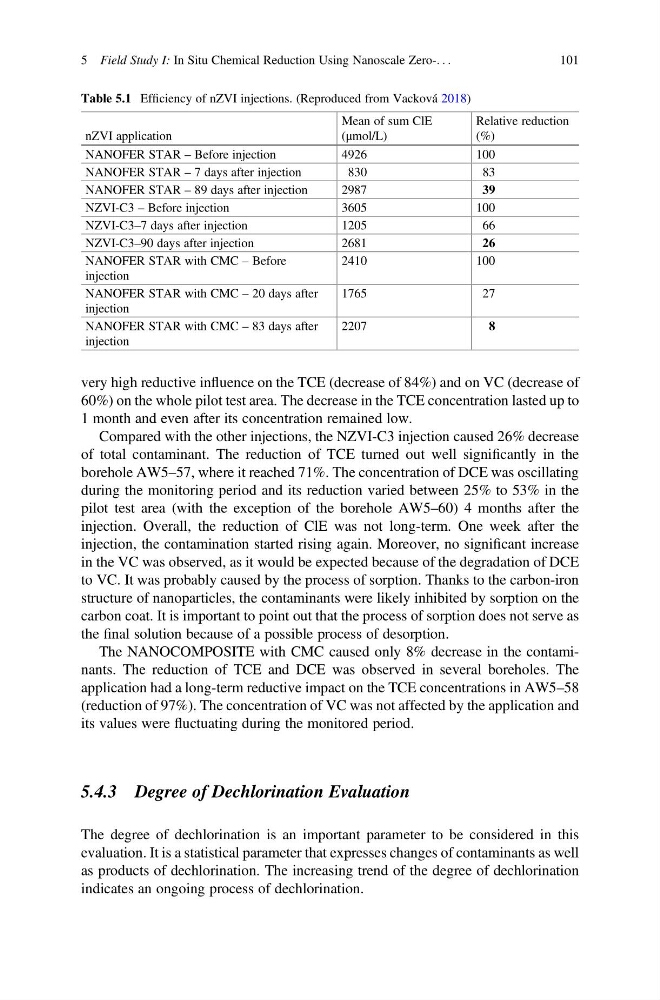
Compared with the other injections, the NZVI-C3 injection caused 26% decrease
of total contaminant. The reduction of TCE turned out well significantly in the
borehole AW5–57, where it reached 71%. The concentration of DCE was oscillating
during the monitoring period and its reduction varied between 25% to 53% in the
pilot test area (with the exception of the borehole AW5–60) 4 months after the
injection. Overall, the reduction of ClE was not long-term. One week after the
injection, the contamination started rising again. Moreover, no significant increase
in the VC was observed, as it would be expected because of the degradation of DCE
to VC. It was probably caused by the process of sorption. Thanks to the carbon-iron
structure of nanoparticles, the contaminants were likely inhibited by sorption on the
carbon coat. It is important to point out that the process of sorption does not serve as
the final solution because of a possible process of desorption.
The NANOCOMPOSITE with CMC caused only 8% decrease in the contaminants. The reduction of TCE and DCE was observed in several boreholes. The
application had a long-term reductive impact on the TCE concentrations in AW5–58
(reduction of 97%). The concentration of VC was not affected by the application and
its values were fluctuating during the monitored period.
5.4.3 Degree of Dechlorination Evaluation
The degree of dechlorination is an important parameter to be considered in this
evaluation. It is a statistical parameter that expresses changes of contaminants as well
as products of dechlorination. The increasing trend of the degree of dechlorination
indicates an ongoing process of dechlorination.
Table 5.1 Efficiency of nZVI injections. (Reproduced from Vacková 2018)
nZVI application
Mean of sum ClE
(μmol/L)
Relative reduction
(%)
NANOFER STAR – Before injection
4926
100
NANOFER STAR – 7 days after injection
830
83
NANOFER STAR – 89 days after injection
2987
39
NZVI-C3 – Before injection
3605
100
NZVI-C3–7 days after injection
1205
66
NZVI-C3–90 days after injection
2681
26
NANOFER STAR with CMC – Before
injection
2410
100
NANOFER STAR with CMC – 20 days after
injection
1765
27
NANOFER STAR with CMC – 83 days after
injection
2207
8
5 Field Study I: In Situ Chemical Reduction Using Nanoscale Zero-. . .
101
60%) on the whole pilot test area. The decrease in the TCE concentration lasted up to
1 month and even after its concentration remained low.
Compared with the other injections, the NZVI-C3 injection caused 26% decrease
of total contaminant. The reduction of TCE turned out well significantly in the
borehole AW5–57, where it reached 71%. The concentration of DCE was oscillating
during the monitoring period and its reduction varied between 25% to 53% in the
pilot test area (with the exception of the borehole AW5–60) 4 months after the
injection. Overall, the reduction of ClE was not long-term. One week after the
injection, the contamination started rising again. Moreover, no significant increase
in the VC was observed, as it would be expected because of the degradation of DCE
to VC. It was probably caused by the process of sorption. Thanks to the carbon-iron
structure of nanoparticles, the contaminants were likely inhibited by sorption on the
carbon coat. It is important to point out that the process of sorption does not serve as
the final solution because of a possible process of desorption.
The NANOCOMPOSITE with CMC caused only 8% decrease in the contaminants. The reduction of TCE and DCE was observed in several boreholes. The
application had a long-term reductive impact on the TCE concentrations in AW5–58
(reduction of 97%). The concentration of VC was not affected by the application and
its values were fluctuating during the monitored period.
5.4.3 Degree of Dechlorination Evaluation
The degree of dechlorination is an important parameter to be considered in this
evaluation. It is a statistical parameter that expresses changes of contaminants as well
as products of dechlorination. The increasing trend of the degree of dechlorination
indicates an ongoing process of dechlorination.
Table 5.1 Efficiency of nZVI injections. (Reproduced from Vacková 2018)
nZVI application
Mean of sum ClE
(μmol/L)
Relative reduction
(%)
NANOFER STAR – Before injection
4926
100
NANOFER STAR – 7 days after injection
830
83
NANOFER STAR – 89 days after injection
2987
39
NZVI-C3 – Before injection
3605
100
NZVI-C3–7 days after injection
1205
66
NZVI-C3–90 days after injection
2681
26
NANOFER STAR with CMC – Before
injection
2410
100
NANOFER STAR with CMC – 20 days after
injection
1765
27
NANOFER STAR with CMC – 83 days after
injection
2207
8
5 Field Study I: In Situ Chemical Reduction Using Nanoscale Zero-. . .
101