

the end of the monitoring period could have signified an inflow of new water
contaminated mainly with TCE. The samples of groundwater from the time of
3 months after the nZVI injection showed 72% reduction of VC. Considering the
highest toxicity and high mobility of VC among ClE, this is a very positive result for
the NANOFER STAR application.
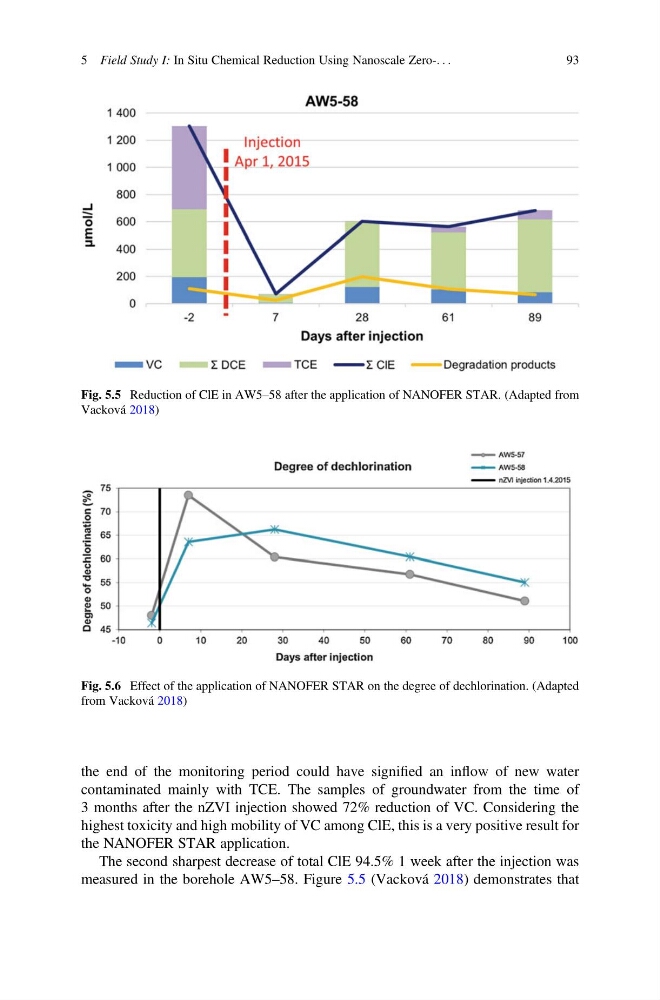
The second sharpest decrease of total ClE 94.5% 1 week after the injection was
measured in the borehole AW5–58. Figure 5.5 (Vacková 2018) demonstrates that
Fig. 5.5 Reduction of ClE in AW5–58 after the application of NANOFER STAR. (Adapted from
Vacková 2018)
Fig. 5.6 Effect of the application of NANOFER STAR on the degree of dechlorination. (Adapted
from Vacková 2018)
5 Field Study I: In Situ Chemical Reduction Using Nanoscale Zero-. . .
93
contaminated mainly with TCE. The samples of groundwater from the time of
3 months after the nZVI injection showed 72% reduction of VC. Considering the
highest toxicity and high mobility of VC among ClE, this is a very positive result for
the NANOFER STAR application.
The second sharpest decrease of total ClE 94.5% 1 week after the injection was
measured in the borehole AW5–58. Figure 5.5 (Vacková 2018) demonstrates that
Fig. 5.5 Reduction of ClE in AW5–58 after the application of NANOFER STAR. (Adapted from
Vacková 2018)
Fig. 5.6 Effect of the application of NANOFER STAR on the degree of dechlorination. (Adapted
from Vacková 2018)
5 Field Study I: In Situ Chemical Reduction Using Nanoscale Zero-. . .
93