

5 Design of Measurement System
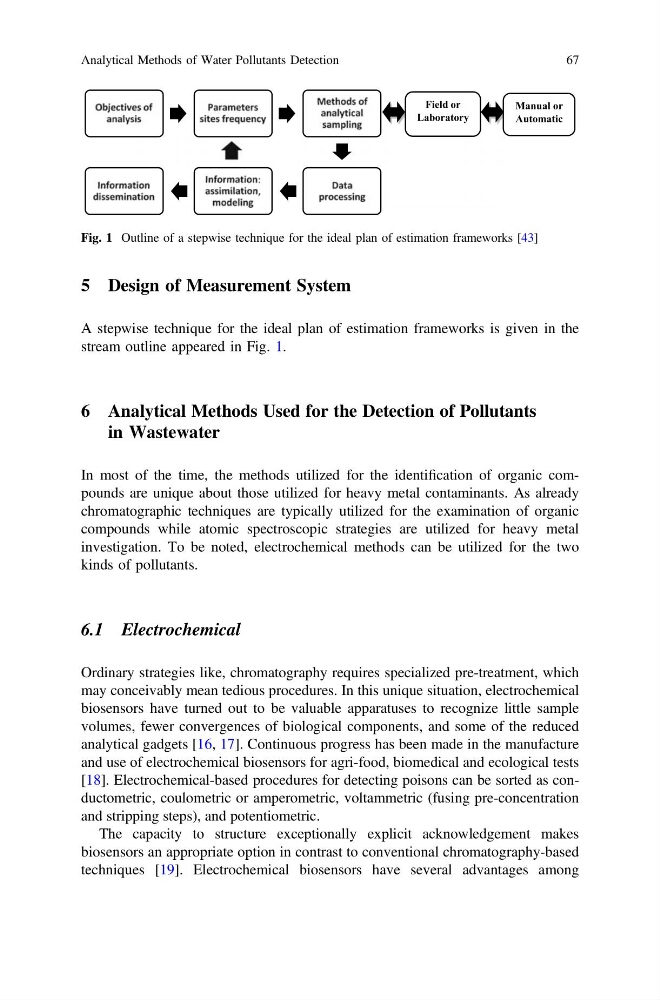
A stepwise technique for the ideal plan of estimation frameworks is given in the
stream outline appeared in Fig. 1.
6 Analytical Methods Used for the Detection of Pollutants
in Wastewater
In most of the time, the methods utilized for the identification of organic compounds are unique about those utilized for heavy metal contaminants. As already
chromatographic techniques are typically utilized for the examination of organic
compounds while atomic spectroscopic strategies are utilized for heavy metal
investigation. To be noted, electrochemical methods can be utilized for the two
kinds of pollutants.
6.1 Electrochemical
Ordinary strategies like, chromatography requires specialized pre-treatment, which
may conceivably mean tedious procedures. In this unique situation, electrochemical
biosensors have turned out to be valuable apparatuses to recognize little sample
volumes, fewer convergences of biological components, and some of the reduced
analytical gadgets [16, 17]. Continuous progress has been made in the manufacture
and use of electrochemical biosensors for agri-food, biomedical and ecological tests
[18]. Electrochemical-based procedures for detecting poisons can be sorted as conductometric, coulometric or amperometric, voltammetric (fusing pre-concentration
and stripping steps), and potentiometric.
The capacity to structure exceptionally explicit acknowledgement makes
biosensors an appropriate option in contrast to conventional chromatography-based
techniques [19]. Electrochemical biosensors have several advantages among
Manual or
Automatic
Field or
Laboratory
Fig. 1 Outline of a stepwise technique for the ideal plan of estimation frameworks [43]
Analytical Methods of Water Pollutants Detection
67
A stepwise technique for the ideal plan of estimation frameworks is given in the
stream outline appeared in Fig. 1.
6 Analytical Methods Used for the Detection of Pollutants
in Wastewater
In most of the time, the methods utilized for the identification of organic compounds are unique about those utilized for heavy metal contaminants. As already
chromatographic techniques are typically utilized for the examination of organic
compounds while atomic spectroscopic strategies are utilized for heavy metal
investigation. To be noted, electrochemical methods can be utilized for the two
kinds of pollutants.
6.1 Electrochemical
Ordinary strategies like, chromatography requires specialized pre-treatment, which
may conceivably mean tedious procedures. In this unique situation, electrochemical
biosensors have turned out to be valuable apparatuses to recognize little sample
volumes, fewer convergences of biological components, and some of the reduced
analytical gadgets [16, 17]. Continuous progress has been made in the manufacture
and use of electrochemical biosensors for agri-food, biomedical and ecological tests
[18]. Electrochemical-based procedures for detecting poisons can be sorted as conductometric, coulometric or amperometric, voltammetric (fusing pre-concentration
and stripping steps), and potentiometric.
The capacity to structure exceptionally explicit acknowledgement makes
biosensors an appropriate option in contrast to conventional chromatography-based
techniques [19]. Electrochemical biosensors have several advantages among
Manual or
Automatic
Field or
Laboratory
Fig. 1 Outline of a stepwise technique for the ideal plan of estimation frameworks [43]
Analytical Methods of Water Pollutants Detection
67