

3.3 Heavy Metals
Heavy metals are regarded as a metal or metalloid having high atomic weight and
specific density and are often assumed as toxic even at very low concentrations
[46]. The heavy metal sources may be geogenic or anthropogenic. Chemical
weathering of rocks with their constituent minerals, decomposing vegetation and
animal matter and also atmospheric dry or wet deposition is natural sources.
Anthropogenic sources such as mining, discharge of industrial effluents, industrial
emissions (both in elemental or compound form), fertilizers used in agricultural
activities, roadside and automobiles etc. are considered as prime contributors for
heavy metal contamination in water [47].
Iron (Fe)
Fe found in soil and minerals mainly as insoluble ferrous oxide and iron sulphide
form. CO 2 present in groundwater react with ferrous carbonate and release Fe
+2 in
solutions form [48].
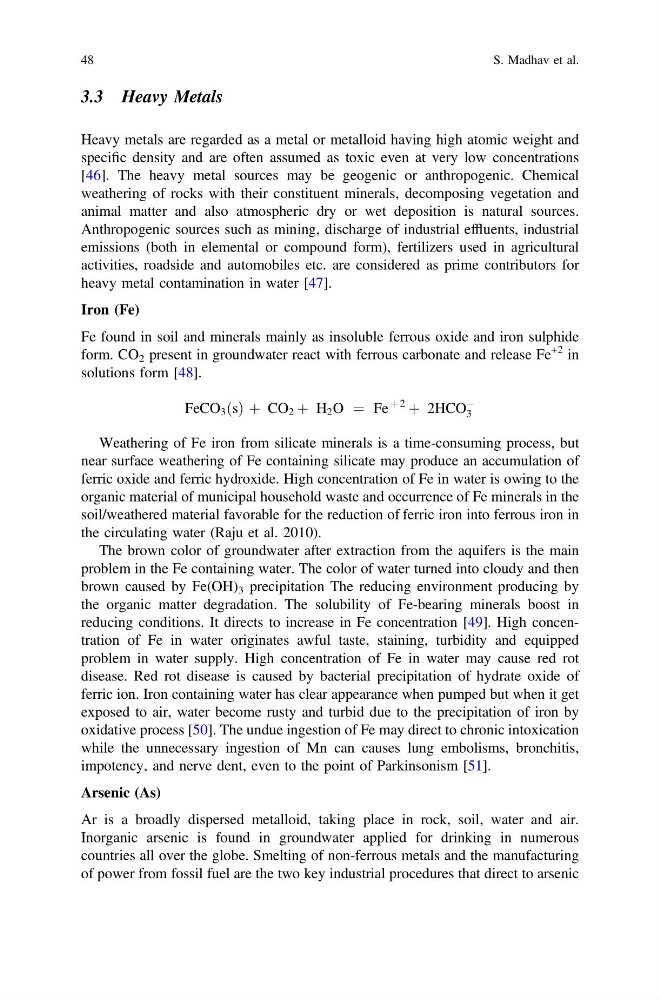
FeCO 3 s
ð Þ þ CO 2 þ H 2 O ¼ Fe
þ 2
þ 2HCO
À
3
Weathering of Fe iron from silicate minerals is a time-consuming process, but
near surface weathering of Fe containing silicate may produce an accumulation of
ferric oxide and ferric hydroxide. High concentration of Fe in water is owing to the
organic material of municipal household waste and occurrence of Fe minerals in the
soil/weathered material favorable for the reduction of ferric iron into ferrous iron in
the circulating water (Raju et al. 2010).
The brown color of groundwater after extraction from the aquifers is the main
problem in the Fe containing water. The color of water turned into cloudy and then
brown caused by Fe(OH) 3 precipitation The reducing environment producing by
the organic matter degradation. The solubility of Fe-bearing minerals boost in
reducing conditions. It directs to increase in Fe concentration [49]. High concentration of Fe in water originates awful taste, staining, turbidity and equipped
problem in water supply. High concentration of Fe in water may cause red rot
disease. Red rot disease is caused by bacterial precipitation of hydrate oxide of
ferric ion. Iron containing water has clear appearance when pumped but when it get
exposed to air, water become rusty and turbid due to the precipitation of iron by
oxidative process [50]. The undue ingestion of Fe may direct to chronic intoxication
while the unnecessary ingestion of Mn can causes lung embolisms, bronchitis,
impotency, and nerve dent, even to the point of Parkinsonism [51].
Arsenic (As)
Ar is a broadly dispersed metalloid, taking place in rock, soil, water and air.
Inorganic arsenic is found in groundwater applied for drinking in numerous
countries all over the globe. Smelting of non-ferrous metals and the manufacturing
of power from fossil fuel are the two key industrial procedures that direct to arsenic
48
S. Madhav et al.
Heavy metals are regarded as a metal or metalloid having high atomic weight and
specific density and are often assumed as toxic even at very low concentrations
[46]. The heavy metal sources may be geogenic or anthropogenic. Chemical
weathering of rocks with their constituent minerals, decomposing vegetation and
animal matter and also atmospheric dry or wet deposition is natural sources.
Anthropogenic sources such as mining, discharge of industrial effluents, industrial
emissions (both in elemental or compound form), fertilizers used in agricultural
activities, roadside and automobiles etc. are considered as prime contributors for
heavy metal contamination in water [47].
Iron (Fe)
Fe found in soil and minerals mainly as insoluble ferrous oxide and iron sulphide
form. CO 2 present in groundwater react with ferrous carbonate and release Fe
+2 in
solutions form [48].
FeCO 3 s
ð Þ þ CO 2 þ H 2 O ¼ Fe
þ 2
þ 2HCO
À
3
Weathering of Fe iron from silicate minerals is a time-consuming process, but
near surface weathering of Fe containing silicate may produce an accumulation of
ferric oxide and ferric hydroxide. High concentration of Fe in water is owing to the
organic material of municipal household waste and occurrence of Fe minerals in the
soil/weathered material favorable for the reduction of ferric iron into ferrous iron in
the circulating water (Raju et al. 2010).
The brown color of groundwater after extraction from the aquifers is the main
problem in the Fe containing water. The color of water turned into cloudy and then
brown caused by Fe(OH) 3 precipitation The reducing environment producing by
the organic matter degradation. The solubility of Fe-bearing minerals boost in
reducing conditions. It directs to increase in Fe concentration [49]. High concentration of Fe in water originates awful taste, staining, turbidity and equipped
problem in water supply. High concentration of Fe in water may cause red rot
disease. Red rot disease is caused by bacterial precipitation of hydrate oxide of
ferric ion. Iron containing water has clear appearance when pumped but when it get
exposed to air, water become rusty and turbid due to the precipitation of iron by
oxidative process [50]. The undue ingestion of Fe may direct to chronic intoxication
while the unnecessary ingestion of Mn can causes lung embolisms, bronchitis,
impotency, and nerve dent, even to the point of Parkinsonism [51].
Arsenic (As)
Ar is a broadly dispersed metalloid, taking place in rock, soil, water and air.
Inorganic arsenic is found in groundwater applied for drinking in numerous
countries all over the globe. Smelting of non-ferrous metals and the manufacturing
of power from fossil fuel are the two key industrial procedures that direct to arsenic
48
S. Madhav et al.