

active constituent in insect repellents and is known to persist in the water bodies for
long durations [120].
Synthetic musks have been used as economical substitutes for natural musks
since 1930s as fragrances in wide variety of products (domestic and industrial) such
as food, perfume, detergent, shampoo, cosmetics and cigarette additives [81].
Synthetic musks have been widely categorised into two groups namely, polycyclic
and nitro musks. Amongst them, nitro musks were the most frequently used synthetic musks initially but eventually their usage was reduced by 1950s because of
their toxic nature towards humans and environment [102]. Polycyclic musks has
replaced the nitromusks, which accounted for around 85% of worldwide production
whereas remaining 15% is contributed by nitro musks [18, 102]. UV filters are
generally used in sunscreens, cosmetics and lotions for protecting the skin against
UV radiation. Their usage has seen a surge owing to increased awareness of people
regarding the detrimental health consequences caused by UV radiation. These filters
are discharged into water bodies as effluents and through various water based
recreational activities [18].
3.2 Endocrine Disruptors (EDCs)
EDCs has been described by the Endocrine Society, (the largest international group
of scientists and physicians which work in the area of endocrinology), as: “an
exogenous [non-natural] chemical, or mixture of chemicals, that interferes with any
aspect of hormone action” [40]. EDCs disrupt the endocrine system by either
mirroring the structure of the natural hormone or by obstructing its functional
pathway. These have been characterized as artificial chemicals that either mimic or
block hormones after entering the body thereby affecting its usual operation. The
Environmental Protection Agency (EPA) has described EDCs as foreign factor that
may interfere with the development, release, attachment, transport, activity and/or
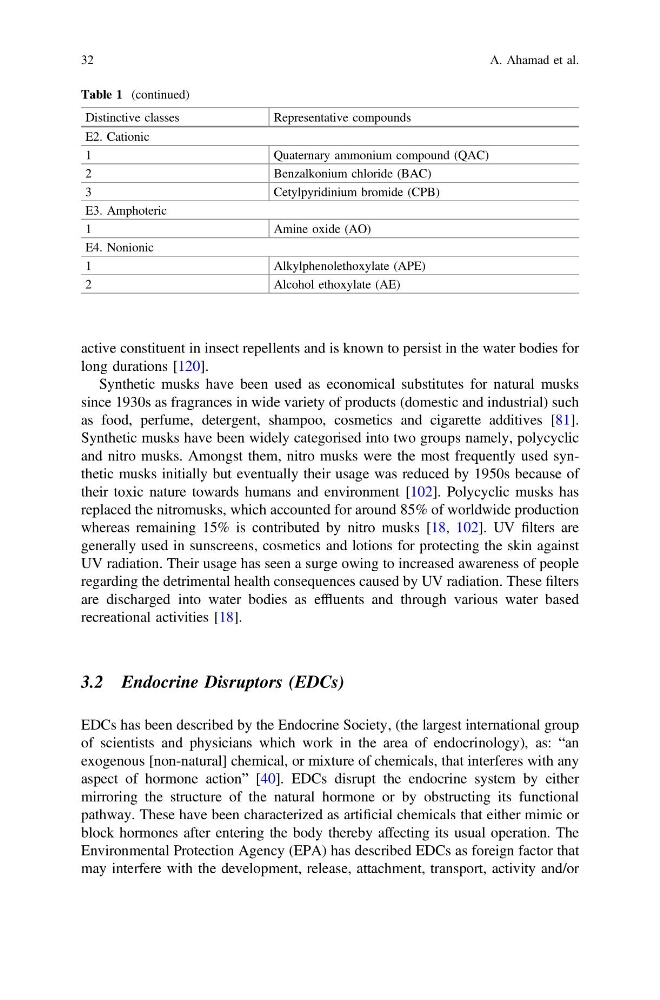
Table 1 (continued)
Distinctive classes
Representative compounds
E2. Cationic
1
Quaternary ammonium compound (QAC)
2
Benzalkonium chloride (BAC)
3
Cetylpyridinium bromide (CPB)
E3. Amphoteric
1
Amine oxide (AO)
E4. Nonionic
1
Alkylphenolethoxylate (APE)
2
Alcohol ethoxylate (AE)
32
A. Ahamad et al.
long durations [120].
Synthetic musks have been used as economical substitutes for natural musks
since 1930s as fragrances in wide variety of products (domestic and industrial) such
as food, perfume, detergent, shampoo, cosmetics and cigarette additives [81].
Synthetic musks have been widely categorised into two groups namely, polycyclic
and nitro musks. Amongst them, nitro musks were the most frequently used synthetic musks initially but eventually their usage was reduced by 1950s because of
their toxic nature towards humans and environment [102]. Polycyclic musks has
replaced the nitromusks, which accounted for around 85% of worldwide production
whereas remaining 15% is contributed by nitro musks [18, 102]. UV filters are
generally used in sunscreens, cosmetics and lotions for protecting the skin against
UV radiation. Their usage has seen a surge owing to increased awareness of people
regarding the detrimental health consequences caused by UV radiation. These filters
are discharged into water bodies as effluents and through various water based
recreational activities [18].
3.2 Endocrine Disruptors (EDCs)
EDCs has been described by the Endocrine Society, (the largest international group
of scientists and physicians which work in the area of endocrinology), as: “an
exogenous [non-natural] chemical, or mixture of chemicals, that interferes with any
aspect of hormone action” [40]. EDCs disrupt the endocrine system by either
mirroring the structure of the natural hormone or by obstructing its functional
pathway. These have been characterized as artificial chemicals that either mimic or
block hormones after entering the body thereby affecting its usual operation. The
Environmental Protection Agency (EPA) has described EDCs as foreign factor that
may interfere with the development, release, attachment, transport, activity and/or
Table 1 (continued)
Distinctive classes
Representative compounds
E2. Cationic
1
Quaternary ammonium compound (QAC)
2
Benzalkonium chloride (BAC)
3
Cetylpyridinium bromide (CPB)
E3. Amphoteric
1
Amine oxide (AO)
E4. Nonionic
1
Alkylphenolethoxylate (APE)
2
Alcohol ethoxylate (AE)
32
A. Ahamad et al.