

available for the detection of harmful pathogens like Fluorescence detection,
Polymer chain reaction(PCR), Electrochemical method, Raman based and microfluidic sensors [9, 97–101]. Nanofibers are an important class of material and can be
utilized for not only detection but also for water remediation from pathogens.
The most classical approach of utilizing nanofibers for pathogen detection is the
florescence spectroscopy. Most commonly, the fluorescent markers are either
grafted in the nanofibers or doped in the polymer solution before fiber spinning. The
nanofiber morphology provides the added advantage of trapping the bacteria as well
as provide large surface area for the interaction of bacterial cells with the sensing
molecules. Zhao et al. [102] have utilized electrospun nanofibers mats of polystyrene-co-maleic anhydride with conjugated mannose and tetraphenylethylene as a
fluorescent sensor for Escherichia Coli (E. Coli). The sensor, in the test strip format,
was able to provide visual sensitivity for concentration as low as 100 CFU/ml of the
bacteria. Another recent report by Yu et al. [103], demonstrates an ultrafast and
sensitive platform for bacterial concentration detection. They utilize a novel
fluorescent molecule with a dynamic layer by layer film on nanofibers of polyvinyl
alcohol-co-polyethylene as the platform for immobilizing the bacteria. The bacteria
concentration showed a linear relationship with surface fluorescence and detection
time as low as 5 min. There are other reports also which use Boronic acid, as
dopant for fluorescence based detection of biological contaminants [104].
Luo et al. [105] have demonstrated a nanofiber biosensor based on conductometric immunoassay. The fabricated sensor demonstrated a detection time of 8 min
and a limit of 61 CFU/ml and 10
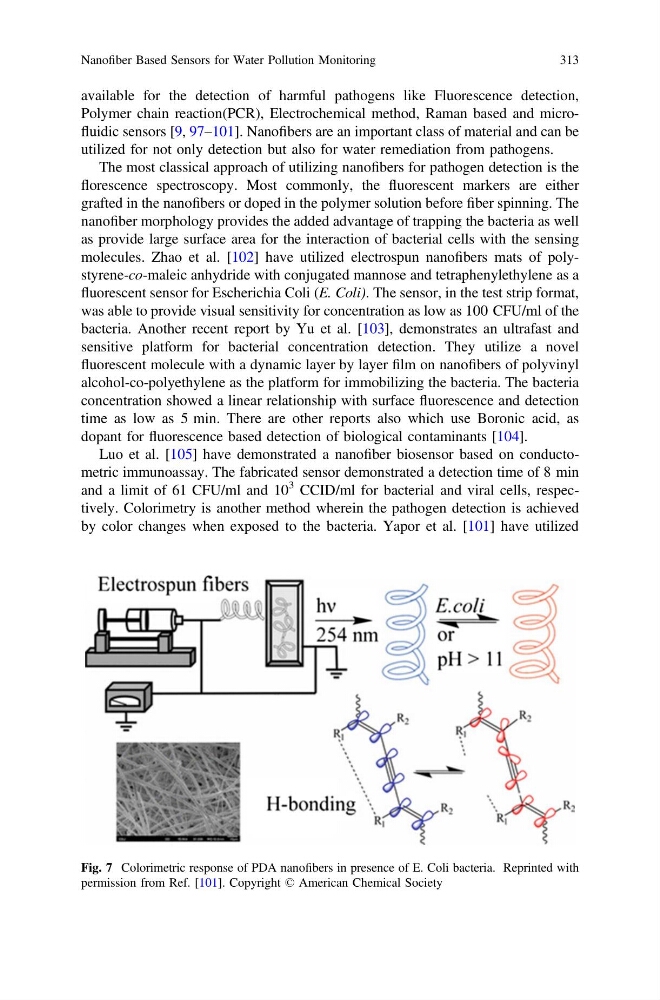
3 CCID/ml for bacterial and viral cells, respectively. Colorimetry is another method wherein the pathogen detection is achieved
by color changes when exposed to the bacteria. Yapor et al. [101] have utilized
Fig. 7 Colorimetric response of PDA nanofibers in presence of E. Coli bacteria. Reprinted with
permission from Ref. [101]. Copyright © American Chemical Society
Nanofiber Based Sensors for Water Pollution Monitoring
313
Polymer chain reaction(PCR), Electrochemical method, Raman based and microfluidic sensors [9, 97–101]. Nanofibers are an important class of material and can be
utilized for not only detection but also for water remediation from pathogens.
The most classical approach of utilizing nanofibers for pathogen detection is the
florescence spectroscopy. Most commonly, the fluorescent markers are either
grafted in the nanofibers or doped in the polymer solution before fiber spinning. The
nanofiber morphology provides the added advantage of trapping the bacteria as well
as provide large surface area for the interaction of bacterial cells with the sensing
molecules. Zhao et al. [102] have utilized electrospun nanofibers mats of polystyrene-co-maleic anhydride with conjugated mannose and tetraphenylethylene as a
fluorescent sensor for Escherichia Coli (E. Coli). The sensor, in the test strip format,
was able to provide visual sensitivity for concentration as low as 100 CFU/ml of the
bacteria. Another recent report by Yu et al. [103], demonstrates an ultrafast and
sensitive platform for bacterial concentration detection. They utilize a novel
fluorescent molecule with a dynamic layer by layer film on nanofibers of polyvinyl
alcohol-co-polyethylene as the platform for immobilizing the bacteria. The bacteria
concentration showed a linear relationship with surface fluorescence and detection
time as low as 5 min. There are other reports also which use Boronic acid, as
dopant for fluorescence based detection of biological contaminants [104].
Luo et al. [105] have demonstrated a nanofiber biosensor based on conductometric immunoassay. The fabricated sensor demonstrated a detection time of 8 min
and a limit of 61 CFU/ml and 10
3 CCID/ml for bacterial and viral cells, respectively. Colorimetry is another method wherein the pathogen detection is achieved
by color changes when exposed to the bacteria. Yapor et al. [101] have utilized
Fig. 7 Colorimetric response of PDA nanofibers in presence of E. Coli bacteria. Reprinted with
permission from Ref. [101]. Copyright © American Chemical Society
Nanofiber Based Sensors for Water Pollution Monitoring
313