

3.7 Organic Contaminants
Organic contaminants are released in the water resources mainly from industries.
Gasoline and aromatic hydrocarbon solvents are produced and used in large
quantities. Many incidents of oil spillage in ocean have been reported. The environmental impact of these spillage often results in loss of aquatic life as well as
ground water contamination [86]. To ensure remediation, there is a need for
monitoring of these toxic compounds. The common organic contaminants as per the
EPA include volatile organic compounds (VOC), pesticides, insecticides, aromatic
and chlorinated hydrocarbons [87–89]. Almost all the chlorinated hydrocarbons like
chloroethylene pose severe kidney and liver problems while aromatics can harm our
nervous system [3].
Surface enhanced Raman spectroscopy-based sensors for organics monitoring
has been studied by many researchers. These sensors have the advantage of being
extremely specific and sensitive to the analyte being monitored. Wei et al. [90]
provide an extremely exhaustive review of the application of SERS sensing technique for environmental monitoring. Though SERS phenomena is observed in
many nanomaterials, this section will limit its discussion on role of nanofibers in
SERS sensors for organic contaminants. Nanofibers offer the optimum size for the
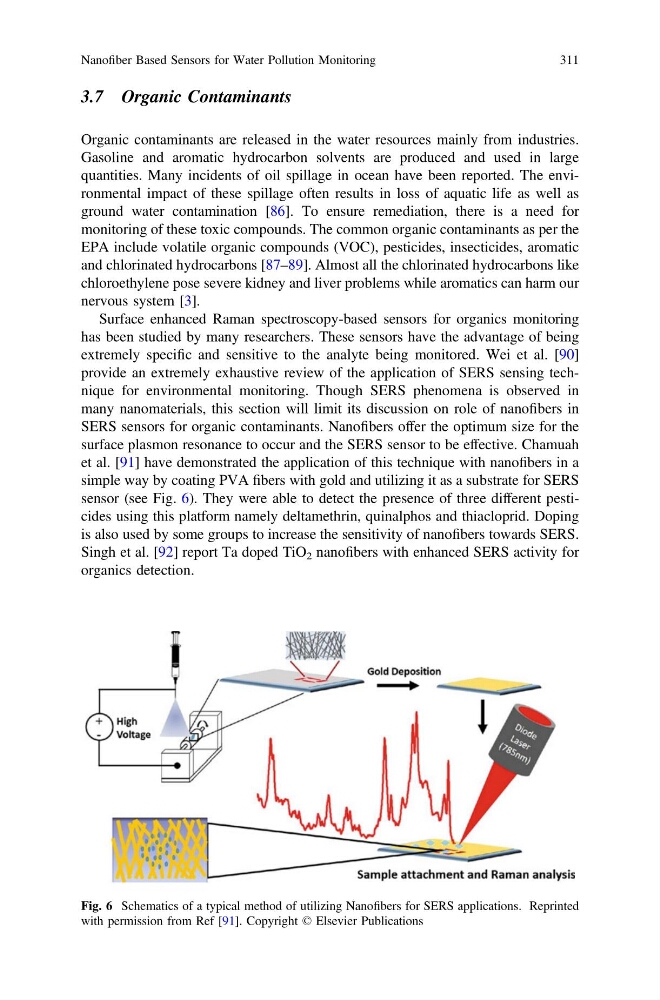
surface plasmon resonance to occur and the SERS sensor to be effective. Chamuah
et al. [91] have demonstrated the application of this technique with nanofibers in a
simple way by coating PVA fibers with gold and utilizing it as a substrate for SERS
sensor (see Fig. 6). They were able to detect the presence of three different pesticides using this platform namely deltamethrin, quinalphos and thiacloprid. Doping
is also used by some groups to increase the sensitivity of nanofibers towards SERS.
Singh et al. [92] report Ta doped TiO 2 nanofibers with enhanced SERS activity for
organics detection.
Fig. 6 Schematics of a typical method of utilizing Nanofibers for SERS applications. Reprinted
with permission from Ref [91]. Copyright © Elsevier Publications
Nanofiber Based Sensors for Water Pollution Monitoring
311
Organic contaminants are released in the water resources mainly from industries.
Gasoline and aromatic hydrocarbon solvents are produced and used in large
quantities. Many incidents of oil spillage in ocean have been reported. The environmental impact of these spillage often results in loss of aquatic life as well as
ground water contamination [86]. To ensure remediation, there is a need for
monitoring of these toxic compounds. The common organic contaminants as per the
EPA include volatile organic compounds (VOC), pesticides, insecticides, aromatic
and chlorinated hydrocarbons [87–89]. Almost all the chlorinated hydrocarbons like
chloroethylene pose severe kidney and liver problems while aromatics can harm our
nervous system [3].
Surface enhanced Raman spectroscopy-based sensors for organics monitoring
has been studied by many researchers. These sensors have the advantage of being
extremely specific and sensitive to the analyte being monitored. Wei et al. [90]
provide an extremely exhaustive review of the application of SERS sensing technique for environmental monitoring. Though SERS phenomena is observed in
many nanomaterials, this section will limit its discussion on role of nanofibers in
SERS sensors for organic contaminants. Nanofibers offer the optimum size for the
surface plasmon resonance to occur and the SERS sensor to be effective. Chamuah
et al. [91] have demonstrated the application of this technique with nanofibers in a
simple way by coating PVA fibers with gold and utilizing it as a substrate for SERS
sensor (see Fig. 6). They were able to detect the presence of three different pesticides using this platform namely deltamethrin, quinalphos and thiacloprid. Doping
is also used by some groups to increase the sensitivity of nanofibers towards SERS.
Singh et al. [92] report Ta doped TiO 2 nanofibers with enhanced SERS activity for
organics detection.
Fig. 6 Schematics of a typical method of utilizing Nanofibers for SERS applications. Reprinted
with permission from Ref [91]. Copyright © Elsevier Publications
Nanofiber Based Sensors for Water Pollution Monitoring
311