

Migliorini et al. [69] have also studied the effect of polyamide-6/chitosan nanofibers
and AuNPs modification of fluorine doped tin oxide electrodes for Cd
2+ detection.
The voltammetry study revealed a linear response in 25–75 µg L
−1 concentration of
Cd
2+ and a detection limit of 0.88 µg L
−1 . One dimensional phytic acid doped
polyaniline nanofibers were utilized as a modifier for glassy carbon electrode for
simultaneous detection of Cd
2+ and Pb
2+ using differential pulse anodic stripping
voltammetry by Huang et al. [70] group. The reported detection limits were 0.02
and 0.05 µg L
−1 for Cd and Pb, respectively.
Zhang et al. [71] have reported a green synthesis scheme for the fabrication of
AuNPs/CNFs over glassy carbon electrodes by electrospinning for detecting Cd
2+ ,
Pb
2+ and Cu
2+ metal ions. Square wave anodic stripping voltammetry was used and
detection limits reaching up to 0.1 µM. Mishra et al. [72] have deposited graphene
oxide nanofibers on screen printed carbon electrodes for the fabrication of HMI
sensor. The GO dispersed in PVA was electrospun over SPCE followed by alkaline
phosphatase immobilization over these composite fibers. There was an inhibition of
ALP activity in presence of HMIs which was used as a scale for monitoring the
level of pollutants in water. The detection limit reported was 0.0075, 0.015 and
0.0312 ppb for detecting Hg
2+ , Pb
2+ and Cd
2+ metal ions. CNFs in three dimensional networks were used as a voltammetric sensors by Qin et al. [73]. CNFs were
prepared from bacterial cellulose by carbonization at 800 °C, wrapped with Nafion
polymer and cast on GCE for trace level determination of Cd
2+ and Pb
2+ metal ions.
The detection limits are 0.38 and 0.33 µg L
−1 for Cd
2+ and Pb
2+ , respectively.
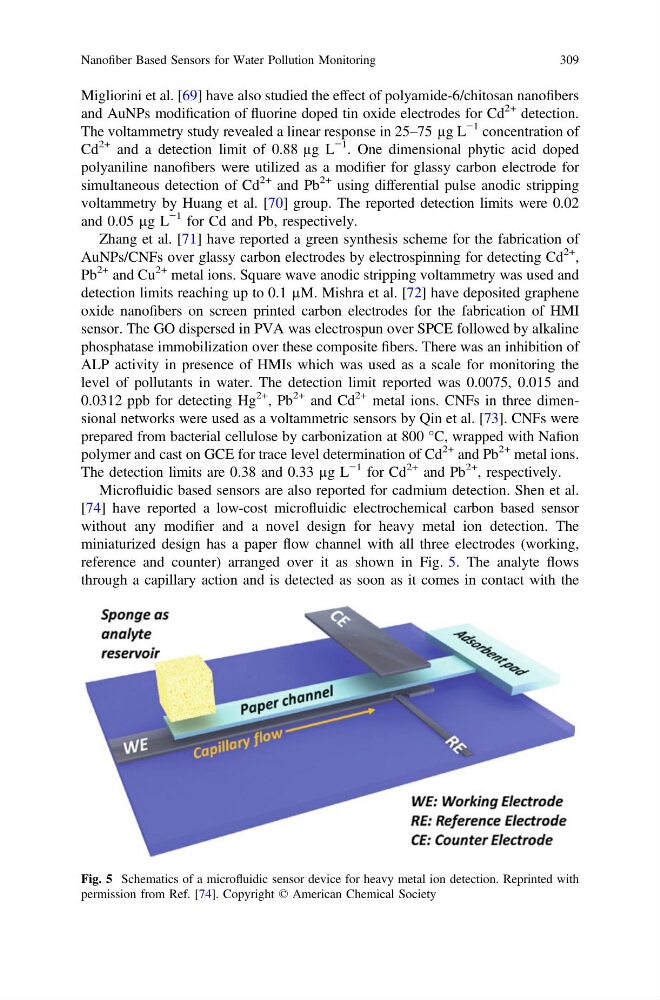
Microfluidic based sensors are also reported for cadmium detection. Shen et al.
[74] have reported a low-cost microfluidic electrochemical carbon based sensor
without any modifier and a novel design for heavy metal ion detection. The
miniaturized design has a paper flow channel with all three electrodes (working,
reference and counter) arranged over it as shown in Fig. 5. The analyte flows
through a capillary action and is detected as soon as it comes in contact with the
Fig. 5 Schematics of a microfluidic sensor device for heavy metal ion detection. Reprinted with
permission from Ref. [74]. Copyright © American Chemical Society
Nanofiber Based Sensors for Water Pollution Monitoring
309
and AuNPs modification of fluorine doped tin oxide electrodes for Cd
2+ detection.
The voltammetry study revealed a linear response in 25–75 µg L
−1 concentration of
Cd
2+ and a detection limit of 0.88 µg L
−1 . One dimensional phytic acid doped
polyaniline nanofibers were utilized as a modifier for glassy carbon electrode for
simultaneous detection of Cd
2+ and Pb
2+ using differential pulse anodic stripping
voltammetry by Huang et al. [70] group. The reported detection limits were 0.02
and 0.05 µg L
−1 for Cd and Pb, respectively.
Zhang et al. [71] have reported a green synthesis scheme for the fabrication of
AuNPs/CNFs over glassy carbon electrodes by electrospinning for detecting Cd
2+ ,
Pb
2+ and Cu
2+ metal ions. Square wave anodic stripping voltammetry was used and
detection limits reaching up to 0.1 µM. Mishra et al. [72] have deposited graphene
oxide nanofibers on screen printed carbon electrodes for the fabrication of HMI
sensor. The GO dispersed in PVA was electrospun over SPCE followed by alkaline
phosphatase immobilization over these composite fibers. There was an inhibition of
ALP activity in presence of HMIs which was used as a scale for monitoring the
level of pollutants in water. The detection limit reported was 0.0075, 0.015 and
0.0312 ppb for detecting Hg
2+ , Pb
2+ and Cd
2+ metal ions. CNFs in three dimensional networks were used as a voltammetric sensors by Qin et al. [73]. CNFs were
prepared from bacterial cellulose by carbonization at 800 °C, wrapped with Nafion
polymer and cast on GCE for trace level determination of Cd
2+ and Pb
2+ metal ions.
The detection limits are 0.38 and 0.33 µg L
−1 for Cd
2+ and Pb
2+ , respectively.
Microfluidic based sensors are also reported for cadmium detection. Shen et al.
[74] have reported a low-cost microfluidic electrochemical carbon based sensor
without any modifier and a novel design for heavy metal ion detection. The
miniaturized design has a paper flow channel with all three electrodes (working,
reference and counter) arranged over it as shown in Fig. 5. The analyte flows
through a capillary action and is detected as soon as it comes in contact with the
Fig. 5 Schematics of a microfluidic sensor device for heavy metal ion detection. Reprinted with
permission from Ref. [74]. Copyright © American Chemical Society
Nanofiber Based Sensors for Water Pollution Monitoring
309