

the electrochemical sensing, Surface enhanced Raman spectroscopy, colorimetry
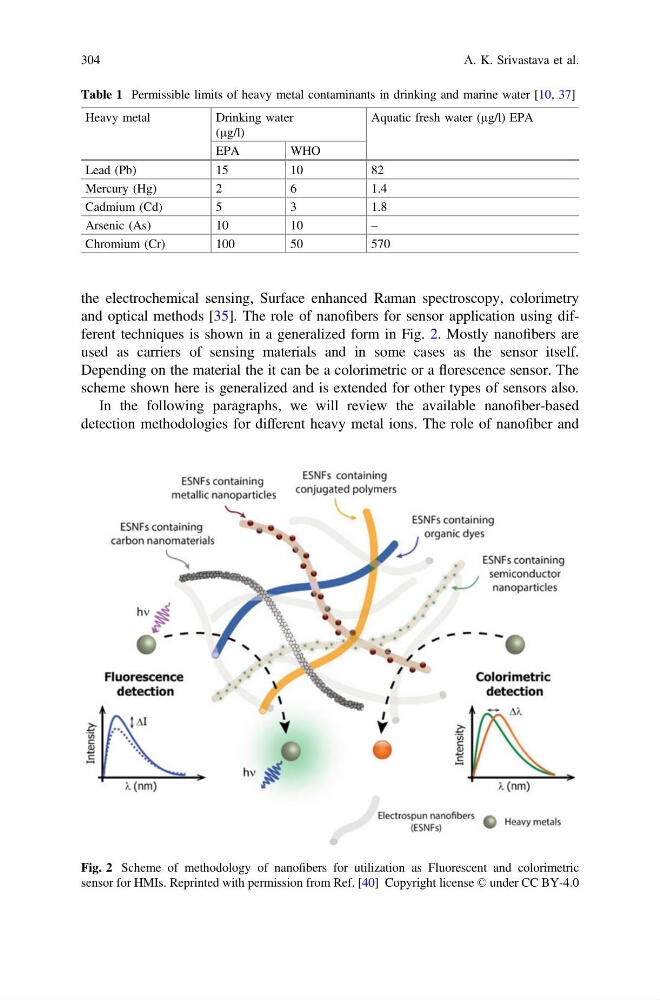
and optical methods [35]. The role of nanofibers for sensor application using different techniques is shown in a generalized form in Fig. 2. Mostly nanofibers are
used as carriers of sensing materials and in some cases as the sensor itself.
Depending on the material the it can be a colorimetric or a florescence sensor. The
scheme shown here is generalized and is extended for other types of sensors also.
In the following paragraphs, we will review the available nanofiber-based
detection methodologies for different heavy metal ions. The role of nanofiber and
Table 1 Permissible limits of heavy metal contaminants in drinking and marine water [10, 37]
Heavy metal
Drinking water
(µg/l)
Aquatic fresh water (µg/l) EPA
EPA
WHO
Lead (Pb)
15
10
82
Mercury (Hg)
2
6
1.4
Cadmium (Cd)
5
3
1.8
Arsenic (As)
10
10
–
Chromium (Cr)
100
50
570
Fig. 2 Scheme of methodology of nanofibers for utilization as Fluorescent and colorimetric
sensor for HMIs. Reprinted with permission from Ref. [40] Copyright license © under CC BY-4.0
304
A. K. Srivastava et al.
and optical methods [35]. The role of nanofibers for sensor application using different techniques is shown in a generalized form in Fig. 2. Mostly nanofibers are
used as carriers of sensing materials and in some cases as the sensor itself.
Depending on the material the it can be a colorimetric or a florescence sensor. The
scheme shown here is generalized and is extended for other types of sensors also.
In the following paragraphs, we will review the available nanofiber-based
detection methodologies for different heavy metal ions. The role of nanofiber and
Table 1 Permissible limits of heavy metal contaminants in drinking and marine water [10, 37]
Heavy metal
Drinking water
(µg/l)
Aquatic fresh water (µg/l) EPA
EPA
WHO
Lead (Pb)
15
10
82
Mercury (Hg)
2
6
1.4
Cadmium (Cd)
5
3
1.8
Arsenic (As)
10
10
–
Chromium (Cr)
100
50
570
Fig. 2 Scheme of methodology of nanofibers for utilization as Fluorescent and colorimetric
sensor for HMIs. Reprinted with permission from Ref. [40] Copyright license © under CC BY-4.0
304
A. K. Srivastava et al.