

nanodevice for ultrasensitive pollutant detection [26]. The type of sensors which
can be fabricated with nanofibers as the active/passive material are electrochemical,
optical, spectroscopic, thermal, piezoelectric and other detection principles [18, 20–
22, 26].
2.1 Synthesis Techniques
There are a variety of ways of synthesizing nanofibers which can be broadly categorized into electro and non-electro spinning techniques [27, 28]. Though the
conventional jet spinning techniques combine well with the current fabrication
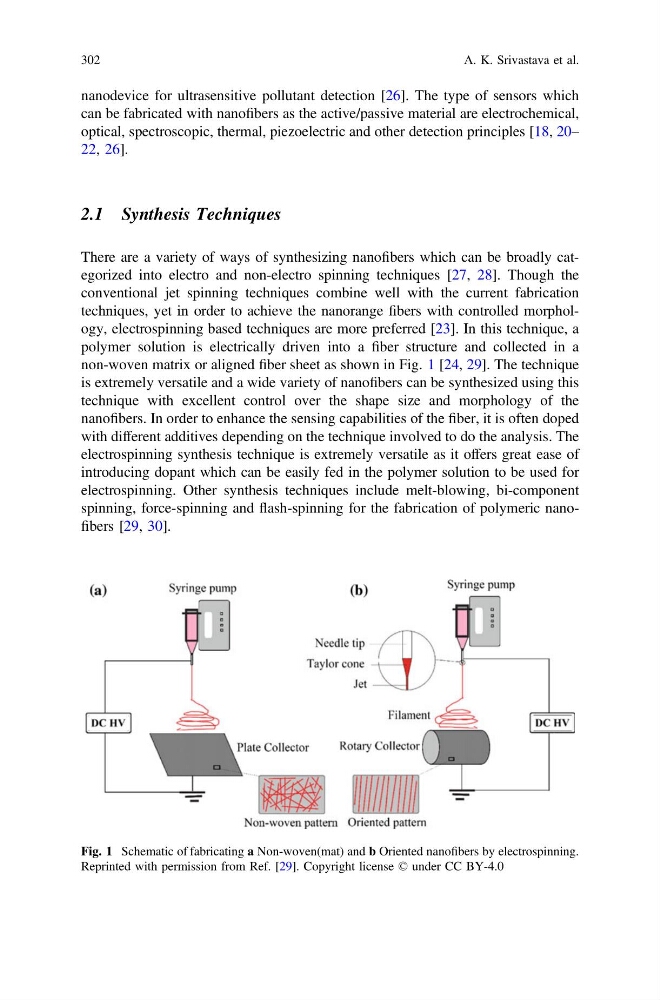
techniques, yet in order to achieve the nanorange fibers with controlled morphology, electrospinning based techniques are more preferred [23]. In this technique, a
polymer solution is electrically driven into a fiber structure and collected in a
non-woven matrix or aligned fiber sheet as shown in Fig. 1 [24, 29]. The technique
is extremely versatile and a wide variety of nanofibers can be synthesized using this
technique with excellent control over the shape size and morphology of the
nanofibers. In order to enhance the sensing capabilities of the fiber, it is often doped
with different additives depending on the technique involved to do the analysis. The
electrospinning synthesis technique is extremely versatile as it offers great ease of
introducing dopant which can be easily fed in the polymer solution to be used for
electrospinning. Other synthesis techniques include melt-blowing, bi-component
spinning, force-spinning and flash-spinning for the fabrication of polymeric nanofibers [29, 30].
Fig. 1 Schematic of fabricating a Non-woven(mat) and b Oriented nanofibers by electrospinning.
Reprinted with permission from Ref. [29]. Copyright license © under CC BY-4.0
302
A. K. Srivastava et al.
can be fabricated with nanofibers as the active/passive material are electrochemical,
optical, spectroscopic, thermal, piezoelectric and other detection principles [18, 20–
22, 26].
2.1 Synthesis Techniques
There are a variety of ways of synthesizing nanofibers which can be broadly categorized into electro and non-electro spinning techniques [27, 28]. Though the
conventional jet spinning techniques combine well with the current fabrication
techniques, yet in order to achieve the nanorange fibers with controlled morphology, electrospinning based techniques are more preferred [23]. In this technique, a
polymer solution is electrically driven into a fiber structure and collected in a
non-woven matrix or aligned fiber sheet as shown in Fig. 1 [24, 29]. The technique
is extremely versatile and a wide variety of nanofibers can be synthesized using this
technique with excellent control over the shape size and morphology of the
nanofibers. In order to enhance the sensing capabilities of the fiber, it is often doped
with different additives depending on the technique involved to do the analysis. The
electrospinning synthesis technique is extremely versatile as it offers great ease of
introducing dopant which can be easily fed in the polymer solution to be used for
electrospinning. Other synthesis techniques include melt-blowing, bi-component
spinning, force-spinning and flash-spinning for the fabrication of polymeric nanofibers [29, 30].
Fig. 1 Schematic of fabricating a Non-woven(mat) and b Oriented nanofibers by electrospinning.
Reprinted with permission from Ref. [29]. Copyright license © under CC BY-4.0
302
A. K. Srivastava et al.