

can be redistributed to the end users using email, text messages, web page, mobile
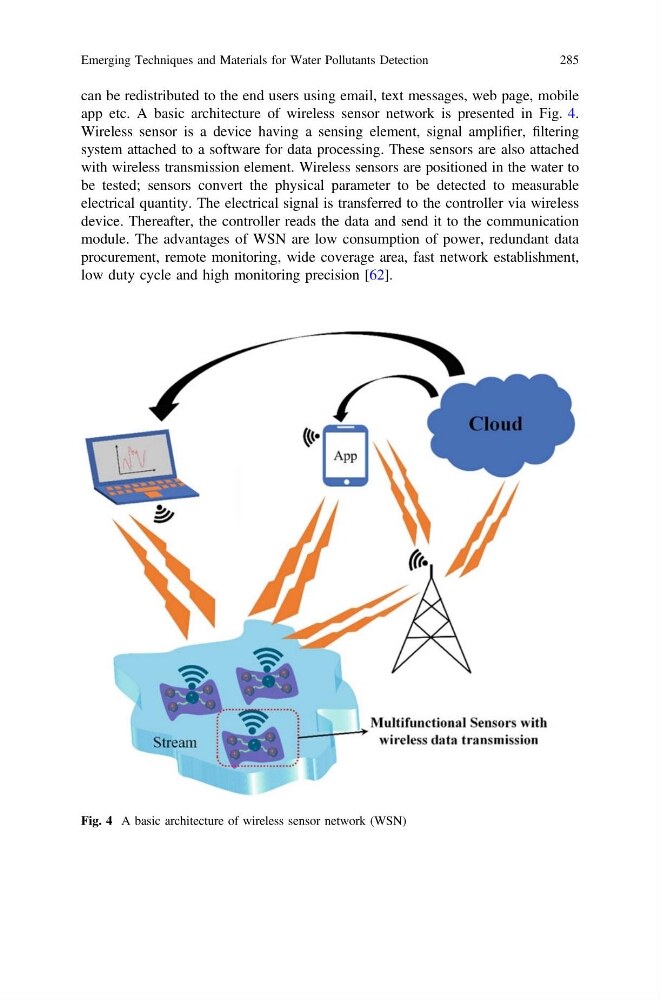
app etc. A basic architecture of wireless sensor network is presented in Fig. 4.
Wireless sensor is a device having a sensing element, signal amplifier, filtering
system attached to a software for data processing. These sensors are also attached
with wireless transmission element. Wireless sensors are positioned in the water to
be tested; sensors convert the physical parameter to be detected to measurable
electrical quantity. The electrical signal is transferred to the controller via wireless
device. Thereafter, the controller reads the data and send it to the communication
module. The advantages of WSN are low consumption of power, redundant data
procurement, remote monitoring, wide coverage area, fast network establishment,
low duty cycle and high monitoring precision [62].
Fig. 4 A basic architecture of wireless sensor network (WSN)
Emerging Techniques and Materials for Water Pollutants Detection
285
app etc. A basic architecture of wireless sensor network is presented in Fig. 4.
Wireless sensor is a device having a sensing element, signal amplifier, filtering
system attached to a software for data processing. These sensors are also attached
with wireless transmission element. Wireless sensors are positioned in the water to
be tested; sensors convert the physical parameter to be detected to measurable
electrical quantity. The electrical signal is transferred to the controller via wireless
device. Thereafter, the controller reads the data and send it to the communication
module. The advantages of WSN are low consumption of power, redundant data
procurement, remote monitoring, wide coverage area, fast network establishment,
low duty cycle and high monitoring precision [62].
Fig. 4 A basic architecture of wireless sensor network (WSN)
Emerging Techniques and Materials for Water Pollutants Detection
285