

having low resources, where wireless transmission is an issue due to network
limitations. In such cases smartphones may be able to store the data locally and then
transmit it when the network connection is available. Alternative power sources like
solar power is also useful for such areas. Main issues that needs attention in paper
based devices are proper validation, ability for long term storage of devices without
hampering its features and enhanced sensitivity.
3 Biosensors
A biosensor is an independent device, which provides specific quantitative or
semi-quantitative analytical information using a biochemical receptor [13]. As
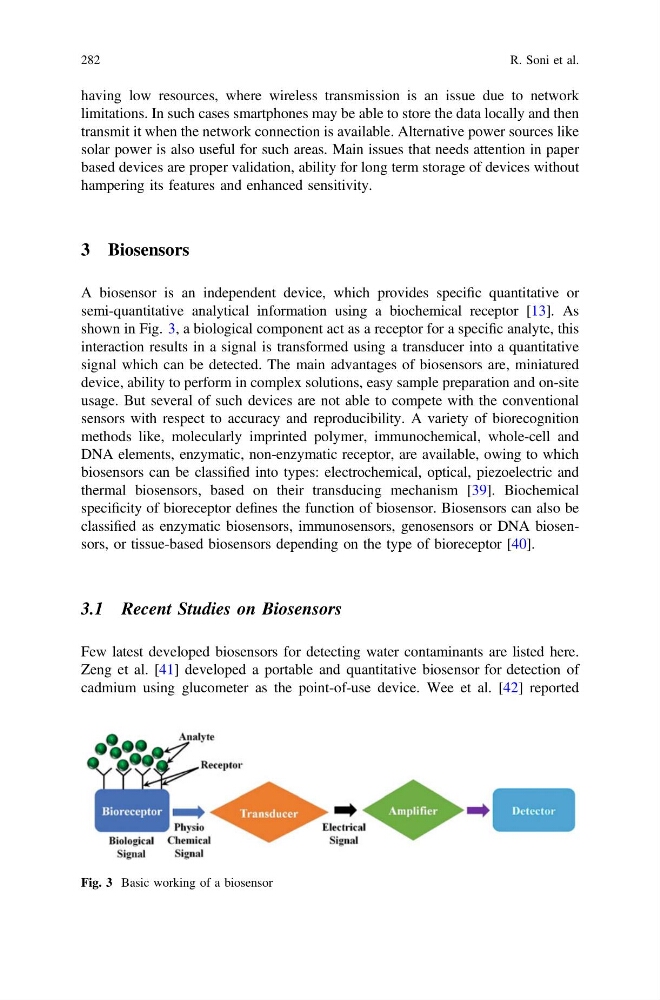
shown in Fig. 3, a biological component act as a receptor for a specific analyte, this
interaction results in a signal is transformed using a transducer into a quantitative
signal which can be detected. The main advantages of biosensors are, miniatured
device, ability to perform in complex solutions, easy sample preparation and on-site
usage. But several of such devices are not able to compete with the conventional
sensors with respect to accuracy and reproducibility. A variety of biorecognition
methods like, molecularly imprinted polymer, immunochemical, whole-cell and
DNA elements, enzymatic, non-enzymatic receptor, are available, owing to which
biosensors can be classified into types: electrochemical, optical, piezoelectric and
thermal biosensors, based on their transducing mechanism [39]. Biochemical
specificity of bioreceptor defines the function of biosensor. Biosensors can also be
classified as enzymatic biosensors, immunosensors, genosensors or DNA biosensors, or tissue-based biosensors depending on the type of bioreceptor [40].
3.1 Recent Studies on Biosensors
Few latest developed biosensors for detecting water contaminants are listed here.
Zeng et al. [41] developed a portable and quantitative biosensor for detection of
cadmium using glucometer as the point-of-use device. Wee et al. [42] reported
Fig. 3 Basic working of a biosensor
282
R. Soni et al.
limitations. In such cases smartphones may be able to store the data locally and then
transmit it when the network connection is available. Alternative power sources like
solar power is also useful for such areas. Main issues that needs attention in paper
based devices are proper validation, ability for long term storage of devices without
hampering its features and enhanced sensitivity.
3 Biosensors
A biosensor is an independent device, which provides specific quantitative or
semi-quantitative analytical information using a biochemical receptor [13]. As
shown in Fig. 3, a biological component act as a receptor for a specific analyte, this
interaction results in a signal is transformed using a transducer into a quantitative
signal which can be detected. The main advantages of biosensors are, miniatured
device, ability to perform in complex solutions, easy sample preparation and on-site
usage. But several of such devices are not able to compete with the conventional
sensors with respect to accuracy and reproducibility. A variety of biorecognition
methods like, molecularly imprinted polymer, immunochemical, whole-cell and
DNA elements, enzymatic, non-enzymatic receptor, are available, owing to which
biosensors can be classified into types: electrochemical, optical, piezoelectric and
thermal biosensors, based on their transducing mechanism [39]. Biochemical
specificity of bioreceptor defines the function of biosensor. Biosensors can also be
classified as enzymatic biosensors, immunosensors, genosensors or DNA biosensors, or tissue-based biosensors depending on the type of bioreceptor [40].
3.1 Recent Studies on Biosensors
Few latest developed biosensors for detecting water contaminants are listed here.
Zeng et al. [41] developed a portable and quantitative biosensor for detection of
cadmium using glucometer as the point-of-use device. Wee et al. [42] reported
Fig. 3 Basic working of a biosensor
282
R. Soni et al.