

themselves as ideal host candidates. Moreover, microbially derived biosensors are
comfortable to use, compact, cheap and easy to relocate.
Biosensor constitutes of bacteria, yeast and algae, possessing a unique advantages and disadvantages (Table 1). The exceptional structural and functional
characteristics of biosensors facilitate monitoring of wide range of environmental
pollutants. Wide array and unique characteristics of a biosensor such as selectivity,
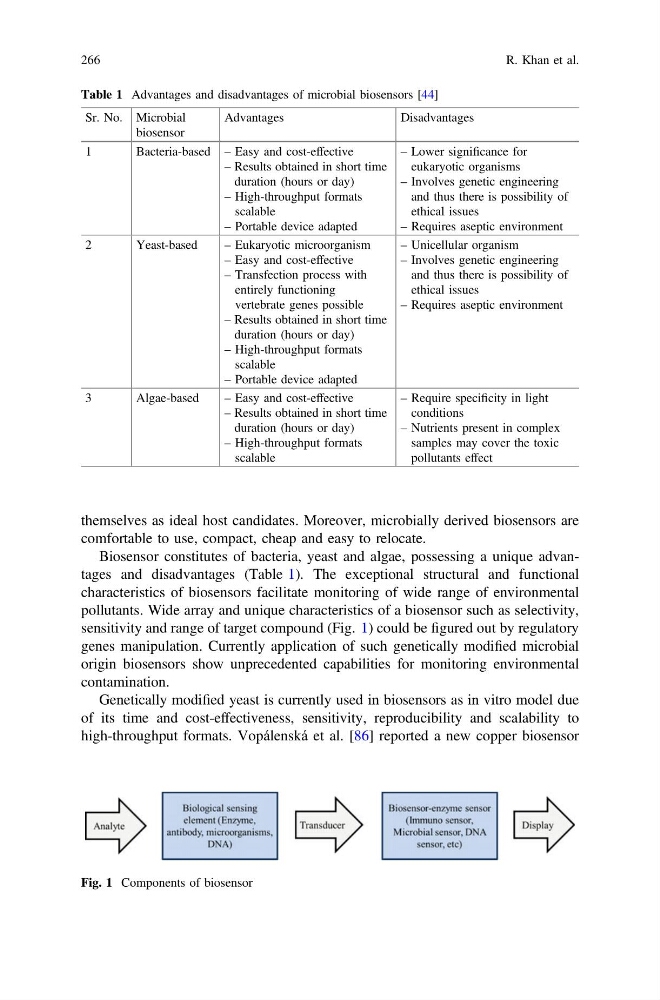
sensitivity and range of target compound (Fig. 1) could be figured out by regulatory
genes manipulation. Currently application of such genetically modified microbial
origin biosensors show unprecedented capabilities for monitoring environmental
contamination.
Genetically modified yeast is currently used in biosensors as in vitro model due
of its time and cost-effectiveness, sensitivity, reproducibility and scalability to
high-throughput formats. Vopálenská et al. [86] reported a new copper biosensor
Table 1 Advantages and disadvantages of microbial biosensors [44]
Sr. No. Microbial
biosensor
Advantages
Disadvantages
1
Bacteria-based – Easy and cost-effective
– Results obtained in short time
duration (hours or day)
– High-throughput formats
scalable
– Portable device adapted
– Lower significance for
eukaryotic organisms
– Involves genetic engineering
and thus there is possibility of
ethical issues
– Requires aseptic environment
2
Yeast-based
– Eukaryotic microorganism
– Easy and cost-effective
– Transfection process with
entirely functioning
vertebrate genes possible
– Results obtained in short time
duration (hours or day)
– High-throughput formats
scalable
– Portable device adapted
– Unicellular organism
– Involves genetic engineering
and thus there is possibility of
ethical issues
– Requires aseptic environment
3
Algae-based
– Easy and cost-effective
– Results obtained in short time
duration (hours or day)
– High-throughput formats
scalable
– Require specificity in light
conditions
– Nutrients present in complex
samples may cover the toxic
pollutants effect
Fig. 1 Components of biosensor
266
R. Khan et al.
comfortable to use, compact, cheap and easy to relocate.
Biosensor constitutes of bacteria, yeast and algae, possessing a unique advantages and disadvantages (Table 1). The exceptional structural and functional
characteristics of biosensors facilitate monitoring of wide range of environmental
pollutants. Wide array and unique characteristics of a biosensor such as selectivity,
sensitivity and range of target compound (Fig. 1) could be figured out by regulatory
genes manipulation. Currently application of such genetically modified microbial
origin biosensors show unprecedented capabilities for monitoring environmental
contamination.
Genetically modified yeast is currently used in biosensors as in vitro model due
of its time and cost-effectiveness, sensitivity, reproducibility and scalability to
high-throughput formats. Vopálenská et al. [86] reported a new copper biosensor
Table 1 Advantages and disadvantages of microbial biosensors [44]
Sr. No. Microbial
biosensor
Advantages
Disadvantages
1
Bacteria-based – Easy and cost-effective
– Results obtained in short time
duration (hours or day)
– High-throughput formats
scalable
– Portable device adapted
– Lower significance for
eukaryotic organisms
– Involves genetic engineering
and thus there is possibility of
ethical issues
– Requires aseptic environment
2
Yeast-based
– Eukaryotic microorganism
– Easy and cost-effective
– Transfection process with
entirely functioning
vertebrate genes possible
– Results obtained in short time
duration (hours or day)
– High-throughput formats
scalable
– Portable device adapted
– Unicellular organism
– Involves genetic engineering
and thus there is possibility of
ethical issues
– Requires aseptic environment
3
Algae-based
– Easy and cost-effective
– Results obtained in short time
duration (hours or day)
– High-throughput formats
scalable
– Require specificity in light
conditions
– Nutrients present in complex
samples may cover the toxic
pollutants effect
Fig. 1 Components of biosensor
266
R. Khan et al.