

large absorption coefficients, photostability, which make them a great asset in
distinguish fields like water pollutant detection cell labelling, cell imaging, DNA
hybridization, drug delivery etc.
Proteins can be conjugated with water soluble quantum dots and make them
more specific as labels. Proteins can be conjugated through their carboxyl and
amine groups. EDC (1-ethyl-3-3-dimethylaminopropyl) and NHS (-N-hydroxy
succinimide) activates the carboxyl group in the QDs which further reacts with the
amine groups present in antibodies and makes them specific towards the analyte
[69, 71]. Based on this principle, QDs based ICS are used the detection of different
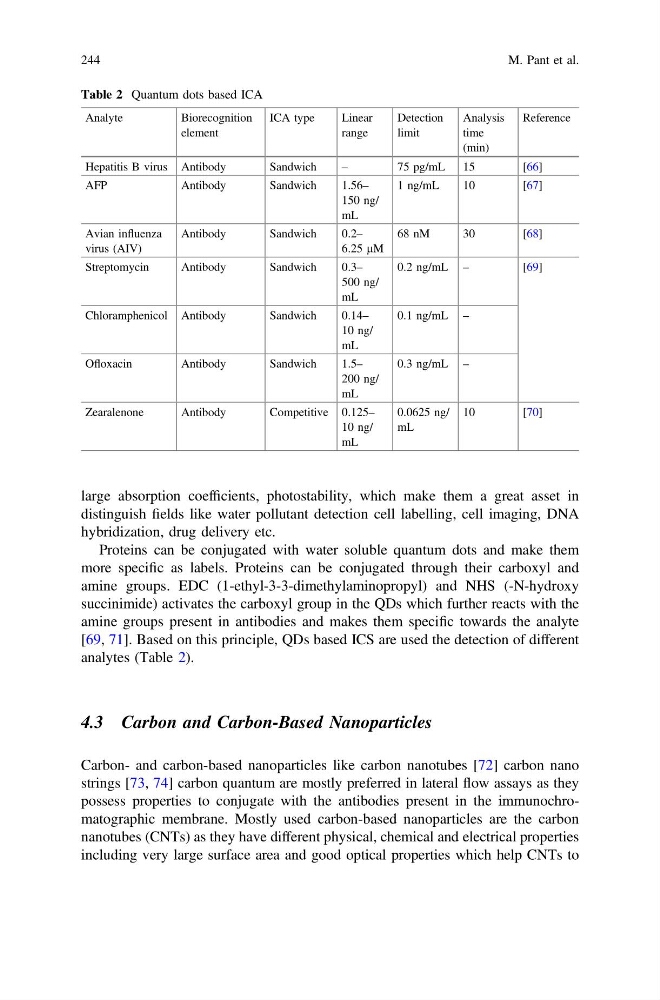
analytes (Table 2).
4.3 Carbon and Carbon-Based Nanoparticles
Carbon- and carbon-based nanoparticles like carbon nanotubes [72] carbon nano
strings [73, 74] carbon quantum are mostly preferred in lateral flow assays as they
possess properties to conjugate with the antibodies present in the immunochromatographic membrane. Mostly used carbon-based nanoparticles are the carbon
nanotubes (CNTs) as they have different physical, chemical and electrical properties
including very large surface area and good optical properties which help CNTs to
Table 2 Quantum dots based ICA
Analyte
Biorecognition
element
ICA type
Linear
range
Detection
limit
Analysis
time
(min)
Reference
Hepatitis B virus Antibody
Sandwich
–
75 pg/mL
15
[66]
AFP
Antibody
Sandwich
1.56–
150 ng/
mL
1 ng/mL
10
[67]
Avian influenza
virus (AIV)
Antibody
Sandwich
0.2–
6.25 lM
68 nM
30
[68]
Streptomycin
Antibody
Sandwich
0.3–
500 ng/
mL
0.2 ng/mL –
[69]
Chloramphenicol Antibody
Sandwich
0.14–
10 ng/
mL
0.1 ng/mL –
Ofloxacin
Antibody
Sandwich
1.5–
200 ng/
mL
0.3 ng/mL –
Zearalenone
Antibody
Competitive 0.125–
10 ng/
mL
0.0625 ng/
mL
10
[70]
244
M. Pant et al.
distinguish fields like water pollutant detection cell labelling, cell imaging, DNA
hybridization, drug delivery etc.
Proteins can be conjugated with water soluble quantum dots and make them
more specific as labels. Proteins can be conjugated through their carboxyl and
amine groups. EDC (1-ethyl-3-3-dimethylaminopropyl) and NHS (-N-hydroxy
succinimide) activates the carboxyl group in the QDs which further reacts with the
amine groups present in antibodies and makes them specific towards the analyte
[69, 71]. Based on this principle, QDs based ICS are used the detection of different
analytes (Table 2).
4.3 Carbon and Carbon-Based Nanoparticles
Carbon- and carbon-based nanoparticles like carbon nanotubes [72] carbon nano
strings [73, 74] carbon quantum are mostly preferred in lateral flow assays as they
possess properties to conjugate with the antibodies present in the immunochromatographic membrane. Mostly used carbon-based nanoparticles are the carbon
nanotubes (CNTs) as they have different physical, chemical and electrical properties
including very large surface area and good optical properties which help CNTs to
Table 2 Quantum dots based ICA
Analyte
Biorecognition
element
ICA type
Linear
range
Detection
limit
Analysis
time
(min)
Reference
Hepatitis B virus Antibody
Sandwich
–
75 pg/mL
15
[66]
AFP
Antibody
Sandwich
1.56–
150 ng/
mL
1 ng/mL
10
[67]
Avian influenza
virus (AIV)
Antibody
Sandwich
0.2–
6.25 lM
68 nM
30
[68]
Streptomycin
Antibody
Sandwich
0.3–
500 ng/
mL
0.2 ng/mL –
[69]
Chloramphenicol Antibody
Sandwich
0.14–
10 ng/
mL
0.1 ng/mL –
Ofloxacin
Antibody
Sandwich
1.5–
200 ng/
mL
0.3 ng/mL –
Zearalenone
Antibody
Competitive 0.125–
10 ng/
mL
0.0625 ng/
mL
10
[70]
244
M. Pant et al.