

1.3 How Does ICS Work?
• The sample to be detected is first applied on the adsorbent sample pad which is
used to wick the excess reagent and prevent backflow.
• Then the sample will flow through the conjugate release pad where the analyte
will interact with the conjugated antibodies that are specific to the analyte.
• The whole sample will then migrate to the porous nitrocellulose membrane. The
membrane is immobilized with mostly antibodies or antigens. The sample will
then move through the capillary action towards the end of the strip. Nonspecific
interactions will be blocked by chemicals. Recognition of the analyte will show
different responses as the control and test lines [17, 18].
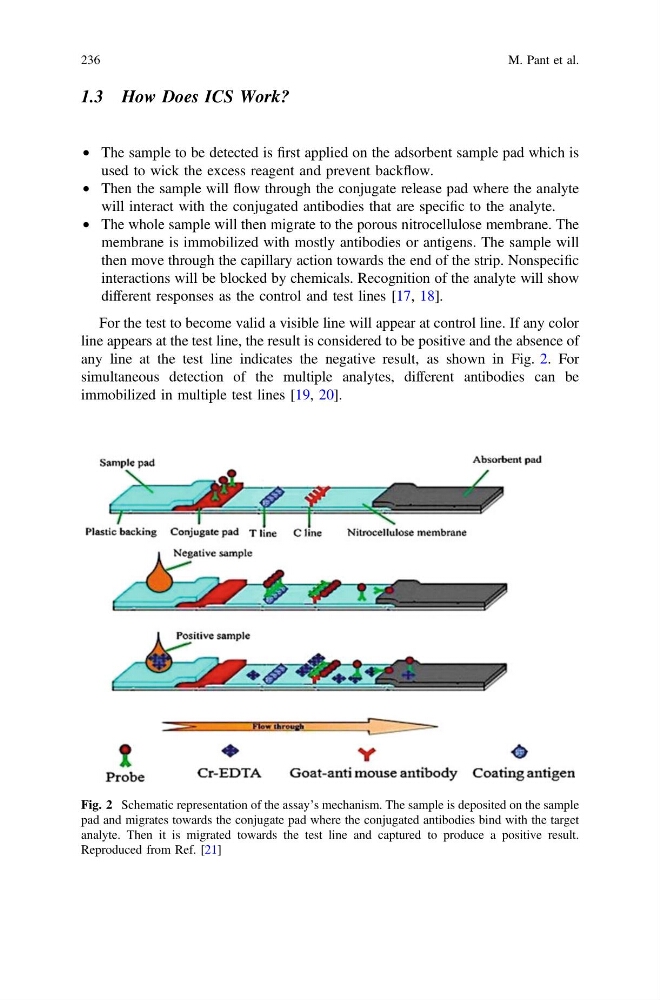
For the test to become valid a visible line will appear at control line. If any color
line appears at the test line, the result is considered to be positive and the absence of
any line at the test line indicates the negative result, as shown in Fig. 2. For
simultaneous detection of the multiple analytes, different antibodies can be
immobilized in multiple test lines [19, 20].
Fig. 2 Schematic representation of the assay’s mechanism. The sample is deposited on the sample
pad and migrates towards the conjugate pad where the conjugated antibodies bind with the target
analyte. Then it is migrated towards the test line and captured to produce a positive result.
Reproduced from Ref. [21]
236
M. Pant et al.
• The sample to be detected is first applied on the adsorbent sample pad which is
used to wick the excess reagent and prevent backflow.
• Then the sample will flow through the conjugate release pad where the analyte
will interact with the conjugated antibodies that are specific to the analyte.
• The whole sample will then migrate to the porous nitrocellulose membrane. The
membrane is immobilized with mostly antibodies or antigens. The sample will
then move through the capillary action towards the end of the strip. Nonspecific
interactions will be blocked by chemicals. Recognition of the analyte will show
different responses as the control and test lines [17, 18].
For the test to become valid a visible line will appear at control line. If any color
line appears at the test line, the result is considered to be positive and the absence of
any line at the test line indicates the negative result, as shown in Fig. 2. For
simultaneous detection of the multiple analytes, different antibodies can be
immobilized in multiple test lines [19, 20].
Fig. 2 Schematic representation of the assay’s mechanism. The sample is deposited on the sample
pad and migrates towards the conjugate pad where the conjugated antibodies bind with the target
analyte. Then it is migrated towards the test line and captured to produce a positive result.
Reproduced from Ref. [21]
236
M. Pant et al.