

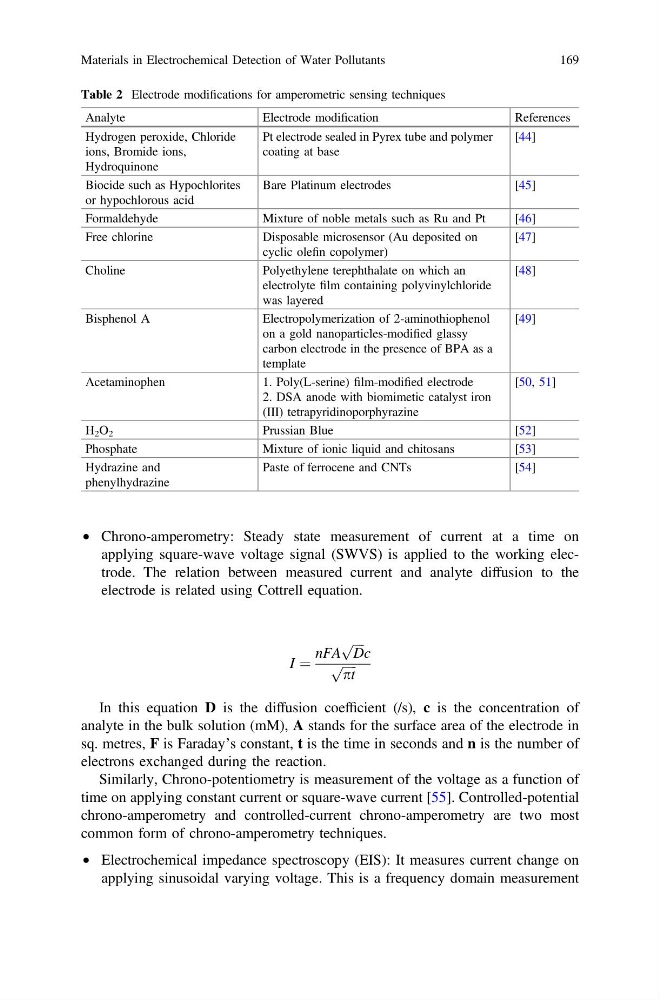
• Chrono-amperometry: Steady state measurement of current at a time on
applying square-wave voltage signal (SWVS) is applied to the working electrode. The relation between measured current and analyte diffusion to the
electrode is related using Cottrell equation.
I ¼
nFA
ffiffiffi ffi
D
p c
ffiffiffiffi ffi
pt
p
In this equation D is the diffusion coefficient (/s), c is the concentration of
analyte in the bulk solution (mM), A stands for the surface area of the electrode in
sq. metres, F is Faraday’s constant, t is the time in seconds and n is the number of
electrons exchanged during the reaction.
Similarly, Chrono-potentiometry is measurement of the voltage as a function of
time on applying constant current or square-wave current [55]. Controlled-potential
chrono-amperometry and controlled-current chrono-amperometry are two most
common form of chrono-amperometry techniques.
• Electrochemical impedance spectroscopy (EIS): It measures current change on
applying sinusoidal varying voltage. This is a frequency domain measurement
Table 2 Electrode modifications for amperometric sensing techniques
Analyte
Electrode modification
References
Hydrogen peroxide, Chloride
ions, Bromide ions,
Hydroquinone
Pt electrode sealed in Pyrex tube and polymer
coating at base
[44]
Biocide such as Hypochlorites
or hypochlorous acid
Bare Platinum electrodes
[45]
Formaldehyde
Mixture of noble metals such as Ru and Pt
[46]
Free chlorine
Disposable microsensor (Au deposited on
cyclic olefin copolymer)
[47]
Choline
Polyethylene terephthalate on which an
electrolyte film containing polyvinylchloride
was layered
[48]
Bisphenol A
Electropolymerization of 2-aminothiophenol
on a gold nanoparticles-modified glassy
carbon electrode in the presence of BPA as a
template
[49]
Acetaminophen
1. Poly(L-serine) film-modified electrode
2. DSA anode with biomimetic catalyst iron
(III) tetrapyridinoporphyrazine
[50, 51]
H 2 O 2
Prussian Blue
[52]
Phosphate
Mixture of ionic liquid and chitosans
[53]
Hydrazine and
phenylhydrazine
Paste of ferrocene and CNTs
[54]
Materials in Electrochemical Detection of Water Pollutants
169
applying square-wave voltage signal (SWVS) is applied to the working electrode. The relation between measured current and analyte diffusion to the
electrode is related using Cottrell equation.
I ¼
nFA
ffiffiffi ffi
D
p c
ffiffiffiffi ffi
pt
p
In this equation D is the diffusion coefficient (/s), c is the concentration of
analyte in the bulk solution (mM), A stands for the surface area of the electrode in
sq. metres, F is Faraday’s constant, t is the time in seconds and n is the number of
electrons exchanged during the reaction.
Similarly, Chrono-potentiometry is measurement of the voltage as a function of
time on applying constant current or square-wave current [55]. Controlled-potential
chrono-amperometry and controlled-current chrono-amperometry are two most
common form of chrono-amperometry techniques.
• Electrochemical impedance spectroscopy (EIS): It measures current change on
applying sinusoidal varying voltage. This is a frequency domain measurement
Table 2 Electrode modifications for amperometric sensing techniques
Analyte
Electrode modification
References
Hydrogen peroxide, Chloride
ions, Bromide ions,
Hydroquinone
Pt electrode sealed in Pyrex tube and polymer
coating at base
[44]
Biocide such as Hypochlorites
or hypochlorous acid
Bare Platinum electrodes
[45]
Formaldehyde
Mixture of noble metals such as Ru and Pt
[46]
Free chlorine
Disposable microsensor (Au deposited on
cyclic olefin copolymer)
[47]
Choline
Polyethylene terephthalate on which an
electrolyte film containing polyvinylchloride
was layered
[48]
Bisphenol A
Electropolymerization of 2-aminothiophenol
on a gold nanoparticles-modified glassy
carbon electrode in the presence of BPA as a
template
[49]
Acetaminophen
1. Poly(L-serine) film-modified electrode
2. DSA anode with biomimetic catalyst iron
(III) tetrapyridinoporphyrazine
[50, 51]
H 2 O 2
Prussian Blue
[52]
Phosphate
Mixture of ionic liquid and chitosans
[53]
Hydrazine and
phenylhydrazine
Paste of ferrocene and CNTs
[54]
Materials in Electrochemical Detection of Water Pollutants
169