

nitrates, heavy metal ions, anions, microplastics, polychlorobiphenyls (PCBs),
polyaromatic hydrocarbons (PAHs), pathogenic microorganisms and so on [11–13].
Water conservation measures and wastewater treatment processes are given
importance to mitigate the adverse societal impact of water pollution [14, 15]. The
quality of water is basically evaluated by measuring the universal parameters such
as pH, total dissolved solids (TDS), biochemical oxygen demand (BOD), chemical
oxygen demand (COD) and total organic carbon (TOC). The existing analytical
techniques for water quality monitoring require sophisticated laboratory, expensive
equipment with frequent maintenance, skilled personnel, laborious sampling procedures and long assay time [16]. However, there is a pressing need in the real time
monitoring of water pollutants to address the timely delivery of potable water to the
consumers. In this context, fluorescent spectroscopy is considered to be the most
dominant analytical tool due to its operational simplicity, improved sensitivity,
rapid and real-time response. Moreover, the acquisition of fluorescence spectra is
relatively straightforward and facilitates simpler detection of water pollutants from
their characteristic fluorescence fingerprint. In addition, the dissolved organic
matter (DOM) in water exhibits fluorescence which is exploited as a useful measure
to correlate well with the TOC and BOD of water samples. The corresponding
excitation-emission matrix of aromatic structures present in naturally occurring
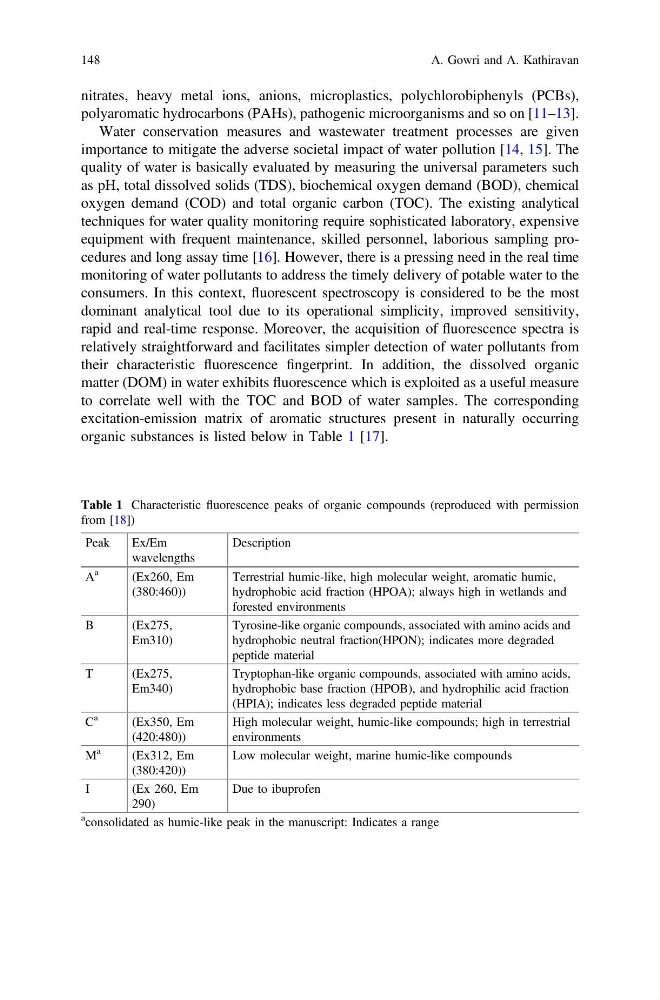
organic substances is listed below in Table 1 [17].
Table 1 Characteristic fluorescence peaks of organic compounds (reproduced with permission
from [18])
Peak
Ex/Em
wavelengths
Description
A
a
(Ex260, Em
(380:460))
Terrestrial humic-like, high molecular weight, aromatic humic,
hydrophobic acid fraction (HPOA); always high in wetlands and
forested environments
B
(Ex275,
Em310)
Tyrosine-like organic compounds, associated with amino acids and
hydrophobic neutral fraction(HPON); indicates more degraded
peptide material
T
(Ex275,
Em340)
Tryptophan-like organic compounds, associated with amino acids,
hydrophobic base fraction (HPOB), and hydrophilic acid fraction
(HPIA); indicates less degraded peptide material
C
a
(Ex350, Em
(420:480))
High molecular weight, humic-like compounds; high in terrestrial
environments
M
a
(Ex312, Em
(380:420))
Low molecular weight, marine humic-like compounds
I
(Ex 260, Em
290)
Due to ibuprofen
a consolidated as humic-like peak in the manuscript: Indicates a range
148
A. Gowri and A. Kathiravan
polyaromatic hydrocarbons (PAHs), pathogenic microorganisms and so on [11–13].
Water conservation measures and wastewater treatment processes are given
importance to mitigate the adverse societal impact of water pollution [14, 15]. The
quality of water is basically evaluated by measuring the universal parameters such
as pH, total dissolved solids (TDS), biochemical oxygen demand (BOD), chemical
oxygen demand (COD) and total organic carbon (TOC). The existing analytical
techniques for water quality monitoring require sophisticated laboratory, expensive
equipment with frequent maintenance, skilled personnel, laborious sampling procedures and long assay time [16]. However, there is a pressing need in the real time
monitoring of water pollutants to address the timely delivery of potable water to the
consumers. In this context, fluorescent spectroscopy is considered to be the most
dominant analytical tool due to its operational simplicity, improved sensitivity,
rapid and real-time response. Moreover, the acquisition of fluorescence spectra is
relatively straightforward and facilitates simpler detection of water pollutants from
their characteristic fluorescence fingerprint. In addition, the dissolved organic
matter (DOM) in water exhibits fluorescence which is exploited as a useful measure
to correlate well with the TOC and BOD of water samples. The corresponding
excitation-emission matrix of aromatic structures present in naturally occurring
organic substances is listed below in Table 1 [17].
Table 1 Characteristic fluorescence peaks of organic compounds (reproduced with permission
from [18])
Peak
Ex/Em
wavelengths
Description
A
a
(Ex260, Em
(380:460))
Terrestrial humic-like, high molecular weight, aromatic humic,
hydrophobic acid fraction (HPOA); always high in wetlands and
forested environments
B
(Ex275,
Em310)
Tyrosine-like organic compounds, associated with amino acids and
hydrophobic neutral fraction(HPON); indicates more degraded
peptide material
T
(Ex275,
Em340)
Tryptophan-like organic compounds, associated with amino acids,
hydrophobic base fraction (HPOB), and hydrophilic acid fraction
(HPIA); indicates less degraded peptide material
C
a
(Ex350, Em
(420:480))
High molecular weight, humic-like compounds; high in terrestrial
environments
M
a
(Ex312, Em
(380:420))
Low molecular weight, marine humic-like compounds
I
(Ex 260, Em
290)
Due to ibuprofen
a consolidated as humic-like peak in the manuscript: Indicates a range
148
A. Gowri and A. Kathiravan