

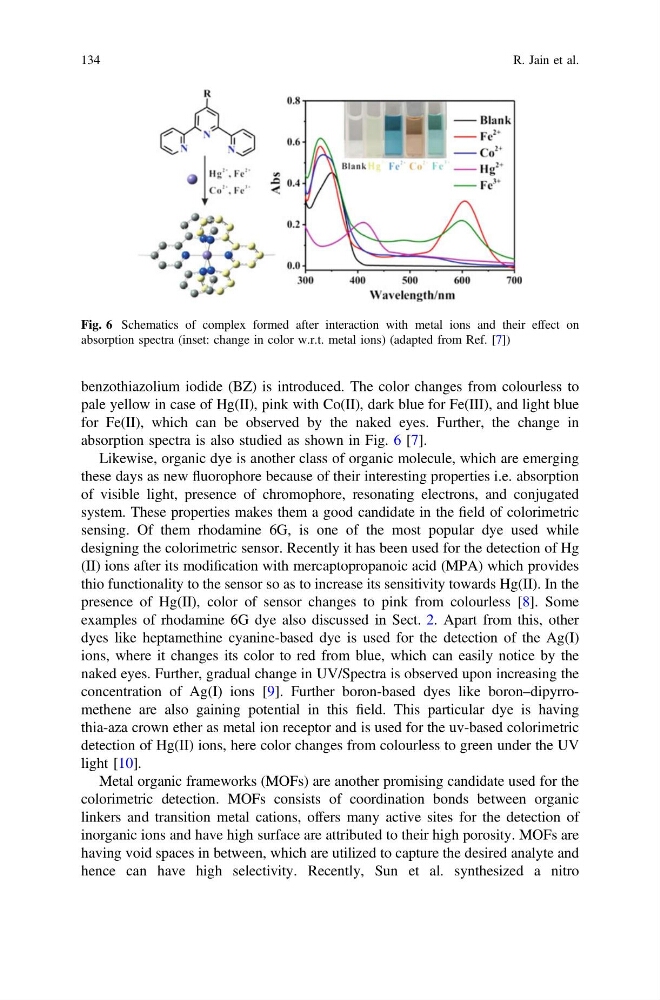
benzothiazolium iodide (BZ) is introduced. The color changes from colourless to
pale yellow in case of Hg(II), pink with Co(II), dark blue for Fe(III), and light blue
for Fe(II), which can be observed by the naked eyes. Further, the change in
absorption spectra is also studied as shown in Fig. 6 [7].
Likewise, organic dye is another class of organic molecule, which are emerging
these days as new fluorophore because of their interesting properties i.e. absorption
of visible light, presence of chromophore, resonating electrons, and conjugated
system. These properties makes them a good candidate in the field of colorimetric
sensing. Of them rhodamine 6G, is one of the most popular dye used while
designing the colorimetric sensor. Recently it has been used for the detection of Hg
(II) ions after its modification with mercaptopropanoic acid (MPA) which provides
thio functionality to the sensor so as to increase its sensitivity towards Hg(II). In the
presence of Hg(II), color of sensor changes to pink from colourless [8]. Some
examples of rhodamine 6G dye also discussed in Sect. 2. Apart from this, other
dyes like heptamethine cyanine-based dye is used for the detection of the Ag(I)
ions, where it changes its color to red from blue, which can easily notice by the
naked eyes. Further, gradual change in UV/Spectra is observed upon increasing the
concentration of Ag(I) ions [9]. Further boron-based dyes like boron–dipyrromethene are also gaining potential in this field. This particular dye is having
thia-aza crown ether as metal ion receptor and is used for the uv-based colorimetric
detection of Hg(II) ions, here color changes from colourless to green under the UV
light [10].
Metal organic frameworks (MOFs) are another promising candidate used for the
colorimetric detection. MOFs consists of coordination bonds between organic
linkers and transition metal cations, offers many active sites for the detection of
inorganic ions and have high surface are attributed to their high porosity. MOFs are
having void spaces in between, which are utilized to capture the desired analyte and
hence can have high selectivity. Recently, Sun et al. synthesized a nitro
Fig. 6 Schematics of complex formed after interaction with metal ions and their effect on
absorption spectra (inset: change in color w.r.t. metal ions) (adapted from Ref. [7])
134
R. Jain et al.
pale yellow in case of Hg(II), pink with Co(II), dark blue for Fe(III), and light blue
for Fe(II), which can be observed by the naked eyes. Further, the change in
absorption spectra is also studied as shown in Fig. 6 [7].
Likewise, organic dye is another class of organic molecule, which are emerging
these days as new fluorophore because of their interesting properties i.e. absorption
of visible light, presence of chromophore, resonating electrons, and conjugated
system. These properties makes them a good candidate in the field of colorimetric
sensing. Of them rhodamine 6G, is one of the most popular dye used while
designing the colorimetric sensor. Recently it has been used for the detection of Hg
(II) ions after its modification with mercaptopropanoic acid (MPA) which provides
thio functionality to the sensor so as to increase its sensitivity towards Hg(II). In the
presence of Hg(II), color of sensor changes to pink from colourless [8]. Some
examples of rhodamine 6G dye also discussed in Sect. 2. Apart from this, other
dyes like heptamethine cyanine-based dye is used for the detection of the Ag(I)
ions, where it changes its color to red from blue, which can easily notice by the
naked eyes. Further, gradual change in UV/Spectra is observed upon increasing the
concentration of Ag(I) ions [9]. Further boron-based dyes like boron–dipyrromethene are also gaining potential in this field. This particular dye is having
thia-aza crown ether as metal ion receptor and is used for the uv-based colorimetric
detection of Hg(II) ions, here color changes from colourless to green under the UV
light [10].
Metal organic frameworks (MOFs) are another promising candidate used for the
colorimetric detection. MOFs consists of coordination bonds between organic
linkers and transition metal cations, offers many active sites for the detection of
inorganic ions and have high surface are attributed to their high porosity. MOFs are
having void spaces in between, which are utilized to capture the desired analyte and
hence can have high selectivity. Recently, Sun et al. synthesized a nitro
Fig. 6 Schematics of complex formed after interaction with metal ions and their effect on
absorption spectra (inset: change in color w.r.t. metal ions) (adapted from Ref. [7])
134
R. Jain et al.