

property exhibits its effect, when the frequency of conducting electrons matches
with the incident electromagnetic radiations. LSPR effect is dependent upon the
morphology i.e. shape, size, and interparticle distance, composition, and optical
properties like refractive index of the nanoparticles. For example, when there is a
decrease in interparticle distance, strong overlap between plasmon fields occurs
which causes the red shift in LSPR and can result in change in intensity and
observable color change that can be noticed by naked eyes. The aggregation-based
approaches are usually simple in design in comparative to other mention approaches. In case of quantum dots, these approaches, when results in the increase of
emission intensity then refer as aggregation induced emission and decrease in
intensity refer as aggregation induced quenching.
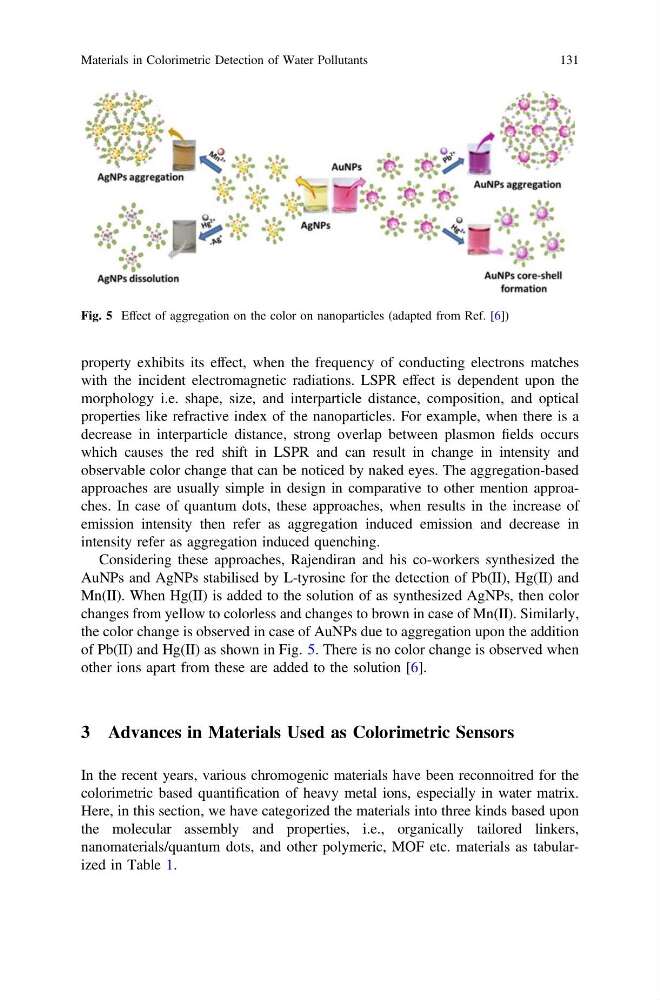
Considering these approaches, Rajendiran and his co-workers synthesized the
AuNPs and AgNPs stabilised by L-tyrosine for the detection of Pb(II), Hg(II) and
Mn(II). When Hg(II) is added to the solution of as synthesized AgNPs, then color
changes from yellow to colorless and changes to brown in case of Mn(II). Similarly,
the color change is observed in case of AuNPs due to aggregation upon the addition
of Pb(II) and Hg(II) as shown in Fig. 5. There is no color change is observed when
other ions apart from these are added to the solution [6].
3 Advances in Materials Used as Colorimetric Sensors
In the recent years, various chromogenic materials have been reconnoitred for the
colorimetric based quantification of heavy metal ions, especially in water matrix.
Here, in this section, we have categorized the materials into three kinds based upon
the molecular assembly and properties, i.e., organically tailored linkers,
nanomaterials/quantum dots, and other polymeric, MOF etc. materials as tabularized in Table 1.
Fig. 5 Effect of aggregation on the color on nanoparticles (adapted from Ref. [6])
Materials in Colorimetric Detection of Water Pollutants
131
with the incident electromagnetic radiations. LSPR effect is dependent upon the
morphology i.e. shape, size, and interparticle distance, composition, and optical
properties like refractive index of the nanoparticles. For example, when there is a
decrease in interparticle distance, strong overlap between plasmon fields occurs
which causes the red shift in LSPR and can result in change in intensity and
observable color change that can be noticed by naked eyes. The aggregation-based
approaches are usually simple in design in comparative to other mention approaches. In case of quantum dots, these approaches, when results in the increase of
emission intensity then refer as aggregation induced emission and decrease in
intensity refer as aggregation induced quenching.
Considering these approaches, Rajendiran and his co-workers synthesized the
AuNPs and AgNPs stabilised by L-tyrosine for the detection of Pb(II), Hg(II) and
Mn(II). When Hg(II) is added to the solution of as synthesized AgNPs, then color
changes from yellow to colorless and changes to brown in case of Mn(II). Similarly,
the color change is observed in case of AuNPs due to aggregation upon the addition
of Pb(II) and Hg(II) as shown in Fig. 5. There is no color change is observed when
other ions apart from these are added to the solution [6].
3 Advances in Materials Used as Colorimetric Sensors
In the recent years, various chromogenic materials have been reconnoitred for the
colorimetric based quantification of heavy metal ions, especially in water matrix.
Here, in this section, we have categorized the materials into three kinds based upon
the molecular assembly and properties, i.e., organically tailored linkers,
nanomaterials/quantum dots, and other polymeric, MOF etc. materials as tabularized in Table 1.
Fig. 5 Effect of aggregation on the color on nanoparticles (adapted from Ref. [6])
Materials in Colorimetric Detection of Water Pollutants
131