

6 Conclusions and Future Prospective
In this chapter, different plasmonic nanoparticles decorated graphene/functionalized
graphene nanocomposites for detection of water, pollutants is discussed. Three
detection techniques have been considered throughout this chapter, namely colorimetric, fluorometry, and electrochemical sensing methods. The electrochemical
detection technique possesses maximum sensitivity and detection limit is found low
in comparison with the other two methods. Compared to other sensing methods,
these three methods are very simple, easy operation, inexpensive, and no need
highly skilled manpower. As all the sensing experiments are performed in the
laboratory condition for real-time analysis, it is necessary to devise some large-scale
synthesis method to use in some device fabrication in the near future.
Acknowledgements The authors are thankful to the Director, CSIR–NEIST, Jorhat, for his
interest and support to carry out the work. The Authors are grateful to CSIR for financial support
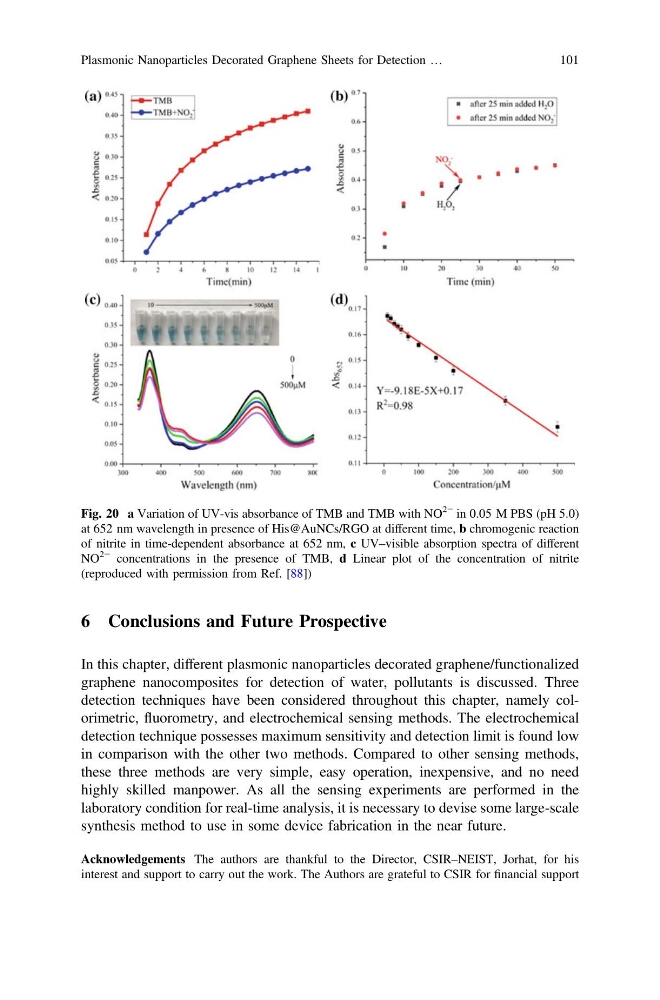
Fig. 20 a Variation of UV-vis absorbance of TMB and TMB with NO
2− in 0.05 M PBS (pH 5.0)
at 652 nm wavelength in presence of His@AuNCs/RGO at different time, b chromogenic reaction
of nitrite in time-dependent absorbance at 652 nm, c UV–visible absorption spectra of different
NO
2− concentrations in the presence of TMB, d Linear plot of the concentration of nitrite
(reproduced with permission from Ref. [88])
Plasmonic Nanoparticles Decorated Graphene Sheets for Detection …
101
In this chapter, different plasmonic nanoparticles decorated graphene/functionalized
graphene nanocomposites for detection of water, pollutants is discussed. Three
detection techniques have been considered throughout this chapter, namely colorimetric, fluorometry, and electrochemical sensing methods. The electrochemical
detection technique possesses maximum sensitivity and detection limit is found low
in comparison with the other two methods. Compared to other sensing methods,
these three methods are very simple, easy operation, inexpensive, and no need
highly skilled manpower. As all the sensing experiments are performed in the
laboratory condition for real-time analysis, it is necessary to devise some large-scale
synthesis method to use in some device fabrication in the near future.
Acknowledgements The authors are thankful to the Director, CSIR–NEIST, Jorhat, for his
interest and support to carry out the work. The Authors are grateful to CSIR for financial support
Fig. 20 a Variation of UV-vis absorbance of TMB and TMB with NO
2− in 0.05 M PBS (pH 5.0)
at 652 nm wavelength in presence of His@AuNCs/RGO at different time, b chromogenic reaction
of nitrite in time-dependent absorbance at 652 nm, c UV–visible absorption spectra of different
NO
2− concentrations in the presence of TMB, d Linear plot of the concentration of nitrite
(reproduced with permission from Ref. [88])
Plasmonic Nanoparticles Decorated Graphene Sheets for Detection …
101