

77
participants aimed to decrease the rate of carbon dioxide emissions to the environment to control the warming up of the earth’s surface. They targeted that the average
temperature of the earth’s surface should rise to 2 °C instead of 5 °C, by the end of
this century (Anwara et al. 2018).
The sources of the emissions of carbon dioxide can be classified as natural and
anthropogenic. As the carbon dioxide is the most important gas in comparing with
the greenhouse gases, extensive research works had been achieved in the fields of
developing the transformation reactions of carbon dioxide, in addition to its capture
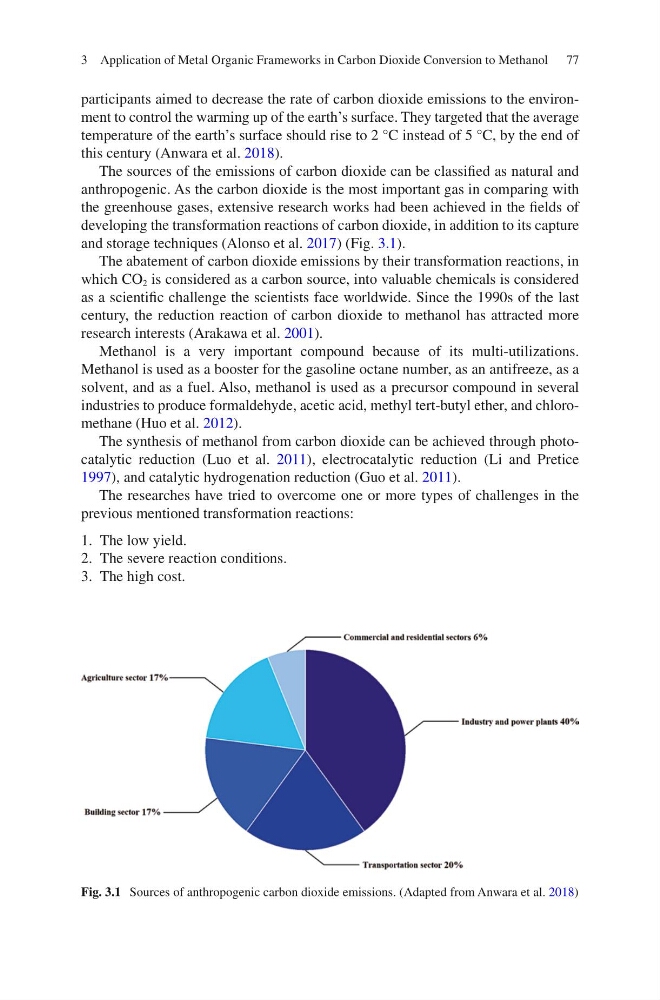
and storage techniques (Alonso et al. 2017) (Fig. 3.1).
The abatement of carbon dioxide emissions by their transformation reactions, in
which CO 2 is considered as a carbon source, into valuable chemicals is considered
as a scientific challenge the scientists face worldwide. Since the 1990s of the last
century, the reduction reaction of carbon dioxide to methanol has attracted more
research interests (Arakawa et al. 2001).
Methanol is a very important compound because of its multi-utilizations.
Methanol is used as a booster for the gasoline octane number, as an antifreeze, as a
solvent, and as a fuel. Also, methanol is used as a precursor compound in several
industries to produce formaldehyde, acetic acid, methyl tert-butyl ether, and chloromethane (Huo et al. 2012).
The synthesis of methanol from carbon dioxide can be achieved through photocatalytic reduction (Luo et al. 2011), electrocatalytic reduction (Li and Pretice
1997), and catalytic hydrogenation reduction (Guo et al. 2011).
The researches have tried to overcome one or more types of challenges in the
previous mentioned transformation reactions:
1. The low yield.
2. The severe reaction conditions.
3. The high cost.
Fig. 3.1 Sources of anthropogenic carbon dioxide emissions. (Adapted from Anwara et al. 2018)
3 Application of Metal Organic Frameworks in Carbon Dioxide Conversion to Methanol
participants aimed to decrease the rate of carbon dioxide emissions to the environment to control the warming up of the earth’s surface. They targeted that the average
temperature of the earth’s surface should rise to 2 °C instead of 5 °C, by the end of
this century (Anwara et al. 2018).
The sources of the emissions of carbon dioxide can be classified as natural and
anthropogenic. As the carbon dioxide is the most important gas in comparing with
the greenhouse gases, extensive research works had been achieved in the fields of
developing the transformation reactions of carbon dioxide, in addition to its capture
and storage techniques (Alonso et al. 2017) (Fig. 3.1).
The abatement of carbon dioxide emissions by their transformation reactions, in
which CO 2 is considered as a carbon source, into valuable chemicals is considered
as a scientific challenge the scientists face worldwide. Since the 1990s of the last
century, the reduction reaction of carbon dioxide to methanol has attracted more
research interests (Arakawa et al. 2001).
Methanol is a very important compound because of its multi-utilizations.
Methanol is used as a booster for the gasoline octane number, as an antifreeze, as a
solvent, and as a fuel. Also, methanol is used as a precursor compound in several
industries to produce formaldehyde, acetic acid, methyl tert-butyl ether, and chloromethane (Huo et al. 2012).
The synthesis of methanol from carbon dioxide can be achieved through photocatalytic reduction (Luo et al. 2011), electrocatalytic reduction (Li and Pretice
1997), and catalytic hydrogenation reduction (Guo et al. 2011).
The researches have tried to overcome one or more types of challenges in the
previous mentioned transformation reactions:
1. The low yield.
2. The severe reaction conditions.
3. The high cost.
Fig. 3.1 Sources of anthropogenic carbon dioxide emissions. (Adapted from Anwara et al. 2018)
3 Application of Metal Organic Frameworks in Carbon Dioxide Conversion to Methanol