

23
silence a native laccase (encoded by slr1573) that oxidizes polyphenols. Cells were
grown in BG11 medium added with 5 mM of glucose for 7 days with an extracellular p-CA accumulation of 0.5 mM (82 g/L). In Ni et al. (2016), the host selected
to produce p-CA was Synechococcus elongatus PCC7942. The tyrosine ammonia
lyase (encoded by sam8) from Saccharothrix espanaensis was introduced in the
photosynthetic microorganism under the IPTG-inducible promoter. 3-Deoxy-Darabino-heptulosonate-7-phosphate synthase (DAHPS) is tightly regulated by transcriptional repression since it regulates the carbon flux into the shikimate pathway.
Since this pathway leads to the production of aromatic compounds, Ni et al. (2016)
optimized their mutant by expressing a feedback-inhibition-resistant DAHPS (fbrDAHPS) to enhance the amount of tyrosine needed to synthesize p-CA. The
Synechococcus elongatus PCC 7942 mutant showed a production level of p-CA up
to 0.73 mM (121.7 mg/L) in 12 days of culture. In Matsusaki et al. (2001), p-CA
was used as a monomer in combination with D,L-lactic acid (20:80) to produce a
biocompatible copolymer with potential application in drug delivery and production
of orthopedic materials. Conversely, in Kaneko et al. (2004), p-CA was used to
produce liquid-crystalline homopolymer completely compatible with cell viability.
3,4-Dihydroxycinnamic Acid
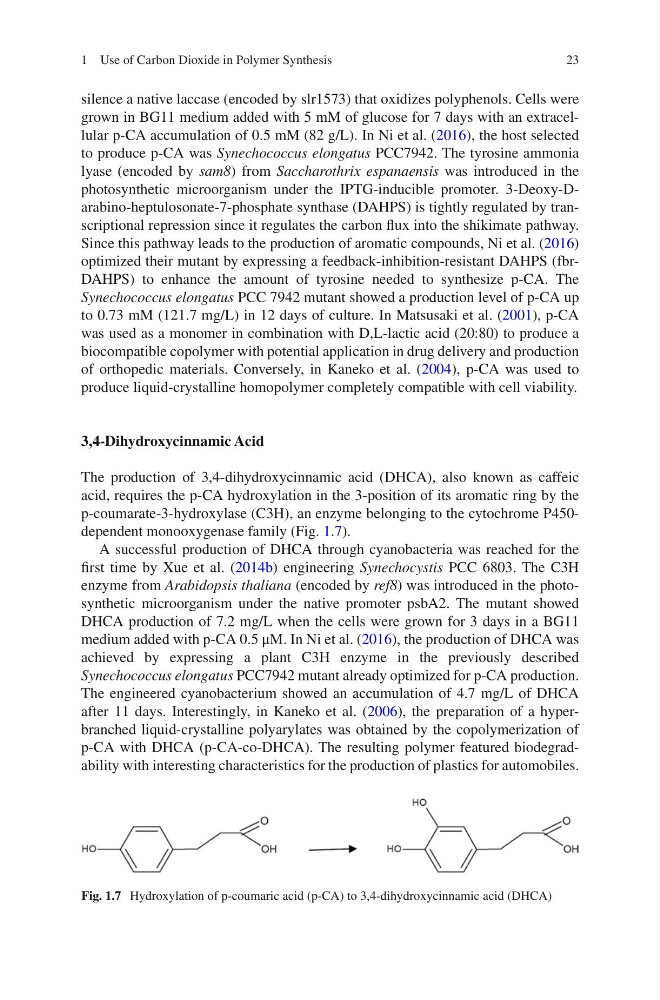
The production of 3,4-dihydroxycinnamic acid (DHCA), also known as caffeic
acid, requires the p-CA hydroxylation in the 3-position of its aromatic ring by the
p-coumarate-3-hydroxylase (C3H), an enzyme belonging to the cytochrome P450dependent monooxygenase family (Fig. 1.7).
A successful production of DHCA through cyanobacteria was reached for the
first time by Xue et al. (2014b) engineering Synechocystis PCC 6803. The C3H
enzyme from Arabidopsis thaliana (encoded by ref8) was introduced in the photosynthetic microorganism under the native promoter psbA2. The mutant showed
DHCA production of 7.2 mg/L when the cells were grown for 3 days in a BG11
medium added with p-CA 0.5 μM. In Ni et al. (2016), the production of DHCA was
achieved by expressing a plant C3H enzyme in the previously described
Synechococcus elongatus PCC7942 mutant already optimized for p-CA production.
The engineered cyanobacterium showed an accumulation of 4.7 mg/L of DHCA
after 11 days. Interestingly, in Kaneko et al. (2006), the preparation of a hyperbranched liquid-crystalline polyarylates was obtained by the copolymerization of
p-CA with DHCA (p-CA-co-DHCA). The resulting polymer featured biodegradability with interesting characteristics for the production of plastics for automobiles.
Fig. 1.7 Hydroxylation of p-coumaric acid (p-CA) to 3,4-dihydroxycinnamic acid (DHCA)
1 Use of Carbon Dioxide in Polymer Synthesis
silence a native laccase (encoded by slr1573) that oxidizes polyphenols. Cells were
grown in BG11 medium added with 5 mM of glucose for 7 days with an extracellular p-CA accumulation of 0.5 mM (82 g/L). In Ni et al. (2016), the host selected
to produce p-CA was Synechococcus elongatus PCC7942. The tyrosine ammonia
lyase (encoded by sam8) from Saccharothrix espanaensis was introduced in the
photosynthetic microorganism under the IPTG-inducible promoter. 3-Deoxy-Darabino-heptulosonate-7-phosphate synthase (DAHPS) is tightly regulated by transcriptional repression since it regulates the carbon flux into the shikimate pathway.
Since this pathway leads to the production of aromatic compounds, Ni et al. (2016)
optimized their mutant by expressing a feedback-inhibition-resistant DAHPS (fbrDAHPS) to enhance the amount of tyrosine needed to synthesize p-CA. The
Synechococcus elongatus PCC 7942 mutant showed a production level of p-CA up
to 0.73 mM (121.7 mg/L) in 12 days of culture. In Matsusaki et al. (2001), p-CA
was used as a monomer in combination with D,L-lactic acid (20:80) to produce a
biocompatible copolymer with potential application in drug delivery and production
of orthopedic materials. Conversely, in Kaneko et al. (2004), p-CA was used to
produce liquid-crystalline homopolymer completely compatible with cell viability.
3,4-Dihydroxycinnamic Acid
The production of 3,4-dihydroxycinnamic acid (DHCA), also known as caffeic
acid, requires the p-CA hydroxylation in the 3-position of its aromatic ring by the
p-coumarate-3-hydroxylase (C3H), an enzyme belonging to the cytochrome P450dependent monooxygenase family (Fig. 1.7).
A successful production of DHCA through cyanobacteria was reached for the
first time by Xue et al. (2014b) engineering Synechocystis PCC 6803. The C3H
enzyme from Arabidopsis thaliana (encoded by ref8) was introduced in the photosynthetic microorganism under the native promoter psbA2. The mutant showed
DHCA production of 7.2 mg/L when the cells were grown for 3 days in a BG11
medium added with p-CA 0.5 μM. In Ni et al. (2016), the production of DHCA was
achieved by expressing a plant C3H enzyme in the previously described
Synechococcus elongatus PCC7942 mutant already optimized for p-CA production.
The engineered cyanobacterium showed an accumulation of 4.7 mg/L of DHCA
after 11 days. Interestingly, in Kaneko et al. (2006), the preparation of a hyperbranched liquid-crystalline polyarylates was obtained by the copolymerization of
p-CA with DHCA (p-CA-co-DHCA). The resulting polymer featured biodegradability with interesting characteristics for the production of plastics for automobiles.
Fig. 1.7 Hydroxylation of p-coumaric acid (p-CA) to 3,4-dihydroxycinnamic acid (DHCA)
1 Use of Carbon Dioxide in Polymer Synthesis