

173
incident light (Ghosh and Pal 2007). By dispersing in nanometer size scale, these
nanoparticles exhibit a considerable improvement in photocatalytic performance
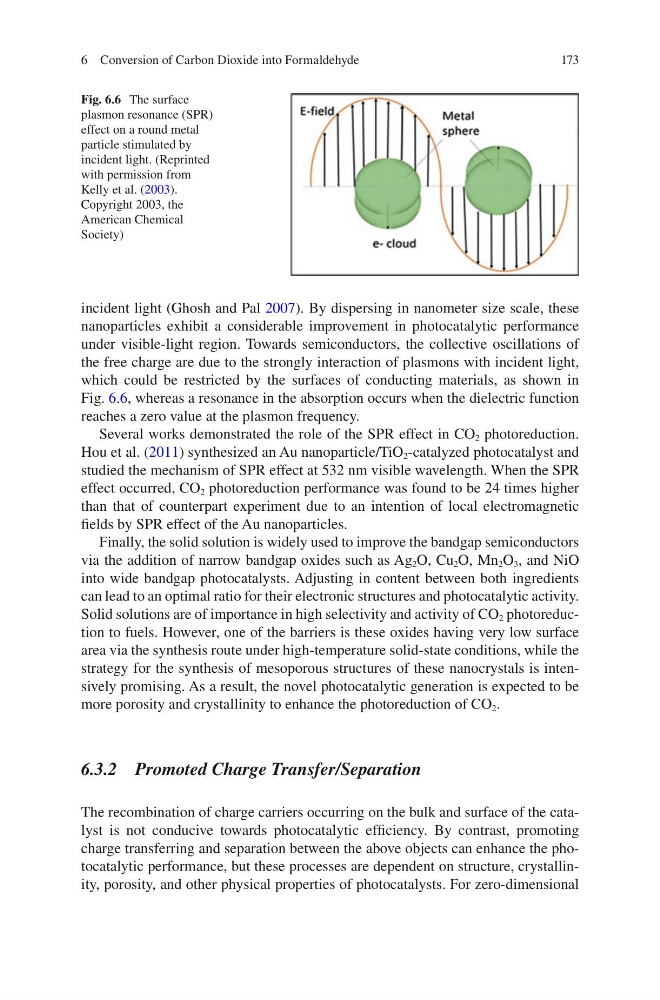
under visible-light region. Towards semiconductors, the collective oscillations of
the free charge are due to the strongly interaction of plasmons with incident light,
which could be restricted by the surfaces of conducting materials, as shown in
Fig. 6.6, whereas a resonance in the absorption occurs when the dielectric function
reaches a zero value at the plasmon frequency.
Several works demonstrated the role of the SPR effect in CO 2 photoreduction.
Hou et al. (2011) synthesized an Au nanoparticle/TiO 2 -catalyzed photocatalyst and
studied the mechanism of SPR effect at 532 nm visible wavelength. When the SPR
effect occurred, CO 2 photoreduction performance was found to be 24 times higher
than that of counterpart experiment due to an intention of local electromagnetic
fields by SPR effect of the Au nanoparticles.
Finally, the solid solution is widely used to improve the bandgap semiconductors
via the addition of narrow bandgap oxides such as Ag 2 O, Cu 2 O, Mn 2 O 3 , and NiO
into wide bandgap photocatalysts. Adjusting in content between both ingredients
can lead to an optimal ratio for their electronic structures and photocatalytic activity.
Solid solutions are of importance in high selectivity and activity of CO 2 photoreduction to fuels. However, one of the barriers is these oxides having very low surface
area via the synthesis route under high-temperature solid-state conditions, while the
strategy for the synthesis of mesoporous structures of these nanocrystals is intensively promising. As a result, the novel photocatalytic generation is expected to be
more porosity and crystallinity to enhance the photoreduction of CO 2 .
6.3.2 Promoted Charge Transfer/Separation
The recombination of charge carriers occurring on the bulk and surface of the catalyst is not conducive towards photocatalytic efficiency. By contrast, promoting
charge transferring and separation between the above objects can enhance the photocatalytic performance, but these processes are dependent on structure, crystallinity, porosity, and other physical properties of photocatalysts. For zero-dimensional
Fig. 6.6 The surface
plasmon resonance (SPR)
effect on a round metal
particle stimulated by
incident light. (Reprinted
with permission from
Kelly et al. (2003).
Copyright 2003, the
American Chemical
Society)
6 Conversion of Carbon Dioxide into Formaldehyde
incident light (Ghosh and Pal 2007). By dispersing in nanometer size scale, these
nanoparticles exhibit a considerable improvement in photocatalytic performance
under visible-light region. Towards semiconductors, the collective oscillations of
the free charge are due to the strongly interaction of plasmons with incident light,
which could be restricted by the surfaces of conducting materials, as shown in
Fig. 6.6, whereas a resonance in the absorption occurs when the dielectric function
reaches a zero value at the plasmon frequency.
Several works demonstrated the role of the SPR effect in CO 2 photoreduction.
Hou et al. (2011) synthesized an Au nanoparticle/TiO 2 -catalyzed photocatalyst and
studied the mechanism of SPR effect at 532 nm visible wavelength. When the SPR
effect occurred, CO 2 photoreduction performance was found to be 24 times higher
than that of counterpart experiment due to an intention of local electromagnetic
fields by SPR effect of the Au nanoparticles.
Finally, the solid solution is widely used to improve the bandgap semiconductors
via the addition of narrow bandgap oxides such as Ag 2 O, Cu 2 O, Mn 2 O 3 , and NiO
into wide bandgap photocatalysts. Adjusting in content between both ingredients
can lead to an optimal ratio for their electronic structures and photocatalytic activity.
Solid solutions are of importance in high selectivity and activity of CO 2 photoreduction to fuels. However, one of the barriers is these oxides having very low surface
area via the synthesis route under high-temperature solid-state conditions, while the
strategy for the synthesis of mesoporous structures of these nanocrystals is intensively promising. As a result, the novel photocatalytic generation is expected to be
more porosity and crystallinity to enhance the photoreduction of CO 2 .
6.3.2 Promoted Charge Transfer/Separation
The recombination of charge carriers occurring on the bulk and surface of the catalyst is not conducive towards photocatalytic efficiency. By contrast, promoting
charge transferring and separation between the above objects can enhance the photocatalytic performance, but these processes are dependent on structure, crystallinity, porosity, and other physical properties of photocatalysts. For zero-dimensional
Fig. 6.6 The surface
plasmon resonance (SPR)
effect on a round metal
particle stimulated by
incident light. (Reprinted
with permission from
Kelly et al. (2003).
Copyright 2003, the
American Chemical
Society)
6 Conversion of Carbon Dioxide into Formaldehyde