

170
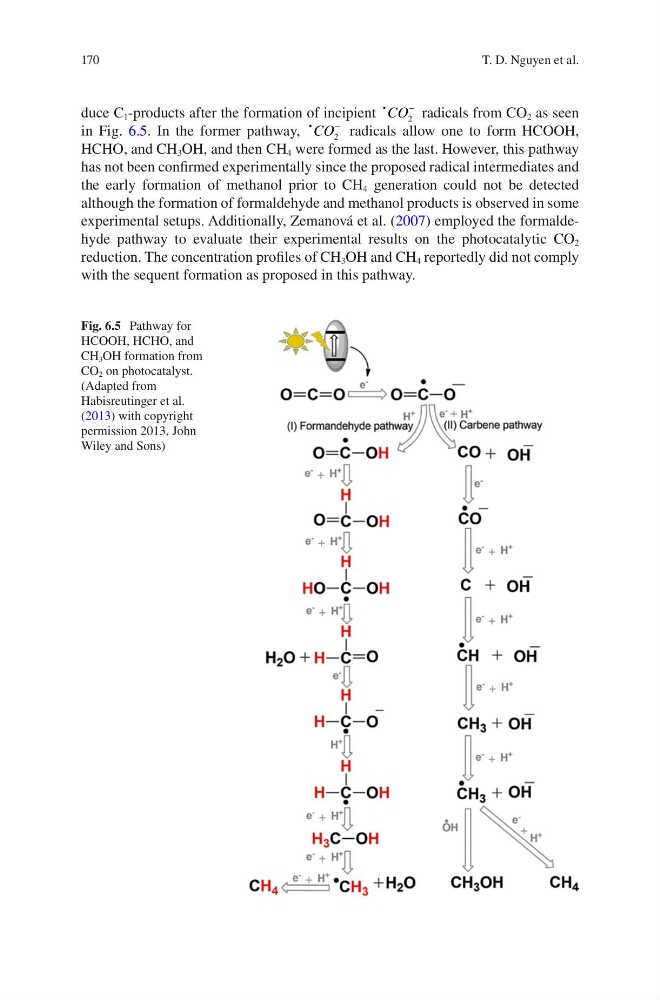
duce C 1 -products after the formation of incipient
• CO 2
− radicals from CO 2 as seen
in Fig. 6.5. In the former pathway,
• CO 2
− radicals allow one to form HCOOH,
HCHO, and CH 3 OH, and then CH 4 were formed as the last. However, this pathway
has not been confirmed experimentally since the proposed radical intermediates and
the early formation of methanol prior to CH 4 generation could not be detected
although the formation of formaldehyde and methanol products is observed in some
experimental setups. Additionally, Zemanová et al. (2007) employed the formaldehyde pathway to evaluate their experimental results on the photocatalytic CO 2
reduction. The concentration profiles of CH 3 OH and CH 4 reportedly did not comply
with the sequent formation as proposed in this pathway.
Fig. 6.5 Pathway for
HCOOH, HCHO, and
CH 3 OH formation from
CO 2 on photocatalyst.
(Adapted from
Habisreutinger et al.
(2013) with copyright
permission 2013, John
Wiley and Sons)
T. D. Nguyen et al.
duce C 1 -products after the formation of incipient
• CO 2
− radicals from CO 2 as seen
in Fig. 6.5. In the former pathway,
• CO 2
− radicals allow one to form HCOOH,
HCHO, and CH 3 OH, and then CH 4 were formed as the last. However, this pathway
has not been confirmed experimentally since the proposed radical intermediates and
the early formation of methanol prior to CH 4 generation could not be detected
although the formation of formaldehyde and methanol products is observed in some
experimental setups. Additionally, Zemanová et al. (2007) employed the formaldehyde pathway to evaluate their experimental results on the photocatalytic CO 2
reduction. The concentration profiles of CH 3 OH and CH 4 reportedly did not comply
with the sequent formation as proposed in this pathway.
Fig. 6.5 Pathway for
HCOOH, HCHO, and
CH 3 OH formation from
CO 2 on photocatalyst.
(Adapted from
Habisreutinger et al.
(2013) with copyright
permission 2013, John
Wiley and Sons)
T. D. Nguyen et al.