

165
efficiency and selectivity of these products rely on both properties of the photocatalysts and the actual operating conditions.
In terms of photocatalytic CO 2 reduction, when the surface of a semiconductor
absorbs a photon that has equal or greater energy than its bandgap energy (E g ), its
electron (e
−
) in the valence band will be excited to the conduction band, and then the
photoexcited electrons react with CO 2 to produce fuel. The thermodynamics of
these processes could be considered in terms of environmental conditions such as
light, pH, and temperature as well as properties of the photocatalyst, which was
analyzed by Shehzad et al. (2018). Although increasing temperature can improve
the rate of product desorption and the resulting yield, it does not enhance the generation of charge carriers, which depend on both ΔG that is provided under light
irradiations and the valence band and conduction band of the photocatalyst.
Generally, the valence band and conduction band potentials of photocatalysts are
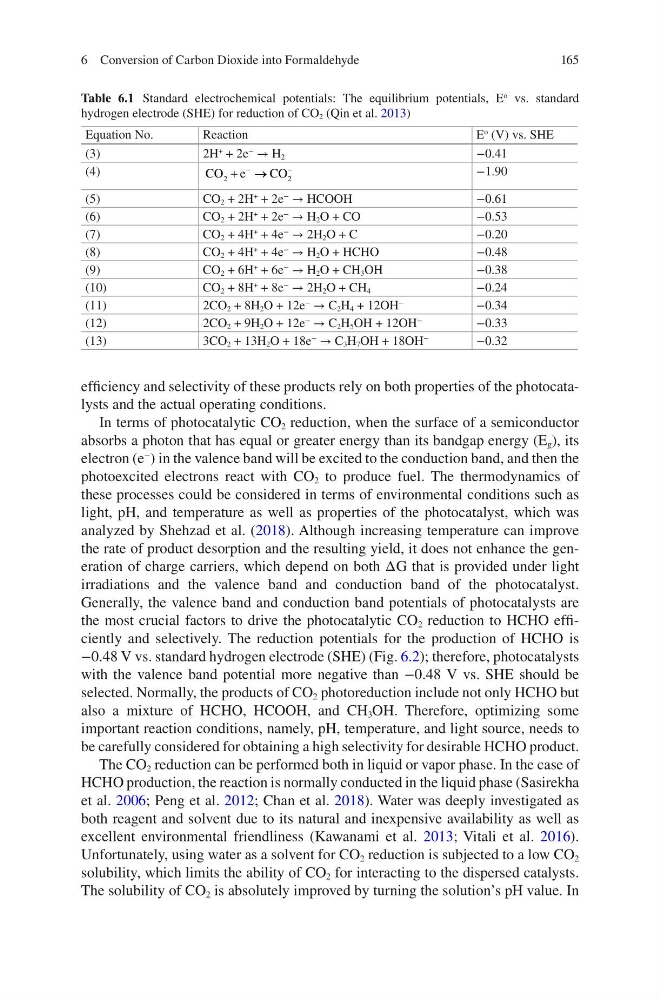
the most crucial factors to drive the photocatalytic CO 2 reduction to HCHO efficiently and selectively. The reduction potentials for the production of HCHO is
−0.48 V vs. standard hydrogen electrode (SHE) (Fig. 6.2); therefore, photocatalysts
with the valence band potential more negative than −0.48 V vs. SHE should be
selected. Normally, the products of CO 2 photoreduction include not only HCHO but
also a mixture of HCHO, HCOOH, and CH 3 OH. Therefore, optimizing some
important reaction conditions, namely, pH, temperature, and light source, needs to
be carefully considered for obtaining a high selectivity for desirable HCHO product.
The CO 2 reduction can be performed both in liquid or vapor phase. In the case of
HCHO production, the reaction is normally conducted in the liquid phase (Sasirekha
et al. 2006; Peng et al. 2012; Chan et al. 2018). Water was deeply investigated as
both reagent and solvent due to its natural and inexpensive availability as well as
excellent environmental friendliness (Kawanami et al. 2013; Vitali et al. 2016).
Unfortunately, using water as a solvent for CO 2 reduction is subjected to a low CO 2
solubility, which limits the ability of CO 2 for interacting to the dispersed catalysts.
The solubility of CO 2 is absolutely improved by turning the solution’s pH value. In
Table 6.1 Standard electrochemical potentials: The equilibrium potentials, E
o vs. standard
hydrogen electrode (SHE) for reduction of CO 2 (Qin et al. 2013)
Equation No.
Reaction
E
o (V) vs. SHE
(3)
2H
+ + 2e
−
→ H 2
−0.41
(4)
CO e
CO
2
2
+ →
−
−
−1.90
(5)
CO 2 + 2H
+
+ 2e
−
→ HCOOH
−0.61
(6)
CO 2 + 2H
+
+ 2e
−
→ H 2 O + CO
−0.53
(7)
CO 2 + 4H
+
+ 4e
−
→ 2H 2 O + C
−0.20
(8)
CO 2 + 4H
+
+ 4e
−
→ H 2 O + HCHO
−0.48
(9)
CO 2 + 6H
+
+ 6e
−
→ H 2 O + CH 3 OH
−0.38
(10)
CO 2 + 8H
+
+ 8e
−
→ 2H 2 O + CH 4
−0.24
(11)
2CO 2 + 8H 2 O + 12e
−
→ C 2 H 4 + 12OH
−
−0.34
(12)
2CO 2 + 9H 2 O + 12e
−
→ C 2 H 5 OH + 12OH
−
−0.33
(13)
3CO 2 + 13H 2 O + 18e
−
→ C 3 H 7 OH + 18OH
−
−0.32
6 Conversion of Carbon Dioxide into Formaldehyde
efficiency and selectivity of these products rely on both properties of the photocatalysts and the actual operating conditions.
In terms of photocatalytic CO 2 reduction, when the surface of a semiconductor
absorbs a photon that has equal or greater energy than its bandgap energy (E g ), its
electron (e
−
) in the valence band will be excited to the conduction band, and then the
photoexcited electrons react with CO 2 to produce fuel. The thermodynamics of
these processes could be considered in terms of environmental conditions such as
light, pH, and temperature as well as properties of the photocatalyst, which was
analyzed by Shehzad et al. (2018). Although increasing temperature can improve
the rate of product desorption and the resulting yield, it does not enhance the generation of charge carriers, which depend on both ΔG that is provided under light
irradiations and the valence band and conduction band of the photocatalyst.
Generally, the valence band and conduction band potentials of photocatalysts are
the most crucial factors to drive the photocatalytic CO 2 reduction to HCHO efficiently and selectively. The reduction potentials for the production of HCHO is
−0.48 V vs. standard hydrogen electrode (SHE) (Fig. 6.2); therefore, photocatalysts
with the valence band potential more negative than −0.48 V vs. SHE should be
selected. Normally, the products of CO 2 photoreduction include not only HCHO but
also a mixture of HCHO, HCOOH, and CH 3 OH. Therefore, optimizing some
important reaction conditions, namely, pH, temperature, and light source, needs to
be carefully considered for obtaining a high selectivity for desirable HCHO product.
The CO 2 reduction can be performed both in liquid or vapor phase. In the case of
HCHO production, the reaction is normally conducted in the liquid phase (Sasirekha
et al. 2006; Peng et al. 2012; Chan et al. 2018). Water was deeply investigated as
both reagent and solvent due to its natural and inexpensive availability as well as
excellent environmental friendliness (Kawanami et al. 2013; Vitali et al. 2016).
Unfortunately, using water as a solvent for CO 2 reduction is subjected to a low CO 2
solubility, which limits the ability of CO 2 for interacting to the dispersed catalysts.
The solubility of CO 2 is absolutely improved by turning the solution’s pH value. In
Table 6.1 Standard electrochemical potentials: The equilibrium potentials, E
o vs. standard
hydrogen electrode (SHE) for reduction of CO 2 (Qin et al. 2013)
Equation No.
Reaction
E
o (V) vs. SHE
(3)
2H
+ + 2e
−
→ H 2
−0.41
(4)
CO e
CO
2
2
+ →
−
−
−1.90
(5)
CO 2 + 2H
+
+ 2e
−
→ HCOOH
−0.61
(6)
CO 2 + 2H
+
+ 2e
−
→ H 2 O + CO
−0.53
(7)
CO 2 + 4H
+
+ 4e
−
→ 2H 2 O + C
−0.20
(8)
CO 2 + 4H
+
+ 4e
−
→ H 2 O + HCHO
−0.48
(9)
CO 2 + 6H
+
+ 6e
−
→ H 2 O + CH 3 OH
−0.38
(10)
CO 2 + 8H
+
+ 8e
−
→ 2H 2 O + CH 4
−0.24
(11)
2CO 2 + 8H 2 O + 12e
−
→ C 2 H 4 + 12OH
−
−0.34
(12)
2CO 2 + 9H 2 O + 12e
−
→ C 2 H 5 OH + 12OH
−
−0.33
(13)
3CO 2 + 13H 2 O + 18e
−
→ C 3 H 7 OH + 18OH
−
−0.32
6 Conversion of Carbon Dioxide into Formaldehyde