

123
5.3.2 Other Transition Metal-Based Catalysts for Carbon
Dioxide Hydrogenation in the Gas Phase
Besides copper, other metals were also used in the catalysis of carbon dioxide
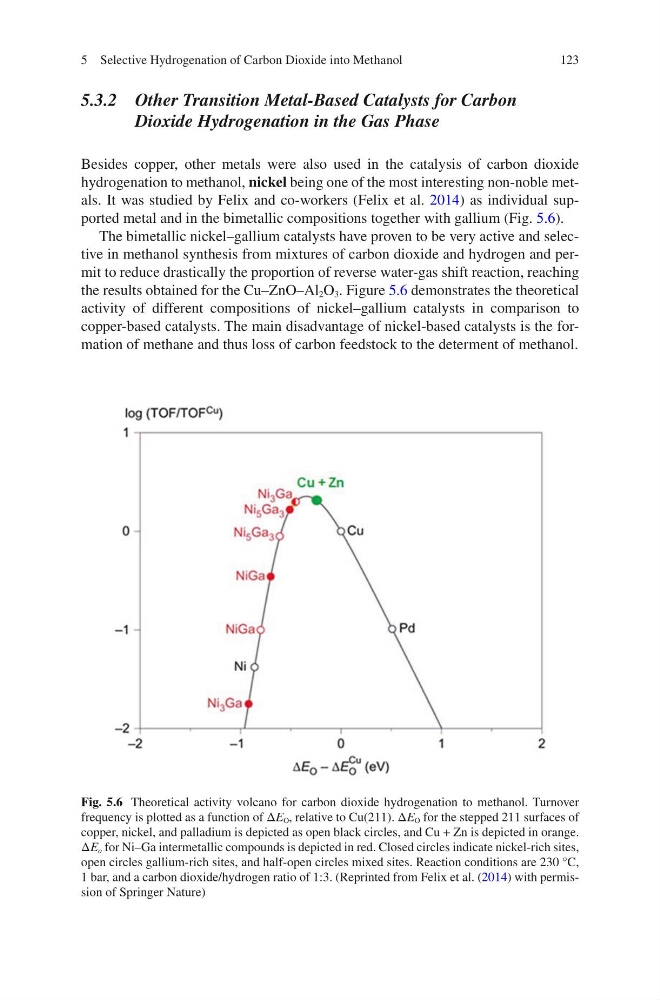
hydrogenation to methanol, nickel being one of the most interesting non-noble metals. It was studied by Felix and co-workers (Felix et al. 2014) as individual supported metal and in the bimetallic compositions together with gallium (Fig. 5.6).
The bimetallic nickel–gallium catalysts have proven to be very active and selective in methanol synthesis from mixtures of carbon dioxide and hydrogen and permit to reduce drastically the proportion of reverse water-gas shift reaction, reaching
the results obtained for the Cu–ZnO–Al 2 O 3 . Figure 5.6 demonstrates the theoretical
activity of different compositions of nickel–gallium catalysts in comparison to
copper- based catalysts. The main disadvantage of nickel-based catalysts is the formation of methane and thus loss of carbon feedstock to the determent of methanol.
Fig. 5.6 Theoretical activity volcano for carbon dioxide hydrogenation to methanol. Turnover
frequency is plotted as a function of ΔE O , relative to Cu(211). ΔE O for the stepped 211 surfaces of
copper, nickel, and palladium is depicted as open black circles, and Cu + Zn is depicted in orange.
ΔE o for Ni–Ga intermetallic compounds is depicted in red. Closed circles indicate nickel-rich sites,
open circles gallium-rich sites, and half-open circles mixed sites. Reaction conditions are 230 °C,
1 bar, and a carbon dioxide/hydrogen ratio of 1:3. (Reprinted from Felix et al. (2014) with permission of Springer Nature)
5 Selective Hydrogenation of Carbon Dioxide into Methanol
5.3.2 Other Transition Metal-Based Catalysts for Carbon
Dioxide Hydrogenation in the Gas Phase
Besides copper, other metals were also used in the catalysis of carbon dioxide
hydrogenation to methanol, nickel being one of the most interesting non-noble metals. It was studied by Felix and co-workers (Felix et al. 2014) as individual supported metal and in the bimetallic compositions together with gallium (Fig. 5.6).
The bimetallic nickel–gallium catalysts have proven to be very active and selective in methanol synthesis from mixtures of carbon dioxide and hydrogen and permit to reduce drastically the proportion of reverse water-gas shift reaction, reaching
the results obtained for the Cu–ZnO–Al 2 O 3 . Figure 5.6 demonstrates the theoretical
activity of different compositions of nickel–gallium catalysts in comparison to
copper- based catalysts. The main disadvantage of nickel-based catalysts is the formation of methane and thus loss of carbon feedstock to the determent of methanol.
Fig. 5.6 Theoretical activity volcano for carbon dioxide hydrogenation to methanol. Turnover
frequency is plotted as a function of ΔE O , relative to Cu(211). ΔE O for the stepped 211 surfaces of
copper, nickel, and palladium is depicted as open black circles, and Cu + Zn is depicted in orange.
ΔE o for Ni–Ga intermetallic compounds is depicted in red. Closed circles indicate nickel-rich sites,
open circles gallium-rich sites, and half-open circles mixed sites. Reaction conditions are 230 °C,
1 bar, and a carbon dioxide/hydrogen ratio of 1:3. (Reprinted from Felix et al. (2014) with permission of Springer Nature)
5 Selective Hydrogenation of Carbon Dioxide into Methanol