

relationships are also observable for geo- and biopolymers such as lignin, suberin,
algaenan or cutan (see also Fig. 4.51).
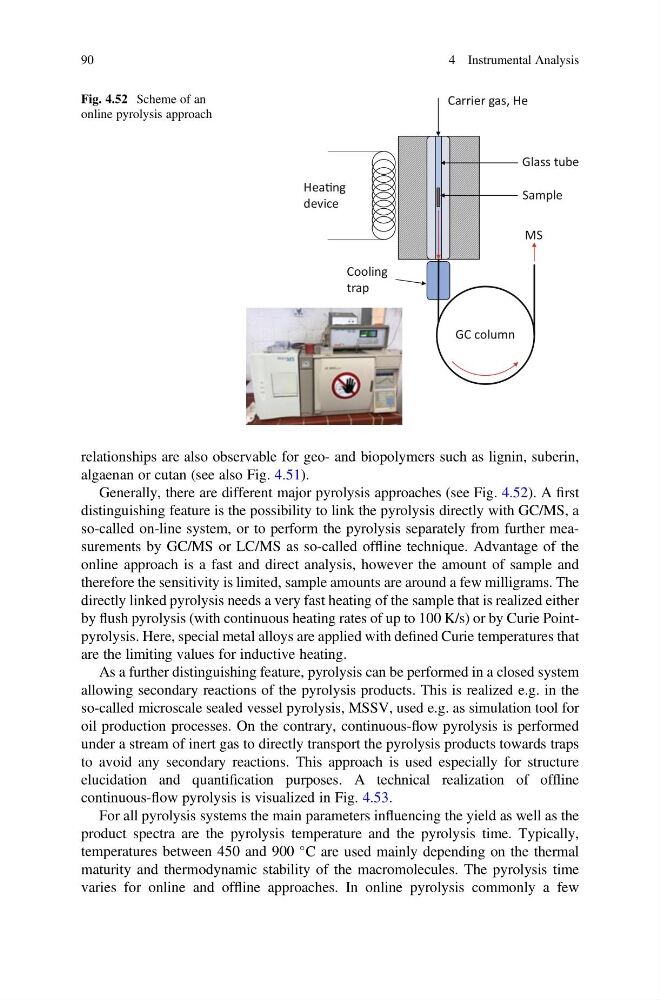
Generally, there are different major pyrolysis approaches (see Fig. 4.52). A first
distinguishing feature is the possibility to link the pyrolysis directly with GC/MS, a
so-called on-line system, or to perform the pyrolysis separately from further measurements by GC/MS or LC/MS as so-called offline technique. Advantage of the
online approach is a fast and direct analysis, however the amount of sample and
therefore the sensitivity is limited, sample amounts are around a few milligrams. The
directly linked pyrolysis needs a very fast heating of the sample that is realized either
by flush pyrolysis (with continuous heating rates of up to 100 K/s) or by Curie Pointpyrolysis. Here, special metal alloys are applied with defined Curie temperatures that
are the limiting values for inductive heating.
As a further distinguishing feature, pyrolysis can be performed in a closed system
allowing secondary reactions of the pyrolysis products. This is realized e.g. in the
so-called microscale sealed vessel pyrolysis, MSSV, used e.g. as simulation tool for
oil production processes. On the contrary, continuous-flow pyrolysis is performed
under a stream of inert gas to directly transport the pyrolysis products towards traps
to avoid any secondary reactions. This approach is used especially for structure
elucidation and quantification purposes. A technical realization of offline
continuous-flow pyrolysis is visualized in Fig. 4.53.
For all pyrolysis systems the main parameters influencing the yield as well as the
product spectra are the pyrolysis temperature and the pyrolysis time. Typically,
temperatures between 450 and 900
C are used mainly depending on the thermal
maturity and thermodynamic stability of the macromolecules. The pyrolysis time
varies for online and offline approaches. In online pyrolysis commonly a few
Carrier gas, He
Cooling
trap
HeaƟng
device
Sample
Glass tube
GC column
MS
Fig. 4.52 Scheme of an
online pyrolysis approach
90
4 Instrumental Analysis
algaenan or cutan (see also Fig. 4.51).
Generally, there are different major pyrolysis approaches (see Fig. 4.52). A first
distinguishing feature is the possibility to link the pyrolysis directly with GC/MS, a
so-called on-line system, or to perform the pyrolysis separately from further measurements by GC/MS or LC/MS as so-called offline technique. Advantage of the
online approach is a fast and direct analysis, however the amount of sample and
therefore the sensitivity is limited, sample amounts are around a few milligrams. The
directly linked pyrolysis needs a very fast heating of the sample that is realized either
by flush pyrolysis (with continuous heating rates of up to 100 K/s) or by Curie Pointpyrolysis. Here, special metal alloys are applied with defined Curie temperatures that
are the limiting values for inductive heating.
As a further distinguishing feature, pyrolysis can be performed in a closed system
allowing secondary reactions of the pyrolysis products. This is realized e.g. in the
so-called microscale sealed vessel pyrolysis, MSSV, used e.g. as simulation tool for
oil production processes. On the contrary, continuous-flow pyrolysis is performed
under a stream of inert gas to directly transport the pyrolysis products towards traps
to avoid any secondary reactions. This approach is used especially for structure
elucidation and quantification purposes. A technical realization of offline
continuous-flow pyrolysis is visualized in Fig. 4.53.
For all pyrolysis systems the main parameters influencing the yield as well as the
product spectra are the pyrolysis temperature and the pyrolysis time. Typically,
temperatures between 450 and 900
C are used mainly depending on the thermal
maturity and thermodynamic stability of the macromolecules. The pyrolysis time
varies for online and offline approaches. In online pyrolysis commonly a few
Carrier gas, He
Cooling
trap
HeaƟng
device
Sample
Glass tube
GC column
MS
Fig. 4.52 Scheme of an
online pyrolysis approach
90
4 Instrumental Analysis