

states in molecular systems. Hence, changing any energy state in molecules is only
possible by adding a corresponding energy package. With respect to absorption
processes and describing electromagnetic radiation as particles, the absorption is
only possible if the energy of the absorbed photon fits exactly the energy difference
between initial or ground state and excited state (as exemplified in Fig. 4.33). Since
many energy states and their distances depend on the molecular structures and
atomic properties, the absorption energy can provide information on molecule and
atom characteristics. This is the basic approach of analytical spectroscopy.
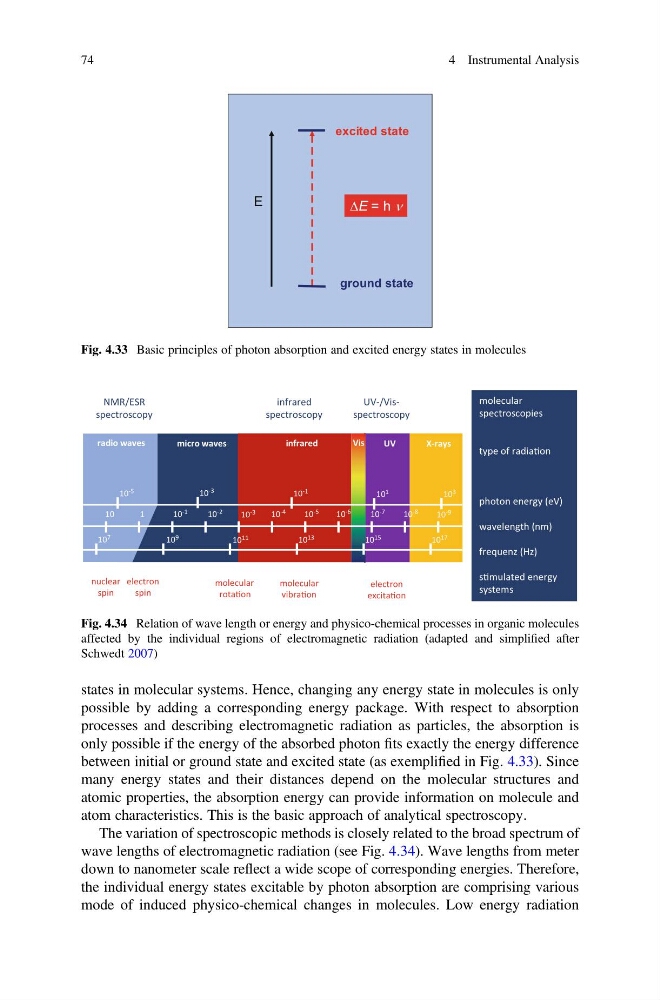
The variation of spectroscopic methods is closely related to the broad spectrum of
wave lengths of electromagnetic radiation (see Fig. 4.34). Wave lengths from meter
down to nanometer scale reflect a wide scope of corresponding energies. Therefore,
the individual energy states excitable by photon absorption are comprising various
mode of induced physico-chemical changes in molecules. Low energy radiation
E
excited state
ground state
∆E = h ν
Fig. 4.33 Basic principles of photon absorption and excited energy states in molecules
10
1
radio waves
micro waves
X-rays
infrared
UV
Vis
UV-/Visspectroscopy
infrared
spectroscopy
molecular
rotaƟon
molecular
vibraƟon
electron
excitaƟon
NMR/ESR
spectroscopy
nuclear
spin
electron
spin
molecular
spectroscopies
type of radiaƟon
photon energy (eV)
wavelength (nm)
frequenz (Hz)
sƟmulated energy
systems
10 -5
10 -1
10 -3
10 -3
10 -1
10 -4
10 -5
10 -6
10 -7
10 -8
10 -9
10 13
10 1
10 3
10 15
10 17
10 -2
10 7
10 9
10 11
Fig. 4.34 Relation of wave length or energy and physico-chemical processes in organic molecules
affected by the individual regions of electromagnetic radiation (adapted and simplified after
Schwedt 2007)
74
4 Instrumental Analysis
possible by adding a corresponding energy package. With respect to absorption
processes and describing electromagnetic radiation as particles, the absorption is
only possible if the energy of the absorbed photon fits exactly the energy difference
between initial or ground state and excited state (as exemplified in Fig. 4.33). Since
many energy states and their distances depend on the molecular structures and
atomic properties, the absorption energy can provide information on molecule and
atom characteristics. This is the basic approach of analytical spectroscopy.
The variation of spectroscopic methods is closely related to the broad spectrum of
wave lengths of electromagnetic radiation (see Fig. 4.34). Wave lengths from meter
down to nanometer scale reflect a wide scope of corresponding energies. Therefore,
the individual energy states excitable by photon absorption are comprising various
mode of induced physico-chemical changes in molecules. Low energy radiation
E
excited state
ground state
∆E = h ν
Fig. 4.33 Basic principles of photon absorption and excited energy states in molecules
10
1
radio waves
micro waves
X-rays
infrared
UV
Vis
UV-/Visspectroscopy
infrared
spectroscopy
molecular
rotaƟon
molecular
vibraƟon
electron
excitaƟon
NMR/ESR
spectroscopy
nuclear
spin
electron
spin
molecular
spectroscopies
type of radiaƟon
photon energy (eV)
wavelength (nm)
frequenz (Hz)
sƟmulated energy
systems
10 -5
10 -1
10 -3
10 -3
10 -1
10 -4
10 -5
10 -6
10 -7
10 -8
10 -9
10 13
10 1
10 3
10 15
10 17
10 -2
10 7
10 9
10 11
Fig. 4.34 Relation of wave length or energy and physico-chemical processes in organic molecules
affected by the individual regions of electromagnetic radiation (adapted and simplified after
Schwedt 2007)
74
4 Instrumental Analysis