

Beside the standard injector various technical variations are established,
e.g. allowing the injection of higher volumes or with a very fast ramped temperature
within the injector (e.g. PTV injectors). Also injectors allowing a direct positioning
of the analyte solutions in the capillary column are used (e.g. cold-on-column
injectors).
General Note
As a highly relevant aspect, the discussion of the injection modes clearly
points to a major restriction of gas chromatography. It is limited to analytes
that can be vaporized under the conditions described for the injectors. Hence,
only high to medium volatile substances can be analyzed.
As third main part of a gas chromatograph, the detector has various important
properties influencing the quality of GC measurements. Also here, one type is
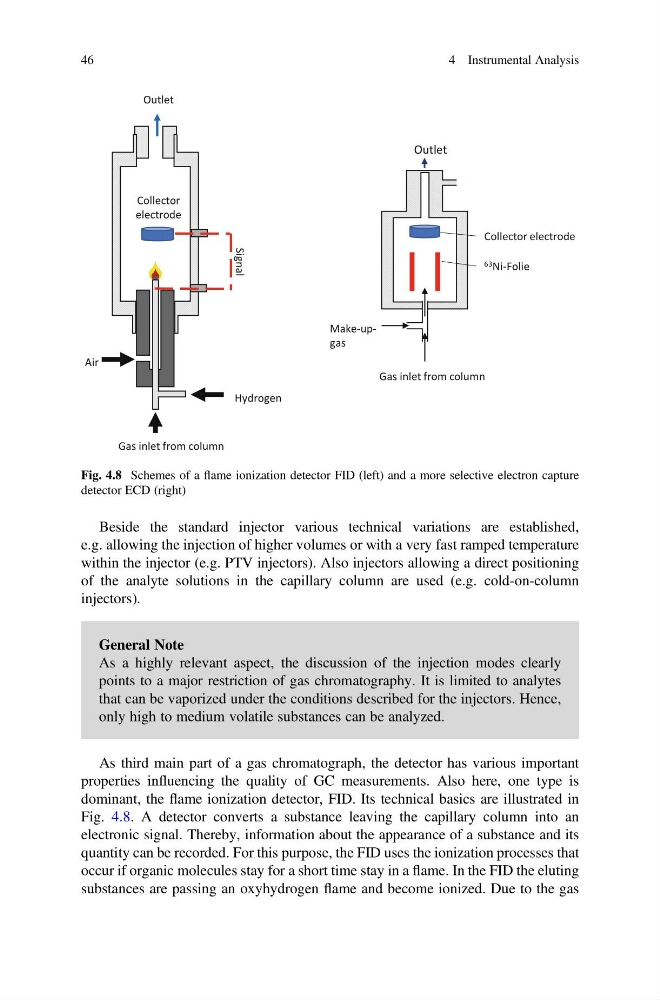
dominant, the flame ionization detector, FID. Its technical basics are illustrated in
Fig. 4.8. A detector converts a substance leaving the capillary column into an
electronic signal. Thereby, information about the appearance of a substance and its
quantity can be recorded. For this purpose, the FID uses the ionization processes that
occur if organic molecules stay for a short time stay in a flame. In the FID the eluting
substances are passing an oxyhydrogen flame and become ionized. Due to the gas
Collector
electrode
Air
Outlet
Gas inlet from column
Signal
Hydrogen
63 Ni-Folie
Collector electrode
Make-upgas
Outlet
Gas inlet from column
Fig. 4.8 Schemes of a flame ionization detector FID (left) and a more selective electron capture
detector ECD (right)
46
4 Instrumental Analysis
e.g. allowing the injection of higher volumes or with a very fast ramped temperature
within the injector (e.g. PTV injectors). Also injectors allowing a direct positioning
of the analyte solutions in the capillary column are used (e.g. cold-on-column
injectors).
General Note
As a highly relevant aspect, the discussion of the injection modes clearly
points to a major restriction of gas chromatography. It is limited to analytes
that can be vaporized under the conditions described for the injectors. Hence,
only high to medium volatile substances can be analyzed.
As third main part of a gas chromatograph, the detector has various important
properties influencing the quality of GC measurements. Also here, one type is
dominant, the flame ionization detector, FID. Its technical basics are illustrated in
Fig. 4.8. A detector converts a substance leaving the capillary column into an
electronic signal. Thereby, information about the appearance of a substance and its
quantity can be recorded. For this purpose, the FID uses the ionization processes that
occur if organic molecules stay for a short time stay in a flame. In the FID the eluting
substances are passing an oxyhydrogen flame and become ionized. Due to the gas
Collector
electrode
Air
Outlet
Gas inlet from column
Signal
Hydrogen
63 Ni-Folie
Collector electrode
Make-upgas
Outlet
Gas inlet from column
Fig. 4.8 Schemes of a flame ionization detector FID (left) and a more selective electron capture
detector ECD (right)
46
4 Instrumental Analysis