

2.1.2 Environmental Samples
Principally, environmental organic-geochemical studies deal with water samples
(surface and groundwater) as well as particulate matter such as soils, sediments
and dust. Samples from surface water systems (rivers, lakes, sewage effluents . . . .)
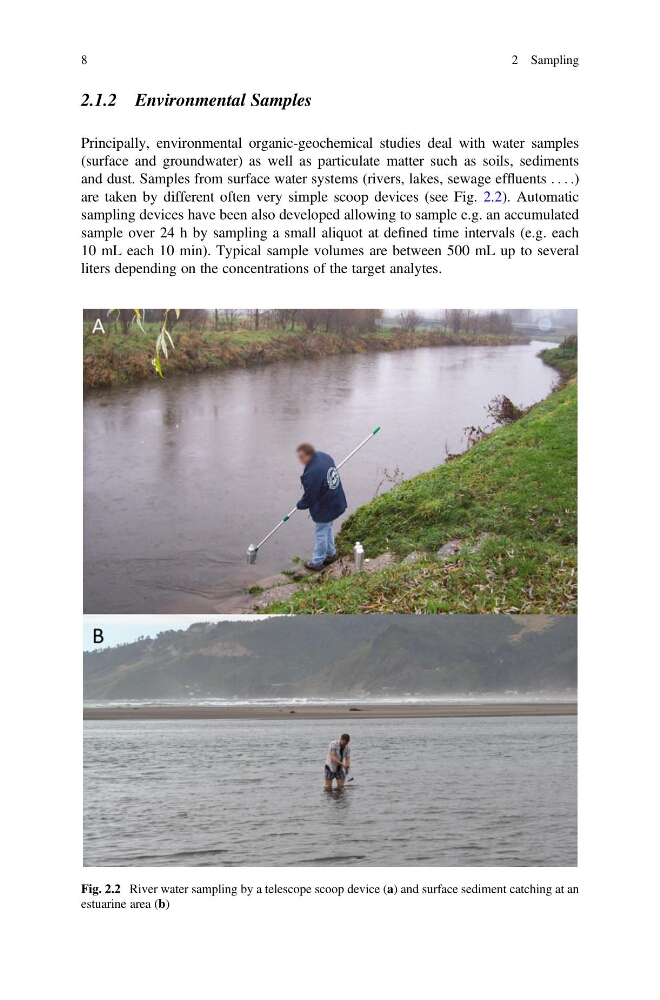
are taken by different often very simple scoop devices (see Fig. 2.2). Automatic
sampling devices have been also developed allowing to sample e.g. an accumulated
sample over 24 h by sampling a small aliquot at defined time intervals (e.g. each
10 mL each 10 min). Typical sample volumes are between 500 mL up to several
liters depending on the concentrations of the target analytes.
Fig. 2.2 River water sampling by a telescope scoop device (a) and surface sediment catching at an
estuarine area (b)
8
2 Sampling
Principally, environmental organic-geochemical studies deal with water samples
(surface and groundwater) as well as particulate matter such as soils, sediments
and dust. Samples from surface water systems (rivers, lakes, sewage effluents . . . .)
are taken by different often very simple scoop devices (see Fig. 2.2). Automatic
sampling devices have been also developed allowing to sample e.g. an accumulated
sample over 24 h by sampling a small aliquot at defined time intervals (e.g. each
10 mL each 10 min). Typical sample volumes are between 500 mL up to several
liters depending on the concentrations of the target analytes.
Fig. 2.2 River water sampling by a telescope scoop device (a) and surface sediment catching at an
estuarine area (b)
8
2 Sampling