

Excursus: What to do in case of missing reference material?
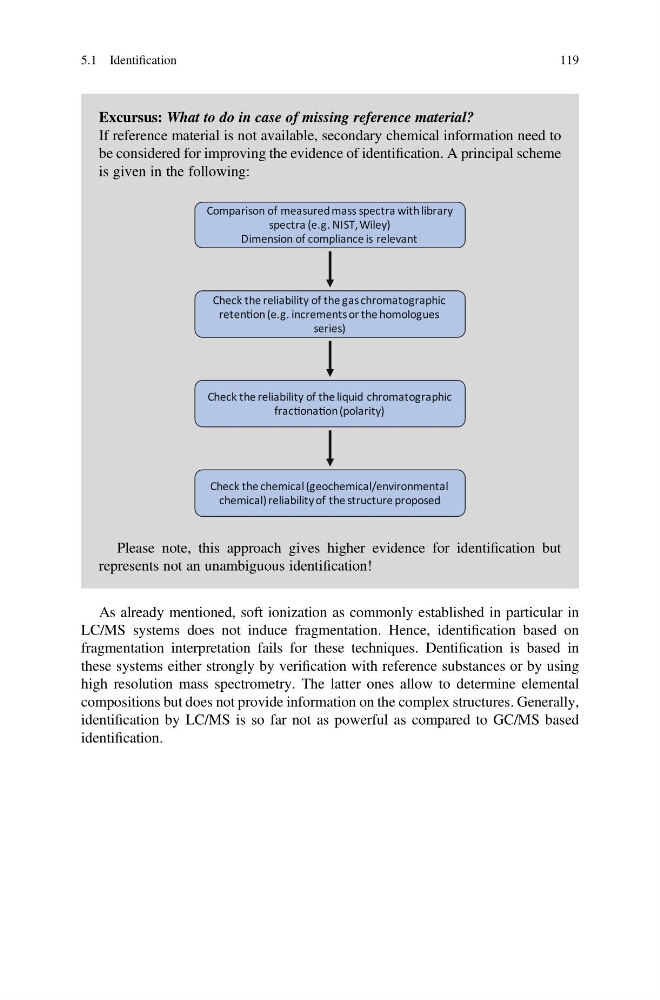
If reference material is not available, secondary chemical information need to
be considered for improving the evidence of identification. A principal scheme
is given in the following:
Comparison of measured mass spectra with library
spectra (e.g. NIST, Wiley)
Dimension of compliance is relevant
Check the reliability of the gas chromatographic
retenƟon (e.g. increments or the homologues
series)
Check the reliability of the liquid chromatographic
fracƟonaƟon (polarity)
Check the chemical (geochemical/environmental
chemical) reliability of the structure proposed
Please note, this approach gives higher evidence for identification but
represents not an unambiguous identification!
As already mentioned, soft ionization as commonly established in particular in
LC/MS systems does not induce fragmentation. Hence, identification based on
fragmentation interpretation fails for these techniques. Dentification is based in
these systems either strongly by verification with reference substances or by using
high resolution mass spectrometry. The latter ones allow to determine elemental
compositions but does not provide information on the complex structures. Generally,
identification by LC/MS is so far not as powerful as compared to GC/MS based
identification.
5.1 Identification
119
If reference material is not available, secondary chemical information need to
be considered for improving the evidence of identification. A principal scheme
is given in the following:
Comparison of measured mass spectra with library
spectra (e.g. NIST, Wiley)
Dimension of compliance is relevant
Check the reliability of the gas chromatographic
retenƟon (e.g. increments or the homologues
series)
Check the reliability of the liquid chromatographic
fracƟonaƟon (polarity)
Check the chemical (geochemical/environmental
chemical) reliability of the structure proposed
Please note, this approach gives higher evidence for identification but
represents not an unambiguous identification!
As already mentioned, soft ionization as commonly established in particular in
LC/MS systems does not induce fragmentation. Hence, identification based on
fragmentation interpretation fails for these techniques. Dentification is based in
these systems either strongly by verification with reference substances or by using
high resolution mass spectrometry. The latter ones allow to determine elemental
compositions but does not provide information on the complex structures. Generally,
identification by LC/MS is so far not as powerful as compared to GC/MS based
identification.
5.1 Identification
119