

4 Aptamer-Based Drug Delivery Systems
85
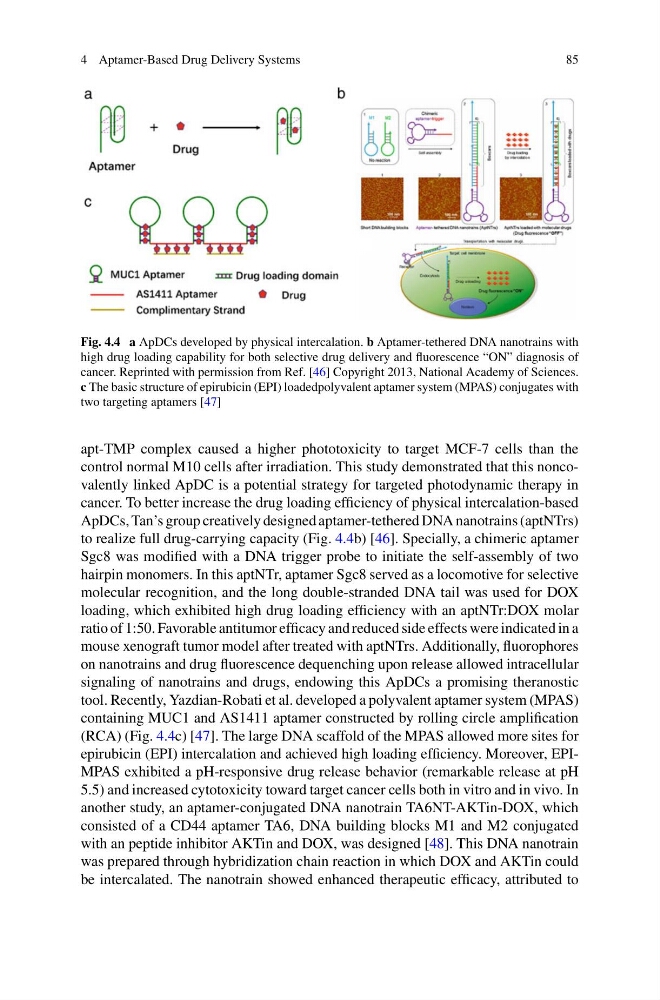
Fig. 4.4 a ApDCs developed by physical intercalation. b Aptamer-tethered DNA nanotrains with
high drug loading capability for both selective drug delivery and fluorescence “ON” diagnosis of
cancer. Reprinted with permission from Ref. [46] Copyright 2013, National Academy of Sciences.
c The basic structure of epirubicin (EPI) loadedpolyvalent aptamer system (MPAS) conjugates with
two targeting aptamers [47]
apt-TMP complex caused a higher phototoxicity to target MCF-7 cells than the
control normal M10 cells after irradiation. This study demonstrated that this noncovalently linked ApDC is a potential strategy for targeted photodynamic therapy in
cancer. To better increase the drug loading efficiency of physical intercalation-based
ApDCs, Tan’s group creatively designed aptamer-tethered DNA nanotrains (aptNTrs)
to realize full drug-carrying capacity (Fig. 4.4b) [46]. Specially, a chimeric aptamer
Sgc8 was modified with a DNA trigger probe to initiate the self-assembly of two
hairpin monomers. In this aptNTr, aptamer Sgc8 served as a locomotive for selective
molecular recognition, and the long double-stranded DNA tail was used for DOX
loading, which exhibited high drug loading efficiency with an aptNTr:DOX molar
ratio of 1:50. Favorable antitumor efficacy and reduced side effects were indicated in a
mouse xenograft tumor model after treated with aptNTrs. Additionally, fluorophores
on nanotrains and drug fluorescence dequenching upon release allowed intracellular
signaling of nanotrains and drugs, endowing this ApDCs a promising theranostic
tool. Recently, Yazdian-Robati et al. developed a polyvalent aptamer system (MPAS)
containing MUC1 and AS1411 aptamer constructed by rolling circle amplification
(RCA) (Fig. 4.4c) [47]. The large DNA scaffold of the MPAS allowed more sites for
epirubicin (EPI) intercalation and achieved high loading efficiency. Moreover, EPIMPAS exhibited a pH-responsive drug release behavior (remarkable release at pH
5.5) and increased cytotoxicity toward target cancer cells both in vitro and in vivo. In
another study, an aptamer-conjugated DNA nanotrain TA6NT-AKTin-DOX, which
consisted of a CD44 aptamer TA6, DNA building blocks M1 and M2 conjugated
with an peptide inhibitor AKTin and DOX, was designed [48]. This DNA nanotrain
was prepared through hybridization chain reaction in which DOX and AKTin could
be intercalated. The nanotrain showed enhanced therapeutic efficacy, attributed to
85
Fig. 4.4 a ApDCs developed by physical intercalation. b Aptamer-tethered DNA nanotrains with
high drug loading capability for both selective drug delivery and fluorescence “ON” diagnosis of
cancer. Reprinted with permission from Ref. [46] Copyright 2013, National Academy of Sciences.
c The basic structure of epirubicin (EPI) loadedpolyvalent aptamer system (MPAS) conjugates with
two targeting aptamers [47]
apt-TMP complex caused a higher phototoxicity to target MCF-7 cells than the
control normal M10 cells after irradiation. This study demonstrated that this noncovalently linked ApDC is a potential strategy for targeted photodynamic therapy in
cancer. To better increase the drug loading efficiency of physical intercalation-based
ApDCs, Tan’s group creatively designed aptamer-tethered DNA nanotrains (aptNTrs)
to realize full drug-carrying capacity (Fig. 4.4b) [46]. Specially, a chimeric aptamer
Sgc8 was modified with a DNA trigger probe to initiate the self-assembly of two
hairpin monomers. In this aptNTr, aptamer Sgc8 served as a locomotive for selective
molecular recognition, and the long double-stranded DNA tail was used for DOX
loading, which exhibited high drug loading efficiency with an aptNTr:DOX molar
ratio of 1:50. Favorable antitumor efficacy and reduced side effects were indicated in a
mouse xenograft tumor model after treated with aptNTrs. Additionally, fluorophores
on nanotrains and drug fluorescence dequenching upon release allowed intracellular
signaling of nanotrains and drugs, endowing this ApDCs a promising theranostic
tool. Recently, Yazdian-Robati et al. developed a polyvalent aptamer system (MPAS)
containing MUC1 and AS1411 aptamer constructed by rolling circle amplification
(RCA) (Fig. 4.4c) [47]. The large DNA scaffold of the MPAS allowed more sites for
epirubicin (EPI) intercalation and achieved high loading efficiency. Moreover, EPIMPAS exhibited a pH-responsive drug release behavior (remarkable release at pH
5.5) and increased cytotoxicity toward target cancer cells both in vitro and in vivo. In
another study, an aptamer-conjugated DNA nanotrain TA6NT-AKTin-DOX, which
consisted of a CD44 aptamer TA6, DNA building blocks M1 and M2 conjugated
with an peptide inhibitor AKTin and DOX, was designed [48]. This DNA nanotrain
was prepared through hybridization chain reaction in which DOX and AKTin could
be intercalated. The nanotrain showed enhanced therapeutic efficacy, attributed to