

4 Aptamer-Based Drug Delivery Systems
79
different diseases, such as ocular disorders, bleeding disorders, cancer, etc. [17].
The first aptamer drug pegaptanib (Macugen, Pfizer) was approved by FDA in
2004 and launched in the UK 2 years later [18]. Pegaptanib is a pegylated antivascular endothelial growth factor (VEGF) aptamer for the neovascular age-related
macular degeneration treatment via inhibiting the activation of VEGF receptors. The
success of Pegaptanib ignited scientists’ enthusiasm for the development of aptamer
drugs, and since then numerous groups have developed aptamer against targets associated with human diseases, mainly involving macular degeneration, coagulation,
oncology and infectious diseases [19–21]. It was reported that cell proliferation can
be suppressed through the interaction between aptamers and target molecules on
cell membrane or inside the cells. Remarkably, aptamer AS1411 is found to inhibit
the proliferation of cancer cells, and it is currently in clinical II trials [22]. AS1411
can specifically bind with nucleolin, a BCL-2 mRNA binding protein involved in
acute myelogenous leukemia (AML). After binding and subsequent cellular internalization, AS1411 can disrupt intracellular pathways to suppress cell proliferation.
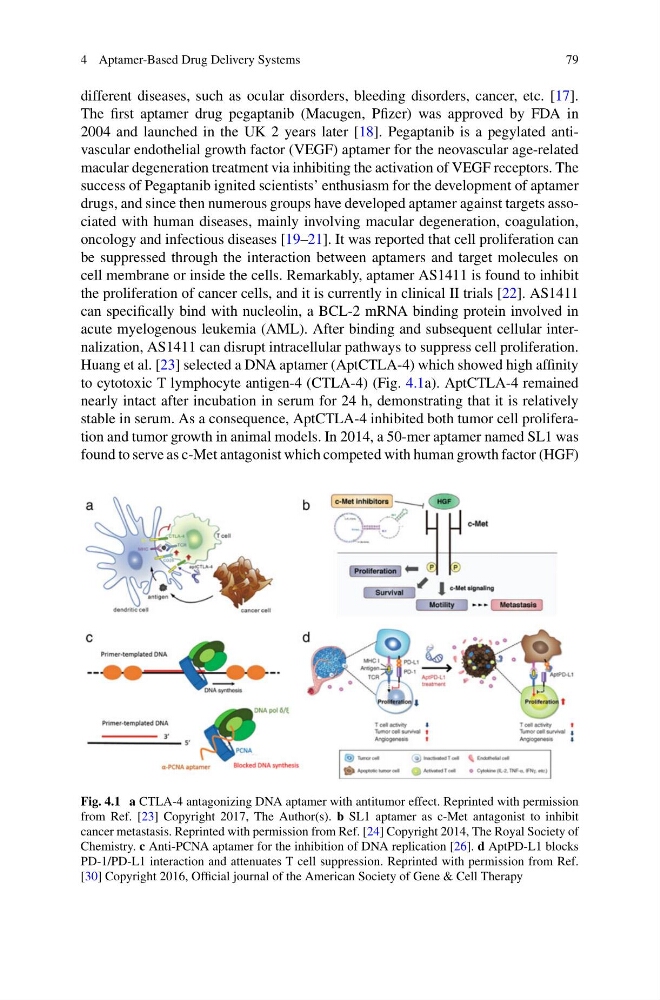
Huang et al. [23] selected a DNA aptamer (AptCTLA-4) which showed high affinity
to cytotoxic T lymphocyte antigen-4 (CTLA-4) (Fig. 4.1a). AptCTLA-4 remained
nearly intact after incubation in serum for 24 h, demonstrating that it is relatively
stable in serum. As a consequence, AptCTLA-4 inhibited both tumor cell proliferation and tumor growth in animal models. In 2014, a 50-mer aptamer named SL1 was
found to serve as c-Met antagonist which competed with human growth factor (HGF)
Fig. 4.1 a CTLA-4 antagonizing DNA aptamer with antitumor effect. Reprinted with permission
from Ref. [23] Copyright 2017, The Author(s). b SL1 aptamer as c-Met antagonist to inhibit
cancer metastasis. Reprinted with permission from Ref. [24] Copyright 2014, The Royal Society of
Chemistry. c Anti-PCNA aptamer for the inhibition of DNA replication [26]. d AptPD-L1 blocks
PD-1/PD-L1 interaction and attenuates T cell suppression. Reprinted with permission from Ref.
[30] Copyright 2016, Official journal of the American Society of Gene & Cell Therapy
79
different diseases, such as ocular disorders, bleeding disorders, cancer, etc. [17].
The first aptamer drug pegaptanib (Macugen, Pfizer) was approved by FDA in
2004 and launched in the UK 2 years later [18]. Pegaptanib is a pegylated antivascular endothelial growth factor (VEGF) aptamer for the neovascular age-related
macular degeneration treatment via inhibiting the activation of VEGF receptors. The
success of Pegaptanib ignited scientists’ enthusiasm for the development of aptamer
drugs, and since then numerous groups have developed aptamer against targets associated with human diseases, mainly involving macular degeneration, coagulation,
oncology and infectious diseases [19–21]. It was reported that cell proliferation can
be suppressed through the interaction between aptamers and target molecules on
cell membrane or inside the cells. Remarkably, aptamer AS1411 is found to inhibit
the proliferation of cancer cells, and it is currently in clinical II trials [22]. AS1411
can specifically bind with nucleolin, a BCL-2 mRNA binding protein involved in
acute myelogenous leukemia (AML). After binding and subsequent cellular internalization, AS1411 can disrupt intracellular pathways to suppress cell proliferation.
Huang et al. [23] selected a DNA aptamer (AptCTLA-4) which showed high affinity
to cytotoxic T lymphocyte antigen-4 (CTLA-4) (Fig. 4.1a). AptCTLA-4 remained
nearly intact after incubation in serum for 24 h, demonstrating that it is relatively
stable in serum. As a consequence, AptCTLA-4 inhibited both tumor cell proliferation and tumor growth in animal models. In 2014, a 50-mer aptamer named SL1 was
found to serve as c-Met antagonist which competed with human growth factor (HGF)
Fig. 4.1 a CTLA-4 antagonizing DNA aptamer with antitumor effect. Reprinted with permission
from Ref. [23] Copyright 2017, The Author(s). b SL1 aptamer as c-Met antagonist to inhibit
cancer metastasis. Reprinted with permission from Ref. [24] Copyright 2014, The Royal Society of
Chemistry. c Anti-PCNA aptamer for the inhibition of DNA replication [26]. d AptPD-L1 blocks
PD-1/PD-L1 interaction and attenuates T cell suppression. Reprinted with permission from Ref.
[30] Copyright 2016, Official journal of the American Society of Gene & Cell Therapy