

66
G. Murtaza et al.
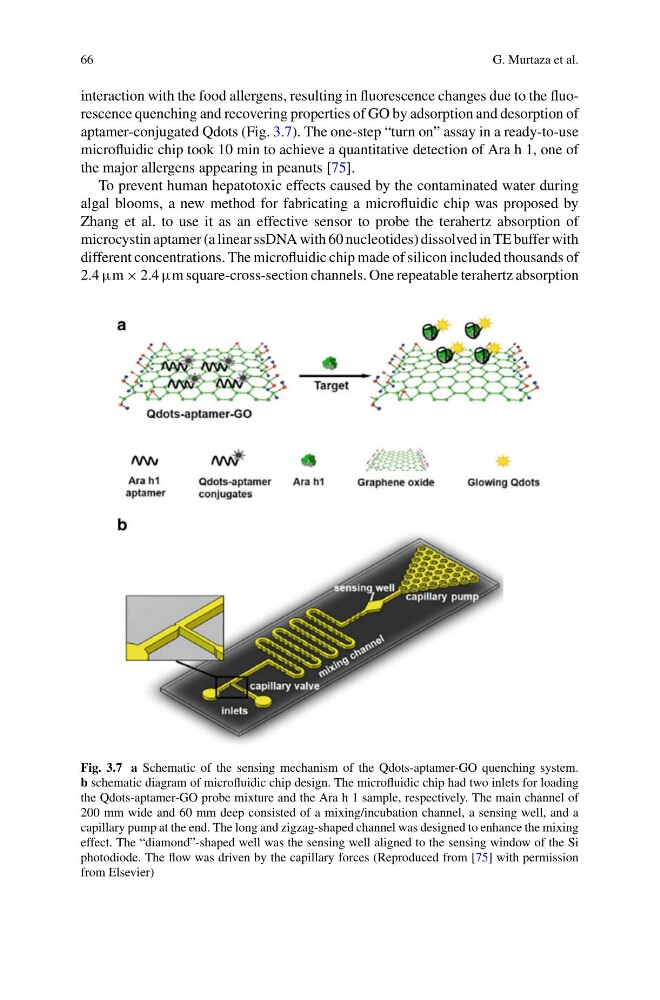
interaction with the food allergens, resulting in fluorescence changes due to the fluorescence quenching and recovering properties of GO by adsorption and desorption of
aptamer-conjugated Qdots (Fig. 3.7). The one-step “turn on” assay in a ready-to-use
microfluidic chip took 10 min to achieve a quantitative detection of Ara h 1, one of
the major allergens appearing in peanuts [75].
To prevent human hepatotoxic effects caused by the contaminated water during
algal blooms, a new method for fabricating a microfluidic chip was proposed by
Zhang et al. to use it as an effective sensor to probe the terahertz absorption of
microcystin aptamer (a linear ssDNA with 60 nucleotides) dissolved in TE buffer with
different concentrations. The microfluidic chip made of silicon included thousands of
2.4 μm × 2.4 μm square-cross-section channels. One repeatable terahertz absorption
Fig. 3.7 a Schematic of the sensing mechanism of the Qdots-aptamer-GO quenching system.
b schematic diagram of microfluidic chip design. The microfluidic chip had two inlets for loading
the Qdots-aptamer-GO probe mixture and the Ara h 1 sample, respectively. The main channel of
200 mm wide and 60 mm deep consisted of a mixing/incubation channel, a sensing well, and a
capillary pump at the end. The long and zigzag-shaped channel was designed to enhance the mixing
effect. The “diamond”-shaped well was the sensing well aligned to the sensing window of the Si
photodiode. The flow was driven by the capillary forces (Reproduced from [75] with permission
from Elsevier)
G. Murtaza et al.
interaction with the food allergens, resulting in fluorescence changes due to the fluorescence quenching and recovering properties of GO by adsorption and desorption of
aptamer-conjugated Qdots (Fig. 3.7). The one-step “turn on” assay in a ready-to-use
microfluidic chip took 10 min to achieve a quantitative detection of Ara h 1, one of
the major allergens appearing in peanuts [75].
To prevent human hepatotoxic effects caused by the contaminated water during
algal blooms, a new method for fabricating a microfluidic chip was proposed by
Zhang et al. to use it as an effective sensor to probe the terahertz absorption of
microcystin aptamer (a linear ssDNA with 60 nucleotides) dissolved in TE buffer with
different concentrations. The microfluidic chip made of silicon included thousands of
2.4 μm × 2.4 μm square-cross-section channels. One repeatable terahertz absorption
Fig. 3.7 a Schematic of the sensing mechanism of the Qdots-aptamer-GO quenching system.
b schematic diagram of microfluidic chip design. The microfluidic chip had two inlets for loading
the Qdots-aptamer-GO probe mixture and the Ara h 1 sample, respectively. The main channel of
200 mm wide and 60 mm deep consisted of a mixing/incubation channel, a sensing well, and a
capillary pump at the end. The long and zigzag-shaped channel was designed to enhance the mixing
effect. The “diamond”-shaped well was the sensing well aligned to the sensing window of the Si
photodiode. The flow was driven by the capillary forces (Reproduced from [75] with permission
from Elsevier)