

64
G. Murtaza et al.
Smartphone-based detection flourished the development of devices for POCT in
physiological health such as blood pressure, weight, pulse rate, electrocardiograph,
blood glucose, blood glucose saturation, sleeping and other physical activities [66].
Preechaburana and colleagues [67] made significant contribution to develop
smartphone-based sensing by integrating smartphone with auxiliary disposable
sensing devices such as sensing chips and SPR. Advantages of smartphone are that
they are well established, have universal use, presence of properly aligned optical
camera, and affordability.
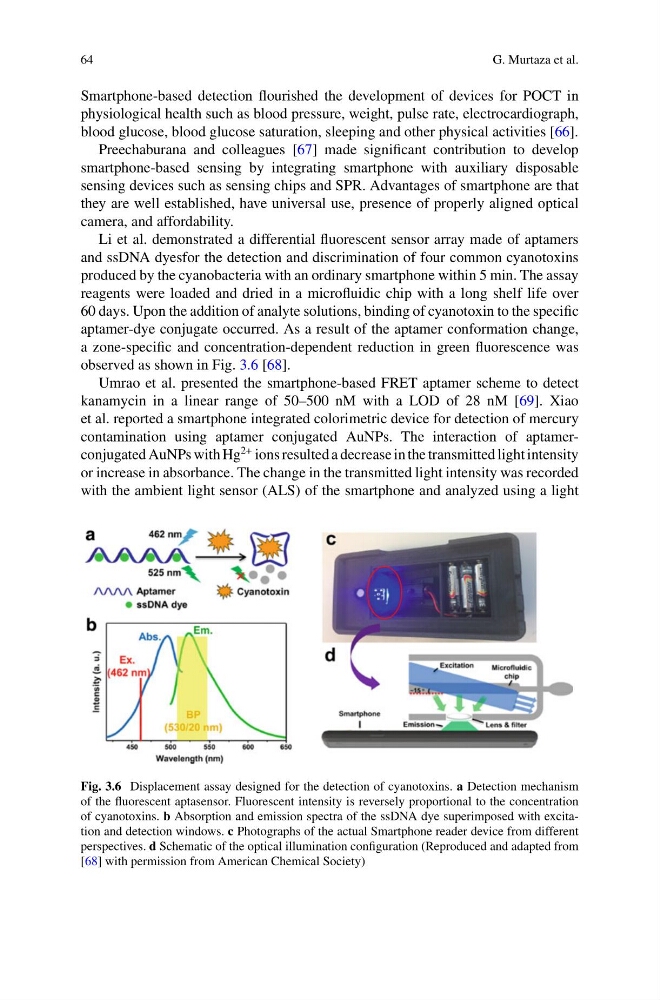
Li et al. demonstrated a differential fluorescent sensor array made of aptamers
and ssDNA dyesfor the detection and discrimination of four common cyanotoxins
produced by the cyanobacteria with an ordinary smartphone within 5 min. The assay
reagents were loaded and dried in a microfluidic chip with a long shelf life over
60 days. Upon the addition of analyte solutions, binding of cyanotoxin to the specific
aptamer-dye conjugate occurred. As a result of the aptamer conformation change,
a zone-specific and concentration-dependent reduction in green fluorescence was
observed as shown in Fig. 3.6 [68].
Umrao et al. presented the smartphone-based FRET aptamer scheme to detect
kanamycin in a linear range of 50–500 nM with a LOD of 28 nM [69]. Xiao
et al. reported a smartphone integrated colorimetric device for detection of mercury
contamination using aptamer conjugated AuNPs. The interaction of aptamerconjugated AuNPs with Hg
2+ ions resulted a decrease in the transmitted light intensity
or increase in absorbance. The change in the transmitted light intensity was recorded
with the ambient light sensor (ALS) of the smartphone and analyzed using a light
Fig. 3.6 Displacement assay designed for the detection of cyanotoxins. a Detection mechanism
of the fluorescent aptasensor. Fluorescent intensity is reversely proportional to the concentration
of cyanotoxins. b Absorption and emission spectra of the ssDNA dye superimposed with excitation and detection windows. c Photographs of the actual Smartphone reader device from different
perspectives. d Schematic of the optical illumination configuration (Reproduced and adapted from
[68] with permission from American Chemical Society)
G. Murtaza et al.
Smartphone-based detection flourished the development of devices for POCT in
physiological health such as blood pressure, weight, pulse rate, electrocardiograph,
blood glucose, blood glucose saturation, sleeping and other physical activities [66].
Preechaburana and colleagues [67] made significant contribution to develop
smartphone-based sensing by integrating smartphone with auxiliary disposable
sensing devices such as sensing chips and SPR. Advantages of smartphone are that
they are well established, have universal use, presence of properly aligned optical
camera, and affordability.
Li et al. demonstrated a differential fluorescent sensor array made of aptamers
and ssDNA dyesfor the detection and discrimination of four common cyanotoxins
produced by the cyanobacteria with an ordinary smartphone within 5 min. The assay
reagents were loaded and dried in a microfluidic chip with a long shelf life over
60 days. Upon the addition of analyte solutions, binding of cyanotoxin to the specific
aptamer-dye conjugate occurred. As a result of the aptamer conformation change,
a zone-specific and concentration-dependent reduction in green fluorescence was
observed as shown in Fig. 3.6 [68].
Umrao et al. presented the smartphone-based FRET aptamer scheme to detect
kanamycin in a linear range of 50–500 nM with a LOD of 28 nM [69]. Xiao
et al. reported a smartphone integrated colorimetric device for detection of mercury
contamination using aptamer conjugated AuNPs. The interaction of aptamerconjugated AuNPs with Hg
2+ ions resulted a decrease in the transmitted light intensity
or increase in absorbance. The change in the transmitted light intensity was recorded
with the ambient light sensor (ALS) of the smartphone and analyzed using a light
Fig. 3.6 Displacement assay designed for the detection of cyanotoxins. a Detection mechanism
of the fluorescent aptasensor. Fluorescent intensity is reversely proportional to the concentration
of cyanotoxins. b Absorption and emission spectra of the ssDNA dye superimposed with excitation and detection windows. c Photographs of the actual Smartphone reader device from different
perspectives. d Schematic of the optical illumination configuration (Reproduced and adapted from
[68] with permission from American Chemical Society)