

38
D. Li et al.
cross-linked dextran iron oxide (CLIO) nanoparticles, which can be functionalized with DNA and detect specific oligonucleotides by MRI [40]. The process was
fully reversible; the oligonucleotides were recoverable from the sensors. Then they
selected four different types of molecular interactions as model systems (DNA–
DNA, protein–protein, protein–small molecule, and enzyme reactions) to monitor
these biological interactions with high efficiency and sensitivity [41] by MRI. The
results indicated that CLIO nanoparticles change the spin–spin relaxation time (T2)
of adjacent water protons within minutes. This effect also has been confirmed by
other different assembly and disassembly systems in continuing research, including
the protease assay system [42] and enantiomeric impurities detection system [43].
Using this principle reported in these studies, it was possible to examine the analytes,
which resulted in such transition and differentiate assembled and dissembled states
of the nanoparticles. In 2007, Yigit et al. developed a general method for detecting
chemical and biological molecules with aptamer-based biosensing by MRI [44].
The adenosine aptamer-based design could induce disassembly of CLIO nanoparticle aggregates when adenosine was present. The result of aggregation reduced an
increase in the brightness of T2-weighted MR images. In contrast, changes were
neither observed with control analytes without any activity on adenosine aptamer or
the CLIO nanoparticles functionalized with mutated aptamer (which does not interact
with adenosine). In 2008, the same group tested the system for the detection of human
α-thrombin protein in order to demonstrate the response on proteins instead of small
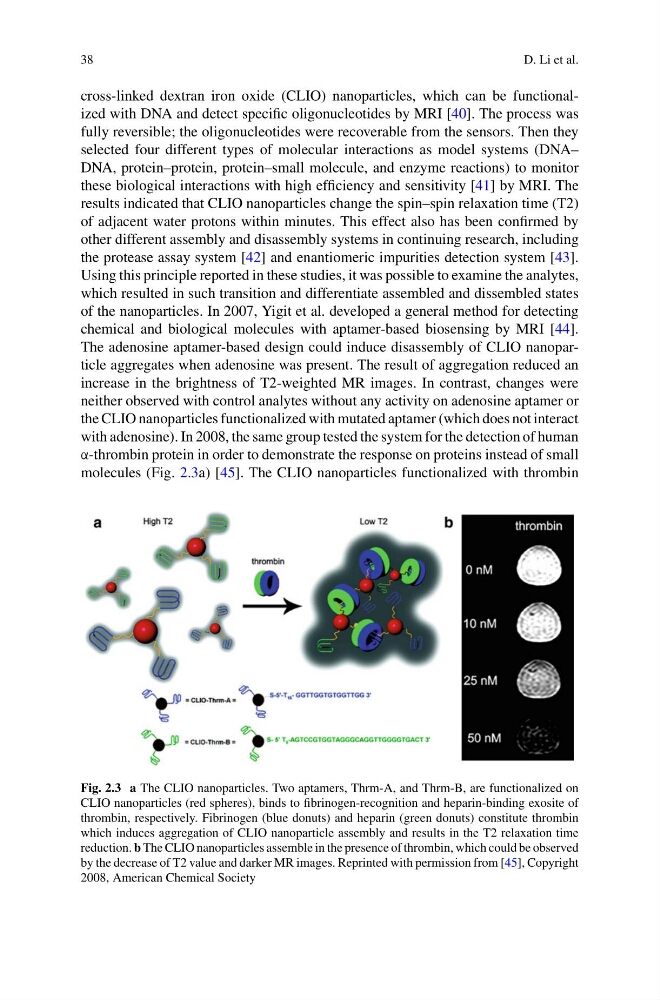
molecules (Fig. 2.3a) [45]. The CLIO nanoparticles functionalized with thrombin
Fig. 2.3 a The CLIO nanoparticles. Two aptamers, Thrm-A, and Thrm-B, are functionalized on
CLIO nanoparticles (red spheres), binds to fibrinogen-recognition and heparin-binding exosite of
thrombin, respectively. Fibrinogen (blue donuts) and heparin (green donuts) constitute thrombin
which induces aggregation of CLIO nanoparticle assembly and results in the T2 relaxation time
reduction. b The CLIO nanoparticles assemble in the presence of thrombin, which could be observed
by the decrease of T2 value and darker MR images. Reprinted with permission from [45], Copyright
2008, American Chemical Society
D. Li et al.
cross-linked dextran iron oxide (CLIO) nanoparticles, which can be functionalized with DNA and detect specific oligonucleotides by MRI [40]. The process was
fully reversible; the oligonucleotides were recoverable from the sensors. Then they
selected four different types of molecular interactions as model systems (DNA–
DNA, protein–protein, protein–small molecule, and enzyme reactions) to monitor
these biological interactions with high efficiency and sensitivity [41] by MRI. The
results indicated that CLIO nanoparticles change the spin–spin relaxation time (T2)
of adjacent water protons within minutes. This effect also has been confirmed by
other different assembly and disassembly systems in continuing research, including
the protease assay system [42] and enantiomeric impurities detection system [43].
Using this principle reported in these studies, it was possible to examine the analytes,
which resulted in such transition and differentiate assembled and dissembled states
of the nanoparticles. In 2007, Yigit et al. developed a general method for detecting
chemical and biological molecules with aptamer-based biosensing by MRI [44].
The adenosine aptamer-based design could induce disassembly of CLIO nanoparticle aggregates when adenosine was present. The result of aggregation reduced an
increase in the brightness of T2-weighted MR images. In contrast, changes were
neither observed with control analytes without any activity on adenosine aptamer or
the CLIO nanoparticles functionalized with mutated aptamer (which does not interact
with adenosine). In 2008, the same group tested the system for the detection of human
α-thrombin protein in order to demonstrate the response on proteins instead of small
molecules (Fig. 2.3a) [45]. The CLIO nanoparticles functionalized with thrombin
Fig. 2.3 a The CLIO nanoparticles. Two aptamers, Thrm-A, and Thrm-B, are functionalized on
CLIO nanoparticles (red spheres), binds to fibrinogen-recognition and heparin-binding exosite of
thrombin, respectively. Fibrinogen (blue donuts) and heparin (green donuts) constitute thrombin
which induces aggregation of CLIO nanoparticle assembly and results in the T2 relaxation time
reduction. b The CLIO nanoparticles assemble in the presence of thrombin, which could be observed
by the decrease of T2 value and darker MR images. Reprinted with permission from [45], Copyright
2008, American Chemical Society