

418
H. Jin
14.3.1.5 Cancer
Cancer is the uncontrolled development of cells. After heart disease, it is the second
most common cause of death in the world. Biological tumor markers that participate
in the carcinogenesis at different stages of cancer development are pivotal tools
in screening cancer-related diseases. In addition to antibodies that have been widely
used clinically as basic tumor marker detection elements, aptamers are also promising
alternatives in tumor diagnosis.
Carcinoembryonic antigen (CEA) is a tumor-associated glycoprotein antigen, it
usually presents at very low levels in the blood of healthy adults (about 2–4 ng/mL)
[61]. It is a common practice to find abnormal elevation of CEA as a good marker
for cancer screening clinically in a wide variety of human cancers, especially in the
colon, breast, and lung [62].
Smith et al. [63] described the first CEA aptamer with the sequence of 5
-
ATACCAGCTTATTCAATT-3
. Aptasensors with various designs based on this
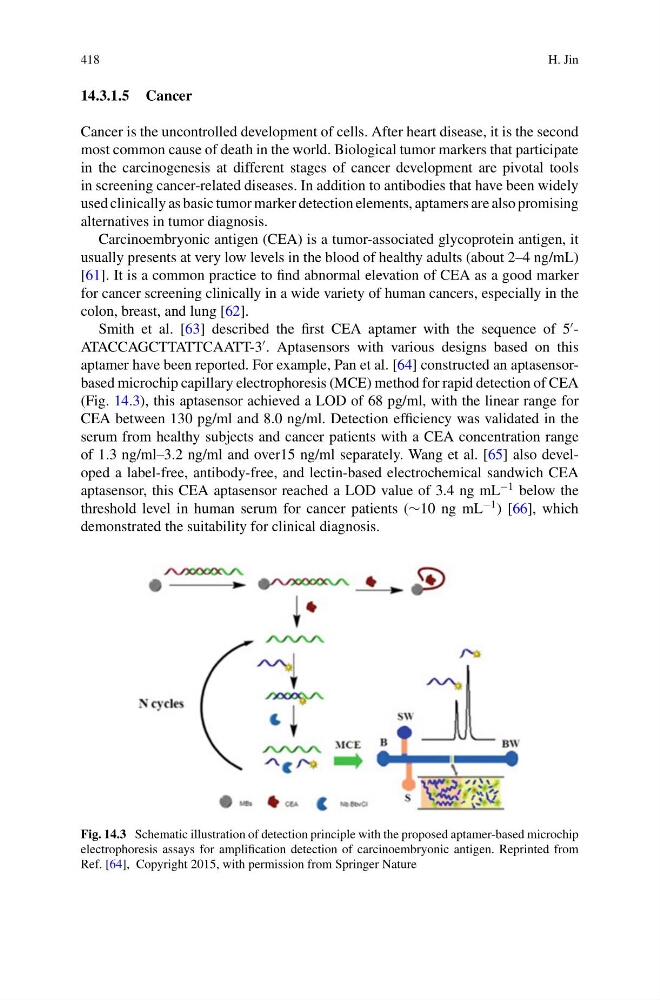
aptamer have been reported. For example, Pan et al. [64] constructed an aptasensorbased microchip capillary electrophoresis (MCE) method for rapid detection of CEA
(Fig. 14.3), this aptasensor achieved a LOD of 68 pg/ml, with the linear range for
CEA between 130 pg/ml and 8.0 ng/ml. Detection efficiency was validated in the
serum from healthy subjects and cancer patients with a CEA concentration range
of 1.3 ng/ml–3.2 ng/ml and over15 ng/ml separately. Wang et al. [65] also developed a label-free, antibody-free, and lectin-based electrochemical sandwich CEA
aptasensor, this CEA aptasensor reached a LOD value of 3.4 ng mL
−1 below the
threshold level in human serum for cancer patients (∼10 ng mL
−1 ) [66], which
demonstrated the suitability for clinical diagnosis.
Fig. 14.3 Schematic illustration of detection principle with the proposed aptamer-based microchip
electrophoresis assays for amplification detection of carcinoembryonic antigen. Reprinted from
Ref. [64], Copyright 2015, with permission from Springer Nature
H. Jin
14.3.1.5 Cancer
Cancer is the uncontrolled development of cells. After heart disease, it is the second
most common cause of death in the world. Biological tumor markers that participate
in the carcinogenesis at different stages of cancer development are pivotal tools
in screening cancer-related diseases. In addition to antibodies that have been widely
used clinically as basic tumor marker detection elements, aptamers are also promising
alternatives in tumor diagnosis.
Carcinoembryonic antigen (CEA) is a tumor-associated glycoprotein antigen, it
usually presents at very low levels in the blood of healthy adults (about 2–4 ng/mL)
[61]. It is a common practice to find abnormal elevation of CEA as a good marker
for cancer screening clinically in a wide variety of human cancers, especially in the
colon, breast, and lung [62].
Smith et al. [63] described the first CEA aptamer with the sequence of 5
-
ATACCAGCTTATTCAATT-3
. Aptasensors with various designs based on this
aptamer have been reported. For example, Pan et al. [64] constructed an aptasensorbased microchip capillary electrophoresis (MCE) method for rapid detection of CEA
(Fig. 14.3), this aptasensor achieved a LOD of 68 pg/ml, with the linear range for
CEA between 130 pg/ml and 8.0 ng/ml. Detection efficiency was validated in the
serum from healthy subjects and cancer patients with a CEA concentration range
of 1.3 ng/ml–3.2 ng/ml and over15 ng/ml separately. Wang et al. [65] also developed a label-free, antibody-free, and lectin-based electrochemical sandwich CEA
aptasensor, this CEA aptasensor reached a LOD value of 3.4 ng mL
−1 below the
threshold level in human serum for cancer patients (∼10 ng mL
−1 ) [66], which
demonstrated the suitability for clinical diagnosis.
Fig. 14.3 Schematic illustration of detection principle with the proposed aptamer-based microchip
electrophoresis assays for amplification detection of carcinoembryonic antigen. Reprinted from
Ref. [64], Copyright 2015, with permission from Springer Nature