

13 Some Frontier Technologies for Aptamers in Medical Applications
401
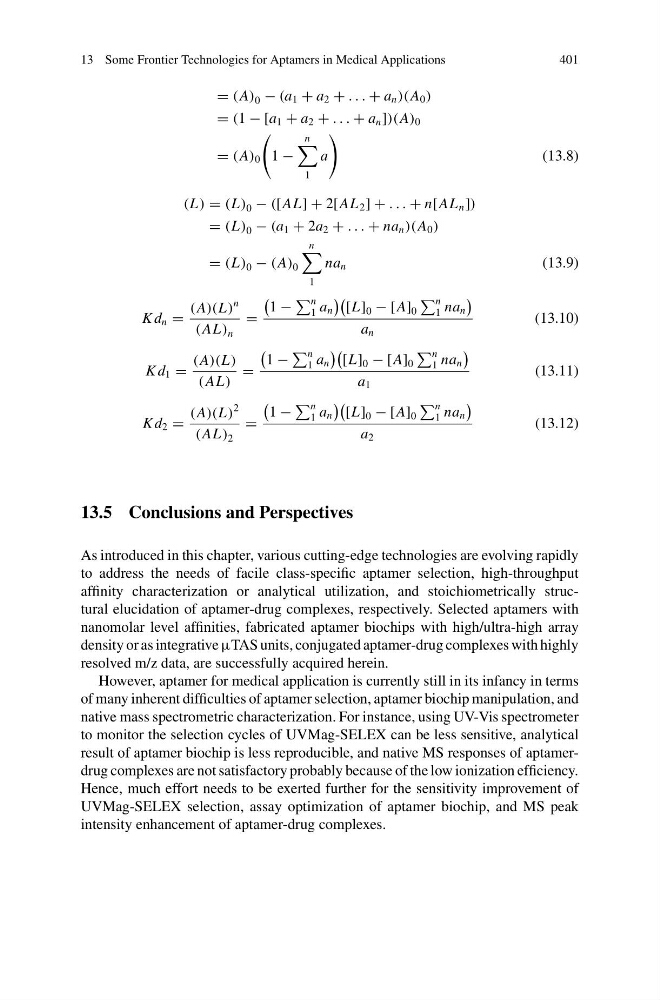
= (A) 0 − (a 1 + a 2 + . . . + a n )(A 0 )
= (1 − [a 1 + a 2 + . . . + a n ])(A) 0
= (A) 0
1 −
n
1
a
(13.8)
(L) = (L) 0 − ([AL] + 2[AL 2 ] + . . . + n[AL n ])
= (L) 0 − (a 1 + 2a 2 + . . . + na n )(A 0 )
= (L) 0 − (A) 0
n
1
na n
(13.9)
K d n =
(A)(L)
n
(AL) n
=
1 −
n
1 a n
[L] 0 − [A] 0
n
1 na n
a n
(13.10)
K d 1 =
(A)(L)
(AL)
=
1 −
n
1 a n
[L] 0 − [A] 0
n
1 na n
a 1
(13.11)
K d 2 =
(A)(L)
2
(AL) 2
=
1 −
n
1 a n
[L] 0 − [A] 0
n
1 na n
a 2
(13.12)
13.5 Conclusions and Perspectives
As introduced in this chapter, various cutting-edge technologies are evolving rapidly
to address the needs of facile class-specific aptamer selection, high-throughput
affinity characterization or analytical utilization, and stoichiometrically structural elucidation of aptamer-drug complexes, respectively. Selected aptamers with
nanomolar level affinities, fabricated aptamer biochips with high/ultra-high array
density or as integrative µTAS units, conjugated aptamer-drug complexes with highly
resolved m/z data, are successfully acquired herein.
However, aptamer for medical application is currently still in its infancy in terms
of many inherent difficulties of aptamer selection, aptamer biochip manipulation, and
native mass spectrometric characterization. For instance, using UV-Vis spectrometer
to monitor the selection cycles of UVMag-SELEX can be less sensitive, analytical
result of aptamer biochip is less reproducible, and native MS responses of aptamerdrug complexes are not satisfactory probably because of the low ionization efficiency.
Hence, much effort needs to be exerted further for the sensitivity improvement of
UVMag-SELEX selection, assay optimization of aptamer biochip, and MS peak
intensity enhancement of aptamer-drug complexes.
401
= (A) 0 − (a 1 + a 2 + . . . + a n )(A 0 )
= (1 − [a 1 + a 2 + . . . + a n ])(A) 0
= (A) 0
1 −
n
1
a
(13.8)
(L) = (L) 0 − ([AL] + 2[AL 2 ] + . . . + n[AL n ])
= (L) 0 − (a 1 + 2a 2 + . . . + na n )(A 0 )
= (L) 0 − (A) 0
n
1
na n
(13.9)
K d n =
(A)(L)
n
(AL) n
=
1 −
n
1 a n
[L] 0 − [A] 0
n
1 na n
a n
(13.10)
K d 1 =
(A)(L)
(AL)
=
1 −
n
1 a n
[L] 0 − [A] 0
n
1 na n
a 1
(13.11)
K d 2 =
(A)(L)
2
(AL) 2
=
1 −
n
1 a n
[L] 0 − [A] 0
n
1 na n
a 2
(13.12)
13.5 Conclusions and Perspectives
As introduced in this chapter, various cutting-edge technologies are evolving rapidly
to address the needs of facile class-specific aptamer selection, high-throughput
affinity characterization or analytical utilization, and stoichiometrically structural elucidation of aptamer-drug complexes, respectively. Selected aptamers with
nanomolar level affinities, fabricated aptamer biochips with high/ultra-high array
density or as integrative µTAS units, conjugated aptamer-drug complexes with highly
resolved m/z data, are successfully acquired herein.
However, aptamer for medical application is currently still in its infancy in terms
of many inherent difficulties of aptamer selection, aptamer biochip manipulation, and
native mass spectrometric characterization. For instance, using UV-Vis spectrometer
to monitor the selection cycles of UVMag-SELEX can be less sensitive, analytical
result of aptamer biochip is less reproducible, and native MS responses of aptamerdrug complexes are not satisfactory probably because of the low ionization efficiency.
Hence, much effort needs to be exerted further for the sensitivity improvement of
UVMag-SELEX selection, assay optimization of aptamer biochip, and MS peak
intensity enhancement of aptamer-drug complexes.