

12 Aptamers for the Diagnosis and Therapy …
365
12.2.4 The Applications of Aptamers in HD
HD is a dominantly inherited autosomal disease in neuronal tissue. It is suggested this
disorder has affected about 5–10 individuals per 100,000 [101]. Affected individuals
always suffer from progressive motors as well as cognitive declines, such as the
loss of awareness, depression, dementia, and anxiety. The pathogenesis of HD is the
aggregation of mutated HTT (mHTT), which indicates that it is required to make
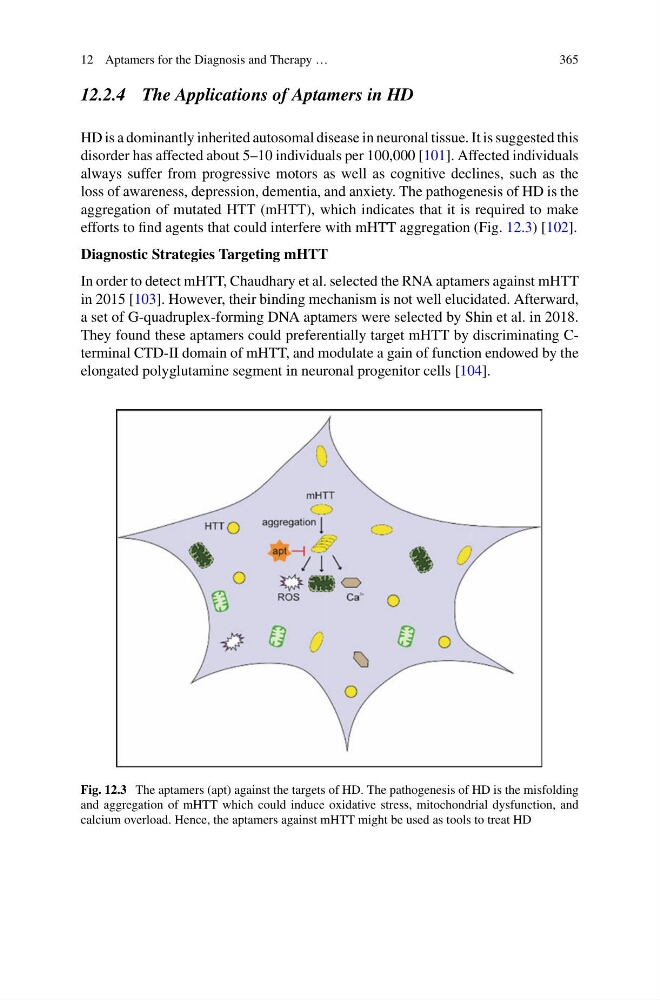
efforts to find agents that could interfere with mHTT aggregation (Fig. 12.3) [102].
Diagnostic Strategies Targeting mHTT
In order to detect mHTT, Chaudhary et al. selected the RNA aptamers against mHTT
in 2015 [103]. However, their binding mechanism is not well elucidated. Afterward,
a set of G-quadruplex-forming DNA aptamers were selected by Shin et al. in 2018.
They found these aptamers could preferentially target mHTT by discriminating Cterminal CTD-II domain of mHTT, and modulate a gain of function endowed by the
elongated polyglutamine segment in neuronal progenitor cells [104].
Fig. 12.3 The aptamers (apt) against the targets of HD. The pathogenesis of HD is the misfolding
and aggregation of mHTT which could induce oxidative stress, mitochondrial dysfunction, and
calcium overload. Hence, the aptamers against mHTT might be used as tools to treat HD
365
12.2.4 The Applications of Aptamers in HD
HD is a dominantly inherited autosomal disease in neuronal tissue. It is suggested this
disorder has affected about 5–10 individuals per 100,000 [101]. Affected individuals
always suffer from progressive motors as well as cognitive declines, such as the
loss of awareness, depression, dementia, and anxiety. The pathogenesis of HD is the
aggregation of mutated HTT (mHTT), which indicates that it is required to make
efforts to find agents that could interfere with mHTT aggregation (Fig. 12.3) [102].
Diagnostic Strategies Targeting mHTT
In order to detect mHTT, Chaudhary et al. selected the RNA aptamers against mHTT
in 2015 [103]. However, their binding mechanism is not well elucidated. Afterward,
a set of G-quadruplex-forming DNA aptamers were selected by Shin et al. in 2018.
They found these aptamers could preferentially target mHTT by discriminating Cterminal CTD-II domain of mHTT, and modulate a gain of function endowed by the
elongated polyglutamine segment in neuronal progenitor cells [104].
Fig. 12.3 The aptamers (apt) against the targets of HD. The pathogenesis of HD is the misfolding
and aggregation of mHTT which could induce oxidative stress, mitochondrial dysfunction, and
calcium overload. Hence, the aptamers against mHTT might be used as tools to treat HD