

354
J. Qu and J. Zhang
12.2.1.1 Aβ
Aβ has been shown to play a key role in the pathology of AD due to its ability to form
both intracellular and extracellular aggregates. Aβ is generated by sequential cleavage
of amyloid precursor protein (APP) by γ- and β-secretases, and Aβ aggregation
may disrupt the normal physiological functions of cells, inducing oxidative stress
and nerve inflammation, which could further lead to the dysfunctions of cells, even
apoptosis, and death [45, 46]. At present, it is predominantly believed that soluble
oligomeric, rather than fibrillar, Aβ assemblies act as the proximate neurotoxins
on neurons in AD. So, monitoring the Aβ aggregation, inhibiting the process of
Aβ aggregation, and interfering with the target receptor of Aβ oligomer, are the
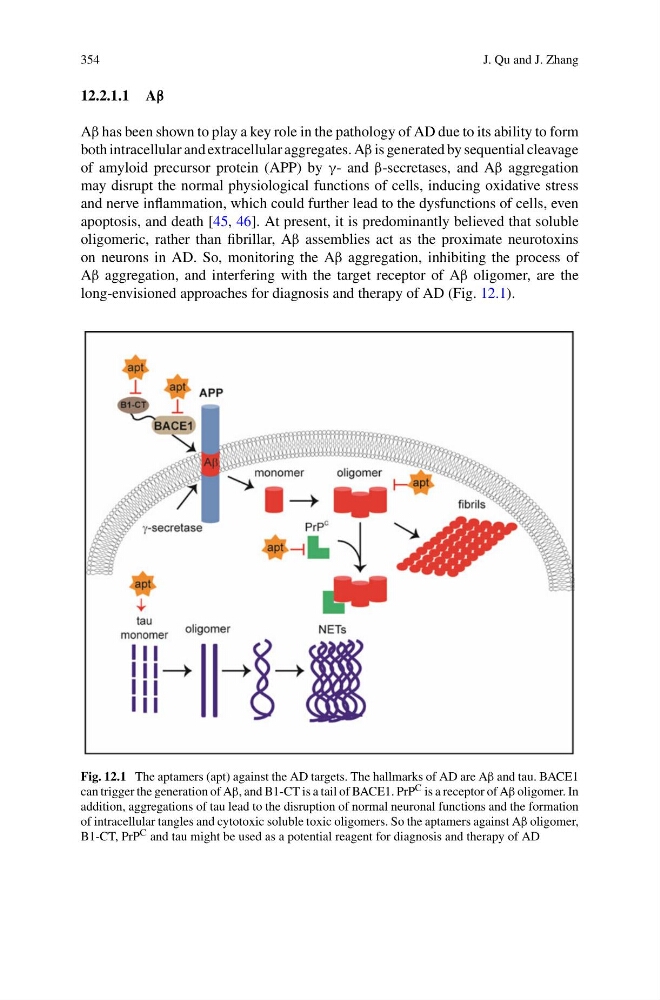
long-envisioned approaches for diagnosis and therapy of AD (Fig. 12.1).
Fig. 12.1 The aptamers (apt) against the AD targets. The hallmarks of AD are Aβ and tau. BACE1
can trigger the generation of Aβ, and B1-CT is a tail of BACE1. PrP C is a receptor of Aβ oligomer. In
addition, aggregations of tau lead to the disruption of normal neuronal functions and the formation
of intracellular tangles and cytotoxic soluble toxic oligomers. So the aptamers against Aβ oligomer,
B1-CT, PrP C and tau might be used as a potential reagent for diagnosis and therapy of AD
J. Qu and J. Zhang
12.2.1.1 Aβ
Aβ has been shown to play a key role in the pathology of AD due to its ability to form
both intracellular and extracellular aggregates. Aβ is generated by sequential cleavage
of amyloid precursor protein (APP) by γ- and β-secretases, and Aβ aggregation
may disrupt the normal physiological functions of cells, inducing oxidative stress
and nerve inflammation, which could further lead to the dysfunctions of cells, even
apoptosis, and death [45, 46]. At present, it is predominantly believed that soluble
oligomeric, rather than fibrillar, Aβ assemblies act as the proximate neurotoxins
on neurons in AD. So, monitoring the Aβ aggregation, inhibiting the process of
Aβ aggregation, and interfering with the target receptor of Aβ oligomer, are the
long-envisioned approaches for diagnosis and therapy of AD (Fig. 12.1).
Fig. 12.1 The aptamers (apt) against the AD targets. The hallmarks of AD are Aβ and tau. BACE1
can trigger the generation of Aβ, and B1-CT is a tail of BACE1. PrP C is a receptor of Aβ oligomer. In
addition, aggregations of tau lead to the disruption of normal neuronal functions and the formation
of intracellular tangles and cytotoxic soluble toxic oligomers. So the aptamers against Aβ oligomer,
B1-CT, PrP C and tau might be used as a potential reagent for diagnosis and therapy of AD