

24
L. Hao and H. Gu
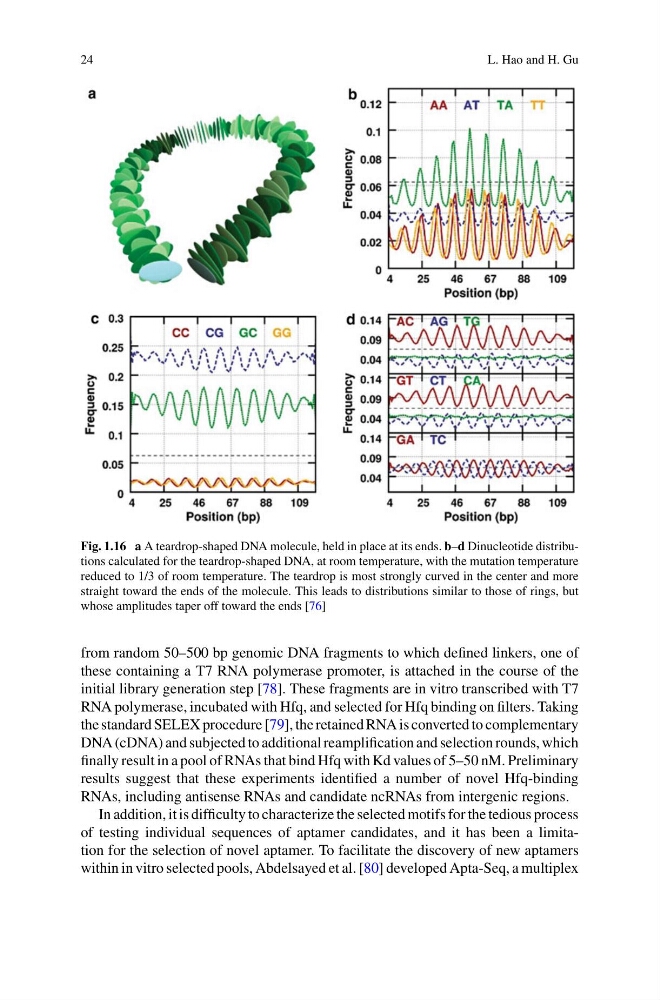
Fig. 1.16 a A teardrop-shaped DNA molecule, held in place at its ends. b–d Dinucleotide distributions calculated for the teardrop-shaped DNA, at room temperature, with the mutation temperature
reduced to 1/3 of room temperature. The teardrop is most strongly curved in the center and more
straight toward the ends of the molecule. This leads to distributions similar to those of rings, but
whose amplitudes taper off toward the ends [76]
from random 50–500 bp genomic DNA fragments to which defined linkers, one of
these containing a T7 RNA polymerase promoter, is attached in the course of the
initial library generation step [78]. These fragments are in vitro transcribed with T7
RNA polymerase, incubated with Hfq, and selected for Hfq binding on filters. Taking
the standard SELEX procedure [79], the retained RNA is converted to complementary
DNA (cDNA) and subjected to additional reamplification and selection rounds, which
finally result in a pool of RNAs that bind Hfq with Kd values of 5–50 nM. Preliminary
results suggest that these experiments identified a number of novel Hfq-binding
RNAs, including antisense RNAs and candidate ncRNAs from intergenic regions.
In addition, it is difficulty to characterize the selected motifs for the tedious process
of testing individual sequences of aptamer candidates, and it has been a limitation for the selection of novel aptamer. To facilitate the discovery of new aptamers
within in vitro selected pools, Abdelsayed et al. [80] developed Apta-Seq, a multiplex
L. Hao and H. Gu
Fig. 1.16 a A teardrop-shaped DNA molecule, held in place at its ends. b–d Dinucleotide distributions calculated for the teardrop-shaped DNA, at room temperature, with the mutation temperature
reduced to 1/3 of room temperature. The teardrop is most strongly curved in the center and more
straight toward the ends of the molecule. This leads to distributions similar to those of rings, but
whose amplitudes taper off toward the ends [76]
from random 50–500 bp genomic DNA fragments to which defined linkers, one of
these containing a T7 RNA polymerase promoter, is attached in the course of the
initial library generation step [78]. These fragments are in vitro transcribed with T7
RNA polymerase, incubated with Hfq, and selected for Hfq binding on filters. Taking
the standard SELEX procedure [79], the retained RNA is converted to complementary
DNA (cDNA) and subjected to additional reamplification and selection rounds, which
finally result in a pool of RNAs that bind Hfq with Kd values of 5–50 nM. Preliminary
results suggest that these experiments identified a number of novel Hfq-binding
RNAs, including antisense RNAs and candidate ncRNAs from intergenic regions.
In addition, it is difficulty to characterize the selected motifs for the tedious process
of testing individual sequences of aptamer candidates, and it has been a limitation for the selection of novel aptamer. To facilitate the discovery of new aptamers
within in vitro selected pools, Abdelsayed et al. [80] developed Apta-Seq, a multiplex