

11 Hormone Aptamers in Endocrine-Related Diseases
325
referred to bind with aptamer DNA and result in QDs releasing the detectable fluorescence, which is previously quenched by combining with the Ru complex. Under
the optimal condition, the fluorescence intensity was linearly proportional to the
concentration of E2 as low as 37 nM in the working solution. This aptasensor also
present a similar result in fetal bovine serum.
Yao et al. [18] described an aptamer-based assay for E2 based on surface-enhanced
Raman scattering (SERS), which uses Au@Ag NPs as an ultrasensitive and versatile
Raman platform with enzyme-free amplification strategy, i.e., hybridization chain
reaction (HCR) for E2 detection. Under the optimal conditions, this aptasensor
provides a limit of detection (LOD) of 0.1 pM and a linear detection range from
0.0001 to 10 nM with a correlation coefficient (R) of 0.98 for the detection of
17β-estradiol. Application in urine sample also confirms this aptasensor’s excellent
reliability and accuracy.
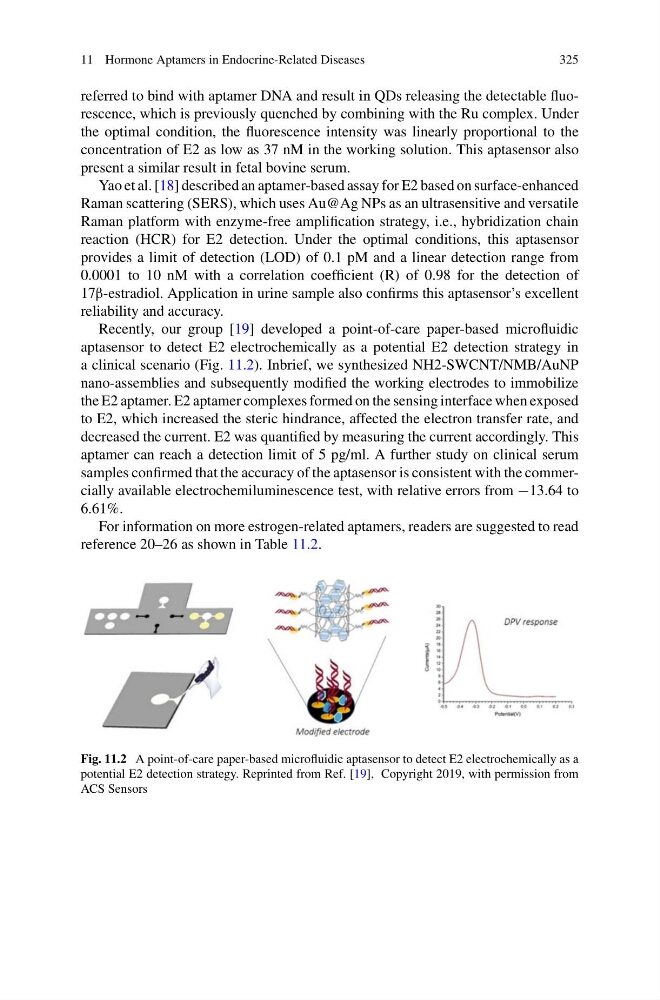
Recently, our group [19] developed a point-of-care paper-based microfluidic
aptasensor to detect E2 electrochemically as a potential E2 detection strategy in
a clinical scenario (Fig. 11.2). Inbrief, we synthesized NH2-SWCNT/NMB/AuNP
nano-assemblies and subsequently modified the working electrodes to immobilize
the E2 aptamer. E2 aptamer complexes formed on the sensing interface when exposed
to E2, which increased the steric hindrance, affected the electron transfer rate, and
decreased the current. E2 was quantified by measuring the current accordingly. This
aptamer can reach a detection limit of 5 pg/ml. A further study on clinical serum
samples confirmed that the accuracy of the aptasensor is consistent with the commercially available electrochemiluminescence test, with relative errors from −13.64 to
6.61%.
For information on more estrogen-related aptamers, readers are suggested to read
reference 20–26 as shown in Table 11.2.
Fig. 11.2 A point-of-care paper-based microfluidic aptasensor to detect E2 electrochemically as a
potential E2 detection strategy. Reprinted from Ref. [19], Copyright 2019, with permission from
ACS Sensors
325
referred to bind with aptamer DNA and result in QDs releasing the detectable fluorescence, which is previously quenched by combining with the Ru complex. Under
the optimal condition, the fluorescence intensity was linearly proportional to the
concentration of E2 as low as 37 nM in the working solution. This aptasensor also
present a similar result in fetal bovine serum.
Yao et al. [18] described an aptamer-based assay for E2 based on surface-enhanced
Raman scattering (SERS), which uses Au@Ag NPs as an ultrasensitive and versatile
Raman platform with enzyme-free amplification strategy, i.e., hybridization chain
reaction (HCR) for E2 detection. Under the optimal conditions, this aptasensor
provides a limit of detection (LOD) of 0.1 pM and a linear detection range from
0.0001 to 10 nM with a correlation coefficient (R) of 0.98 for the detection of
17β-estradiol. Application in urine sample also confirms this aptasensor’s excellent
reliability and accuracy.
Recently, our group [19] developed a point-of-care paper-based microfluidic
aptasensor to detect E2 electrochemically as a potential E2 detection strategy in
a clinical scenario (Fig. 11.2). Inbrief, we synthesized NH2-SWCNT/NMB/AuNP
nano-assemblies and subsequently modified the working electrodes to immobilize
the E2 aptamer. E2 aptamer complexes formed on the sensing interface when exposed
to E2, which increased the steric hindrance, affected the electron transfer rate, and
decreased the current. E2 was quantified by measuring the current accordingly. This
aptamer can reach a detection limit of 5 pg/ml. A further study on clinical serum
samples confirmed that the accuracy of the aptasensor is consistent with the commercially available electrochemiluminescence test, with relative errors from −13.64 to
6.61%.
For information on more estrogen-related aptamers, readers are suggested to read
reference 20–26 as shown in Table 11.2.
Fig. 11.2 A point-of-care paper-based microfluidic aptasensor to detect E2 electrochemically as a
potential E2 detection strategy. Reprinted from Ref. [19], Copyright 2019, with permission from
ACS Sensors