

322
Y. Cheng and H. Jin
Alzheimer’s disease. Meanwhile, menopausal women begin to have uncontrollable
weight gain, and insulin-resistance-related blood glucose disorders, and abnormal
blood lipid metabolism. Therefore, real-time monitoring of estrogen in the female
body is of considerable significance.
In 2007, YeonSeok Kim group [8] isolated the first estrogen aptamer, a 76 mer
estradiol single-strand DNA aptamer by SELEX. The KD of this aptamer was determined to be 130 nM, which can be used to detect femtomolar concentrations of
17 β-estradiol(E2). The team constructed an electrochemical biosensor using the
estrogen aptamer immobilized on a gold electrode based on an avidin–biotin interaction. The sensor successfully detected E2 with good specificity, and the lowest
detection limit reached 0.01 nmoL/L.
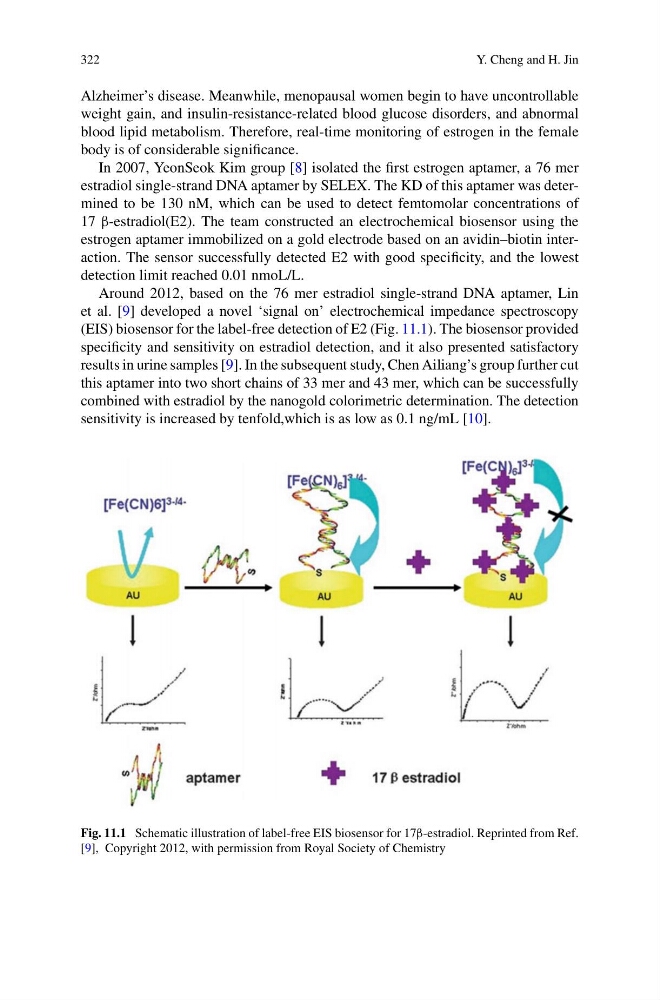
Around 2012, based on the 76 mer estradiol single-strand DNA aptamer, Lin
et al. [9] developed a novel ‘signal on’ electrochemical impedance spectroscopy
(EIS) biosensor for the label-free detection of E2 (Fig. 11.1). The biosensor provided
specificity and sensitivity on estradiol detection, and it also presented satisfactory
results in urine samples [9]. In the subsequent study, Chen Ailiang’s group further cut
this aptamer into two short chains of 33 mer and 43 mer, which can be successfully
combined with estradiol by the nanogold colorimetric determination. The detection
sensitivity is increased by tenfold,which is as low as 0.1 ng/mL [10].
Fig. 11.1 Schematic illustration of label-free EIS biosensor for 17β-estradiol. Reprinted from Ref.
[9], Copyright 2012, with permission from Royal Society of Chemistry
Y. Cheng and H. Jin
Alzheimer’s disease. Meanwhile, menopausal women begin to have uncontrollable
weight gain, and insulin-resistance-related blood glucose disorders, and abnormal
blood lipid metabolism. Therefore, real-time monitoring of estrogen in the female
body is of considerable significance.
In 2007, YeonSeok Kim group [8] isolated the first estrogen aptamer, a 76 mer
estradiol single-strand DNA aptamer by SELEX. The KD of this aptamer was determined to be 130 nM, which can be used to detect femtomolar concentrations of
17 β-estradiol(E2). The team constructed an electrochemical biosensor using the
estrogen aptamer immobilized on a gold electrode based on an avidin–biotin interaction. The sensor successfully detected E2 with good specificity, and the lowest
detection limit reached 0.01 nmoL/L.
Around 2012, based on the 76 mer estradiol single-strand DNA aptamer, Lin
et al. [9] developed a novel ‘signal on’ electrochemical impedance spectroscopy
(EIS) biosensor for the label-free detection of E2 (Fig. 11.1). The biosensor provided
specificity and sensitivity on estradiol detection, and it also presented satisfactory
results in urine samples [9]. In the subsequent study, Chen Ailiang’s group further cut
this aptamer into two short chains of 33 mer and 43 mer, which can be successfully
combined with estradiol by the nanogold colorimetric determination. The detection
sensitivity is increased by tenfold,which is as low as 0.1 ng/mL [10].
Fig. 11.1 Schematic illustration of label-free EIS biosensor for 17β-estradiol. Reprinted from Ref.
[9], Copyright 2012, with permission from Royal Society of Chemistry