

1 Introduction of Aptamer, SELEX, and Different SELEX Variants
21
SELEX can also reduce the potential PCR bias resulted from over selection. Thus,
HTS SELEX can not only save time and money but also reduce the risk of technical
biases [70, 71].
In 2010, Cho et al. first reported the combination of HTS with microfluidic selection to identify aptamer that specifically bind to platelet-derived growth factor BB
(PDGF-BB) protein, a useful biomarker for various pathological states [72]. The
copy number and enrichment-fold of more than 10 million individual sequences
were tracked through multiple selection rounds. Millions of resulting sequences
were computationally filtered, aligned, and analyzed. The 100 most highly enriched
sequences against PDGF-BB were ranked between round 3 and round 2 or between
round 3 and round 1. Finally, aptamers against PDGF-BB protein with K d < 3 nM
were identified within only three rounds. Furthermore, the aptamers identified by
HTS have ~3–8-fold higher affinity and ~2–4-fold higher specificity relative to those
discovered through conventional cloning methods. Thus, this method improves the
speed and outcome of selection.
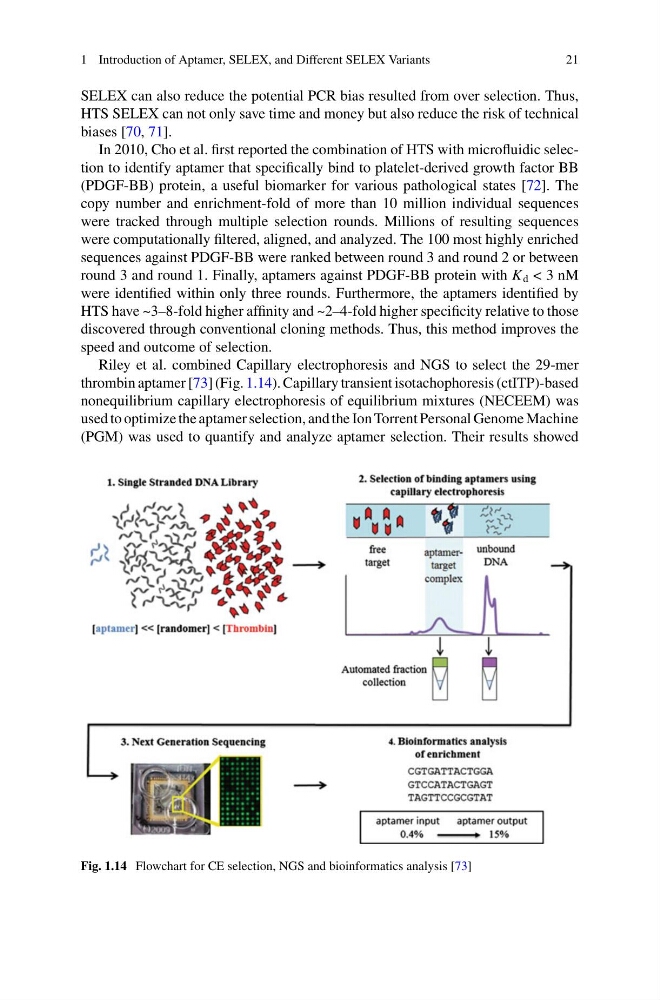
Riley et al. combined Capillary electrophoresis and NGS to select the 29-mer
thrombin aptamer [73] (Fig. 1.14). Capillary transient isotachophoresis (ctITP)-based
nonequilibrium capillary electrophoresis of equilibrium mixtures (NECEEM) was
used to optimize the aptamer selection, and the Ion Torrent Personal Genome Machine
(PGM) was used to quantify and analyze aptamer selection. Their results showed
Fig. 1.14 Flowchart for CE selection, NGS and bioinformatics analysis [73]
21
SELEX can also reduce the potential PCR bias resulted from over selection. Thus,
HTS SELEX can not only save time and money but also reduce the risk of technical
biases [70, 71].
In 2010, Cho et al. first reported the combination of HTS with microfluidic selection to identify aptamer that specifically bind to platelet-derived growth factor BB
(PDGF-BB) protein, a useful biomarker for various pathological states [72]. The
copy number and enrichment-fold of more than 10 million individual sequences
were tracked through multiple selection rounds. Millions of resulting sequences
were computationally filtered, aligned, and analyzed. The 100 most highly enriched
sequences against PDGF-BB were ranked between round 3 and round 2 or between
round 3 and round 1. Finally, aptamers against PDGF-BB protein with K d < 3 nM
were identified within only three rounds. Furthermore, the aptamers identified by
HTS have ~3–8-fold higher affinity and ~2–4-fold higher specificity relative to those
discovered through conventional cloning methods. Thus, this method improves the
speed and outcome of selection.
Riley et al. combined Capillary electrophoresis and NGS to select the 29-mer
thrombin aptamer [73] (Fig. 1.14). Capillary transient isotachophoresis (ctITP)-based
nonequilibrium capillary electrophoresis of equilibrium mixtures (NECEEM) was
used to optimize the aptamer selection, and the Ion Torrent Personal Genome Machine
(PGM) was used to quantify and analyze aptamer selection. Their results showed
Fig. 1.14 Flowchart for CE selection, NGS and bioinformatics analysis [73]