

10 Aptamers for Thrombotic Diseases
301
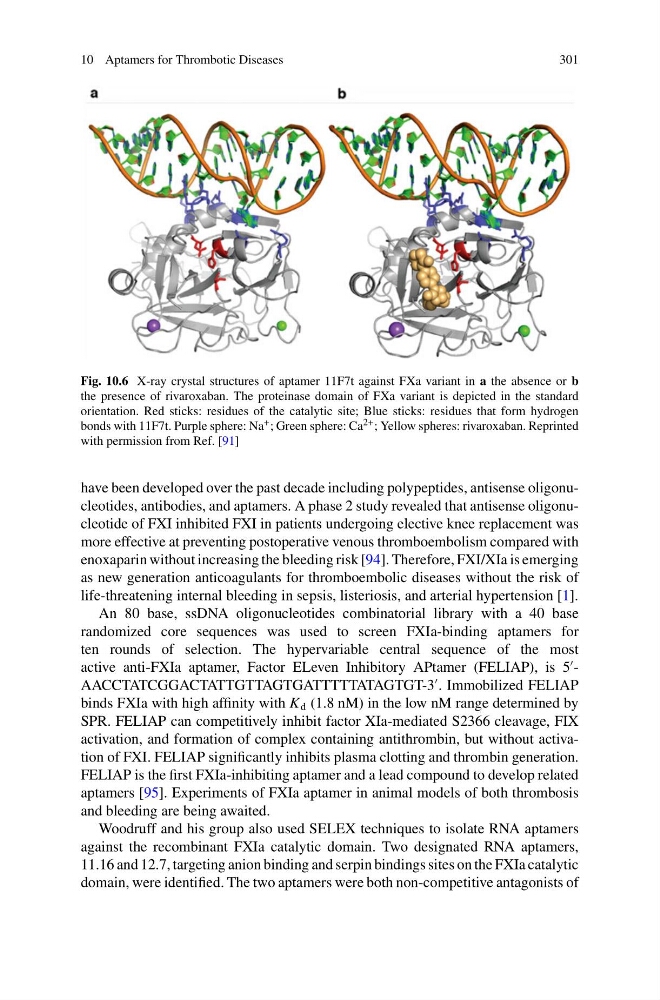
Fig. 10.6 X-ray crystal structures of aptamer 11F7t against FXa variant in a the absence or b
the presence of rivaroxaban. The proteinase domain of FXa variant is depicted in the standard
orientation. Red sticks: residues of the catalytic site; Blue sticks: residues that form hydrogen
bonds with 11F7t. Purple sphere: Na + ; Green sphere: Ca 2+ ; Yellow spheres: rivaroxaban. Reprinted
with permission from Ref. [91]
have been developed over the past decade including polypeptides, antisense oligonucleotides, antibodies, and aptamers. A phase 2 study revealed that antisense oligonucleotide of FXI inhibited FXI in patients undergoing elective knee replacement was
more effective at preventing postoperative venous thromboembolism compared with
enoxaparin without increasing the bleeding risk [94]. Therefore, FXI/XIa is emerging
as new generation anticoagulants for thromboembolic diseases without the risk of
life-threatening internal bleeding in sepsis, listeriosis, and arterial hypertension [1].
An 80 base, ssDNA oligonucleotides combinatorial library with a 40 base
randomized core sequences was used to screen FXIa-binding aptamers for
ten rounds of selection. The hypervariable central sequence of the most
active anti-FXIa aptamer, Factor ELeven Inhibitory APtamer (FELIAP), is 5
-
AACCTATCGGACTATTGTTAGTGATTTTTATAGTGT-3
. Immobilized FELIAP
binds FXIa with high affinity with K d (1.8 nM) in the low nM range determined by
SPR. FELIAP can competitively inhibit factor XIa-mediated S2366 cleavage, FIX
activation, and formation of complex containing antithrombin, but without activation of FXI. FELIAP significantly inhibits plasma clotting and thrombin generation.
FELIAP is the first FXIa-inhibiting aptamer and a lead compound to develop related
aptamers [95]. Experiments of FXIa aptamer in animal models of both thrombosis
and bleeding are being awaited.
Woodruff and his group also used SELEX techniques to isolate RNA aptamers
against the recombinant FXIa catalytic domain. Two designated RNA aptamers,
11.16 and 12.7, targeting anion binding and serpin bindings sites on the FXIa catalytic
domain, were identified. The two aptamers were both non-competitive antagonists of
301
Fig. 10.6 X-ray crystal structures of aptamer 11F7t against FXa variant in a the absence or b
the presence of rivaroxaban. The proteinase domain of FXa variant is depicted in the standard
orientation. Red sticks: residues of the catalytic site; Blue sticks: residues that form hydrogen
bonds with 11F7t. Purple sphere: Na + ; Green sphere: Ca 2+ ; Yellow spheres: rivaroxaban. Reprinted
with permission from Ref. [91]
have been developed over the past decade including polypeptides, antisense oligonucleotides, antibodies, and aptamers. A phase 2 study revealed that antisense oligonucleotide of FXI inhibited FXI in patients undergoing elective knee replacement was
more effective at preventing postoperative venous thromboembolism compared with
enoxaparin without increasing the bleeding risk [94]. Therefore, FXI/XIa is emerging
as new generation anticoagulants for thromboembolic diseases without the risk of
life-threatening internal bleeding in sepsis, listeriosis, and arterial hypertension [1].
An 80 base, ssDNA oligonucleotides combinatorial library with a 40 base
randomized core sequences was used to screen FXIa-binding aptamers for
ten rounds of selection. The hypervariable central sequence of the most
active anti-FXIa aptamer, Factor ELeven Inhibitory APtamer (FELIAP), is 5
-
AACCTATCGGACTATTGTTAGTGATTTTTATAGTGT-3
. Immobilized FELIAP
binds FXIa with high affinity with K d (1.8 nM) in the low nM range determined by
SPR. FELIAP can competitively inhibit factor XIa-mediated S2366 cleavage, FIX
activation, and formation of complex containing antithrombin, but without activation of FXI. FELIAP significantly inhibits plasma clotting and thrombin generation.
FELIAP is the first FXIa-inhibiting aptamer and a lead compound to develop related
aptamers [95]. Experiments of FXIa aptamer in animal models of both thrombosis
and bleeding are being awaited.
Woodruff and his group also used SELEX techniques to isolate RNA aptamers
against the recombinant FXIa catalytic domain. Two designated RNA aptamers,
11.16 and 12.7, targeting anion binding and serpin bindings sites on the FXIa catalytic
domain, were identified. The two aptamers were both non-competitive antagonists of