

9 Aptamers for the Diagnosis of Malign Tumors
253
on the sensing interface for cancer cells capture. The sensitivity of the cytosensors
depends on the capture efficiency of target cancer cells on the sensing interface. Based
on signal-on mode, Yao’s group developed a label-free EC cytosensor for leukemia
cells determination on the aptamer-functional gold electrode with the electrochemical
impedance change. This pioneering work archived the detection linear range from
10
4 to 10
6 cells/mL with the LOD of 6 × 10
3 cells/mL [80]. In another report,
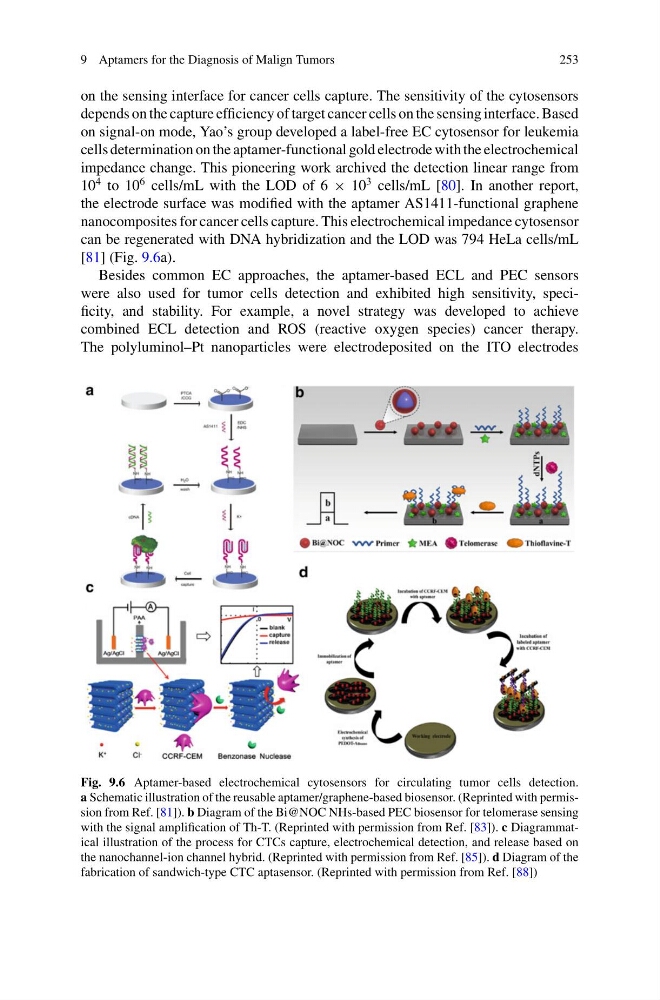
the electrode surface was modified with the aptamer AS1411-functional graphene
nanocomposites for cancer cells capture. This electrochemical impedance cytosensor
can be regenerated with DNA hybridization and the LOD was 794 HeLa cells/mL
[81] (Fig. 9.6a).
Besides common EC approaches, the aptamer-based ECL and PEC sensors
were also used for tumor cells detection and exhibited high sensitivity, specificity, and stability. For example, a novel strategy was developed to achieve
combined ECL detection and ROS (reactive oxygen species) cancer therapy.
The polyluminol–Pt nanoparticles were electrodeposited on the ITO electrodes
Fig. 9.6 Aptamer-based electrochemical cytosensors for circulating tumor cells detection.
a Schematic illustration of the reusable aptamer/graphene-based biosensor. (Reprinted with permission from Ref. [81]). b Diagram of the Bi@NOC NHs-based PEC biosensor for telomerase sensing
with the signal amplification of Th-T. (Reprinted with permission from Ref. [83]). c Diagrammatical illustration of the process for CTCs capture, electrochemical detection, and release based on
the nanochannel-ion channel hybrid. (Reprinted with permission from Ref. [85]). d Diagram of the
fabrication of sandwich-type CTC aptasensor. (Reprinted with permission from Ref. [88])
253
on the sensing interface for cancer cells capture. The sensitivity of the cytosensors
depends on the capture efficiency of target cancer cells on the sensing interface. Based
on signal-on mode, Yao’s group developed a label-free EC cytosensor for leukemia
cells determination on the aptamer-functional gold electrode with the electrochemical
impedance change. This pioneering work archived the detection linear range from
10
4 to 10
6 cells/mL with the LOD of 6 × 10
3 cells/mL [80]. In another report,
the electrode surface was modified with the aptamer AS1411-functional graphene
nanocomposites for cancer cells capture. This electrochemical impedance cytosensor
can be regenerated with DNA hybridization and the LOD was 794 HeLa cells/mL
[81] (Fig. 9.6a).
Besides common EC approaches, the aptamer-based ECL and PEC sensors
were also used for tumor cells detection and exhibited high sensitivity, specificity, and stability. For example, a novel strategy was developed to achieve
combined ECL detection and ROS (reactive oxygen species) cancer therapy.
The polyluminol–Pt nanoparticles were electrodeposited on the ITO electrodes
Fig. 9.6 Aptamer-based electrochemical cytosensors for circulating tumor cells detection.
a Schematic illustration of the reusable aptamer/graphene-based biosensor. (Reprinted with permission from Ref. [81]). b Diagram of the Bi@NOC NHs-based PEC biosensor for telomerase sensing
with the signal amplification of Th-T. (Reprinted with permission from Ref. [83]). c Diagrammatical illustration of the process for CTCs capture, electrochemical detection, and release based on
the nanochannel-ion channel hybrid. (Reprinted with permission from Ref. [85]). d Diagram of the
fabrication of sandwich-type CTC aptasensor. (Reprinted with permission from Ref. [88])