

246
Q. Lv et al.
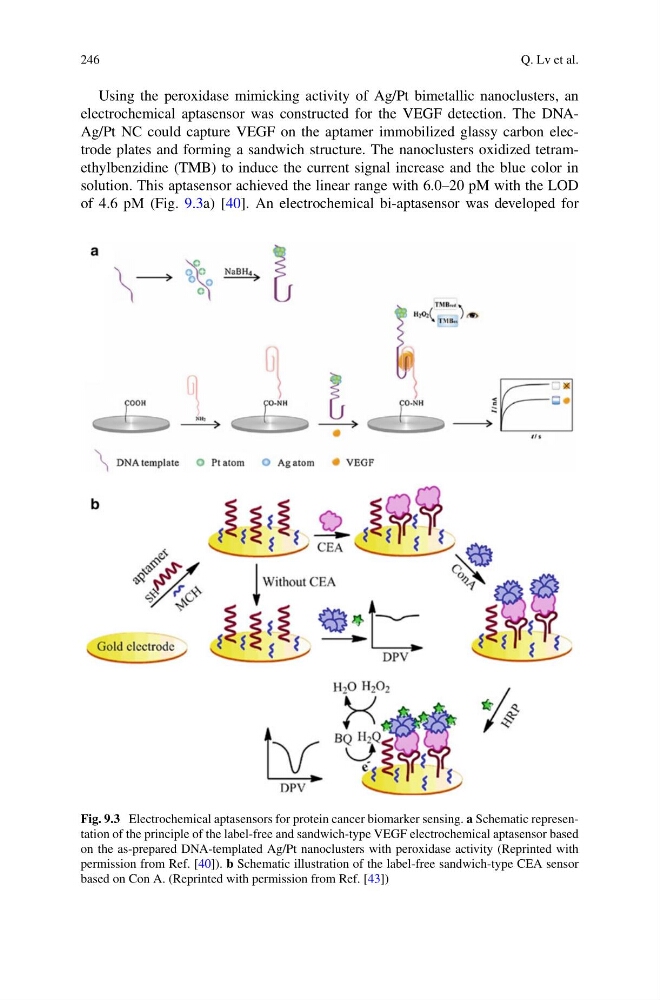
Using the peroxidase mimicking activity of Ag/Pt bimetallic nanoclusters, an
electrochemical aptasensor was constructed for the VEGF detection. The DNAAg/Pt NC could capture VEGF on the aptamer immobilized glassy carbon electrode plates and forming a sandwich structure. The nanoclusters oxidized tetramethylbenzidine (TMB) to induce the current signal increase and the blue color in
solution. This aptasensor achieved the linear range with 6.0–20 pM with the LOD
of 4.6 pM (Fig. 9.3a) [40]. An electrochemical bi-aptasensor was developed for
Fig. 9.3 Electrochemical aptasensors for protein cancer biomarker sensing. a Schematic representation of the principle of the label-free and sandwich-type VEGF electrochemical aptasensor based
on the as-prepared DNA-templated Ag/Pt nanoclusters with peroxidase activity (Reprinted with
permission from Ref. [40]). b Schematic illustration of the label-free sandwich-type CEA sensor
based on Con A. (Reprinted with permission from Ref. [43])
Q. Lv et al.
Using the peroxidase mimicking activity of Ag/Pt bimetallic nanoclusters, an
electrochemical aptasensor was constructed for the VEGF detection. The DNAAg/Pt NC could capture VEGF on the aptamer immobilized glassy carbon electrode plates and forming a sandwich structure. The nanoclusters oxidized tetramethylbenzidine (TMB) to induce the current signal increase and the blue color in
solution. This aptasensor achieved the linear range with 6.0–20 pM with the LOD
of 4.6 pM (Fig. 9.3a) [40]. An electrochemical bi-aptasensor was developed for
Fig. 9.3 Electrochemical aptasensors for protein cancer biomarker sensing. a Schematic representation of the principle of the label-free and sandwich-type VEGF electrochemical aptasensor based
on the as-prepared DNA-templated Ag/Pt nanoclusters with peroxidase activity (Reprinted with
permission from Ref. [40]). b Schematic illustration of the label-free sandwich-type CEA sensor
based on Con A. (Reprinted with permission from Ref. [43])