

154
G. Yang and Y. Huang
cells. In vitro, 4-1BB-Smad4 makes T cells resist the inhibition of TGF-β, limits
the inhibitory effect of TGF-β on tumor-specific T cells, and does not interfere with
its various physiological effects, thus reducing the risk of toxicity. In summary,
the conjugates of 4-1BB aptamers and other functional nucleic acid drugs have
multifunctional synergistic activity, which not only induces immune activation, but
also suppresses tumor-mediated immunosuppression, and has the advantage of low
toxicity.
6.5.1.4 OX40
OX40 (CD134, TNFRSF4) is a member of the TNF receptor family and is expressed
on activated T cells. The combination of OX40 and its ligand stimulates the proliferation of T cells and the production of cytokines [190]. At present, OX40 agonistic
antibodies have been developed [191]. In vitro and in vivo studies have shown that
agonistic antibodies can enhance tumor immune response by inducing dimerization
of OX40 receptors on cell surface. Dollins et al. [177] screened the RNA aptamer
9.8 of OX40 for the first time. However, it has been found that aptamer monomers
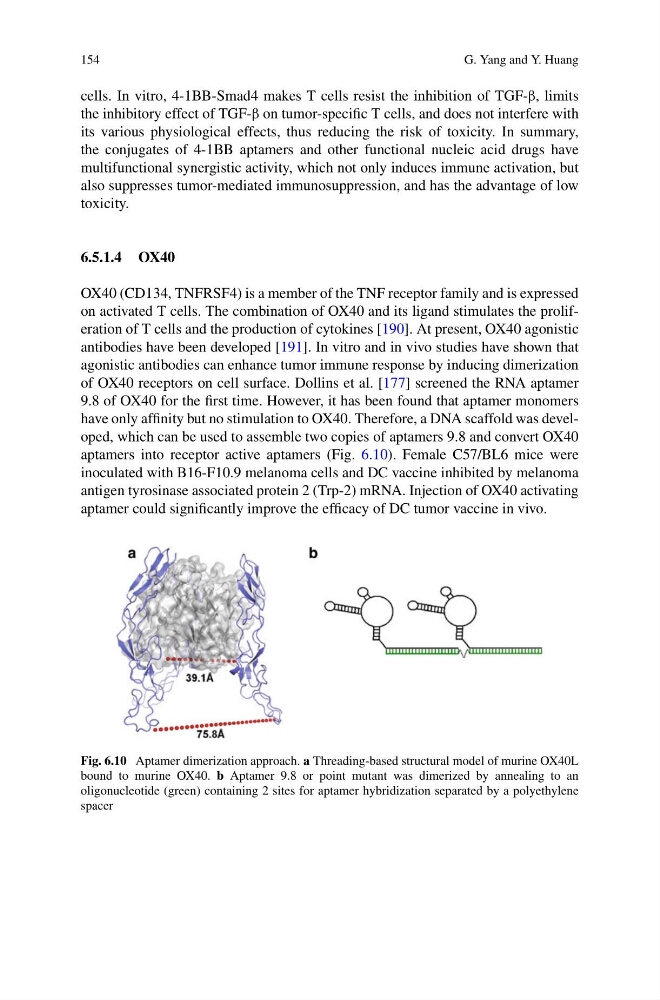
have only affinity but no stimulation to OX40. Therefore, a DNA scaffold was developed, which can be used to assemble two copies of aptamers 9.8 and convert OX40
aptamers into receptor active aptamers (Fig. 6.10). Female C57/BL6 mice were
inoculated with B16-F10.9 melanoma cells and DC vaccine inhibited by melanoma
antigen tyrosinase associated protein 2 (Trp-2) mRNA. Injection of OX40 activating
aptamer could significantly improve the efficacy of DC tumor vaccine in vivo.
Fig. 6.10 Aptamer dimerization approach. a Threading-based structural model of murine OX40L
bound to murine OX40. b Aptamer 9.8 or point mutant was dimerized by annealing to an
oligonucleotide (green) containing 2 sites for aptamer hybridization separated by a polyethylene
spacer
G. Yang and Y. Huang
cells. In vitro, 4-1BB-Smad4 makes T cells resist the inhibition of TGF-β, limits
the inhibitory effect of TGF-β on tumor-specific T cells, and does not interfere with
its various physiological effects, thus reducing the risk of toxicity. In summary,
the conjugates of 4-1BB aptamers and other functional nucleic acid drugs have
multifunctional synergistic activity, which not only induces immune activation, but
also suppresses tumor-mediated immunosuppression, and has the advantage of low
toxicity.
6.5.1.4 OX40
OX40 (CD134, TNFRSF4) is a member of the TNF receptor family and is expressed
on activated T cells. The combination of OX40 and its ligand stimulates the proliferation of T cells and the production of cytokines [190]. At present, OX40 agonistic
antibodies have been developed [191]. In vitro and in vivo studies have shown that
agonistic antibodies can enhance tumor immune response by inducing dimerization
of OX40 receptors on cell surface. Dollins et al. [177] screened the RNA aptamer
9.8 of OX40 for the first time. However, it has been found that aptamer monomers
have only affinity but no stimulation to OX40. Therefore, a DNA scaffold was developed, which can be used to assemble two copies of aptamers 9.8 and convert OX40
aptamers into receptor active aptamers (Fig. 6.10). Female C57/BL6 mice were
inoculated with B16-F10.9 melanoma cells and DC vaccine inhibited by melanoma
antigen tyrosinase associated protein 2 (Trp-2) mRNA. Injection of OX40 activating
aptamer could significantly improve the efficacy of DC tumor vaccine in vivo.
Fig. 6.10 Aptamer dimerization approach. a Threading-based structural model of murine OX40L
bound to murine OX40. b Aptamer 9.8 or point mutant was dimerized by annealing to an
oligonucleotide (green) containing 2 sites for aptamer hybridization separated by a polyethylene
spacer