

6 Aptamers for Targeted Therapy
149
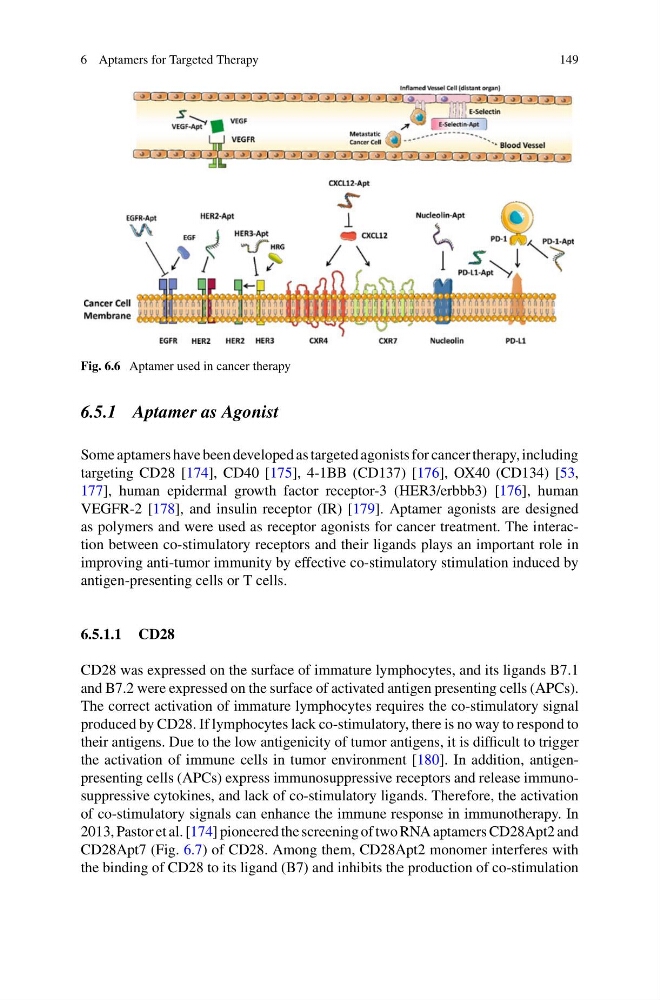
Fig. 6.6 Aptamer used in cancer therapy
6.5.1 Aptamer as Agonist
Some aptamers have been developed as targeted agonists for cancer therapy, including
targeting CD28 [174], CD40 [175], 4-1BB (CD137) [176], OX40 (CD134) [53,
177], human epidermal growth factor receptor-3 (HER3/erbbb3) [176], human
VEGFR-2 [178], and insulin receptor (IR) [179]. Aptamer agonists are designed
as polymers and were used as receptor agonists for cancer treatment. The interaction between co-stimulatory receptors and their ligands plays an important role in
improving anti-tumor immunity by effective co-stimulatory stimulation induced by
antigen-presenting cells or T cells.
6.5.1.1 CD28
CD28 was expressed on the surface of immature lymphocytes, and its ligands B7.1
and B7.2 were expressed on the surface of activated antigen presenting cells (APCs).
The correct activation of immature lymphocytes requires the co-stimulatory signal
produced by CD28. If lymphocytes lack co-stimulatory, there is no way to respond to
their antigens. Due to the low antigenicity of tumor antigens, it is difficult to trigger
the activation of immune cells in tumor environment [180]. In addition, antigenpresenting cells (APCs) express immunosuppressive receptors and release immunosuppressive cytokines, and lack of co-stimulatory ligands. Therefore, the activation
of co-stimulatory signals can enhance the immune response in immunotherapy. In
2013, Pastor et al. [174] pioneered the screening of two RNA aptamers CD28Apt2 and
CD28Apt7 (Fig. 6.7) of CD28. Among them, CD28Apt2 monomer interferes with
the binding of CD28 to its ligand (B7) and inhibits the production of co-stimulation
149
Fig. 6.6 Aptamer used in cancer therapy
6.5.1 Aptamer as Agonist
Some aptamers have been developed as targeted agonists for cancer therapy, including
targeting CD28 [174], CD40 [175], 4-1BB (CD137) [176], OX40 (CD134) [53,
177], human epidermal growth factor receptor-3 (HER3/erbbb3) [176], human
VEGFR-2 [178], and insulin receptor (IR) [179]. Aptamer agonists are designed
as polymers and were used as receptor agonists for cancer treatment. The interaction between co-stimulatory receptors and their ligands plays an important role in
improving anti-tumor immunity by effective co-stimulatory stimulation induced by
antigen-presenting cells or T cells.
6.5.1.1 CD28
CD28 was expressed on the surface of immature lymphocytes, and its ligands B7.1
and B7.2 were expressed on the surface of activated antigen presenting cells (APCs).
The correct activation of immature lymphocytes requires the co-stimulatory signal
produced by CD28. If lymphocytes lack co-stimulatory, there is no way to respond to
their antigens. Due to the low antigenicity of tumor antigens, it is difficult to trigger
the activation of immune cells in tumor environment [180]. In addition, antigenpresenting cells (APCs) express immunosuppressive receptors and release immunosuppressive cytokines, and lack of co-stimulatory ligands. Therefore, the activation
of co-stimulatory signals can enhance the immune response in immunotherapy. In
2013, Pastor et al. [174] pioneered the screening of two RNA aptamers CD28Apt2 and
CD28Apt7 (Fig. 6.7) of CD28. Among them, CD28Apt2 monomer interferes with
the binding of CD28 to its ligand (B7) and inhibits the production of co-stimulation